Copyright © Aluma Capital (Pty) Ltd. All rights reserved.
Aluma Capital (Pty) Ltd is a registered Financial Services Provider (FSP 46449) in terms of The Financial Advisory and Intermediary Services Act (37 of 2002)
May 26, 2025

A view on Demand in the Economy

Retail Sales Performance

March 2025

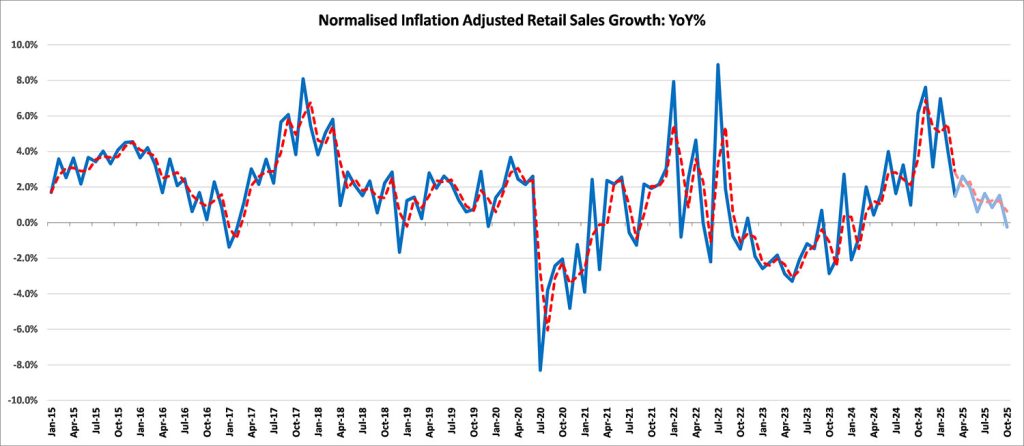
Retail sales in South Africa increased by 1.5% in March, falling short of the market expectation of 2.0%. This modest growth indicates a slower-than-expected recovery in consumer demand since late 2024, particularly following a weak economic starting point earlier in the year.

The South African Chamber of Commerce and Industry (SACCI) reported a decline in the Business Confidence Index, which dropped from 125.8 points in February to 123.5 in March. Additionally, the FNB/BER consumer index for the first quarter of 2025 fell sharply from -6 to -20 points, reflecting increasing consumer caution. Despite low inflation levels and an interest rate cut by the South African Reserve Bank in January 2025, these factors continue to have a limited positive impact on consumer spending.

Key contributors to the small rise in retail sales included:

  • Pharmaceuticals, medical goods, cosmetics, and toiletries: up 7.1%, contributing 0.5 percentage points.
  • Textiles and Clothing: increased by 3.5%, adding another 0.5 percentage points.

This growth during March 2025 suggests some positive momentum, although at a slower pace than initially anticipated. The interest rate cuts implemented from September 2024 to January 2025 appear to have eased household financial pressures, leading to a gradual recovery in demand. Maintaining this momentum through the rest of 2024 and into 2025 will be vital, as consumer demand remains a key driver of economic growth and job creation in South Africa. A potential interest rate reduction at the end of May 2025 could further support demand in the near term.


More Coverage

South Africa entered 2026 with inflation largely under control, offering some relief to households and policymakers alike. January’s consumer price data indicates modest price pressures and a cautiously stable economic environment, while ongoing global uncertainties and domestic cost drivers continue to shape the outlook for interest rates, consumer spending, and overall economic stability.
South Africa’s mining sector rebounded in December 2025, led by strong iron ore, manganese, platinum, and gold output and sales. Despite a slight quarterly dip in production and ongoing challenges from tariffs and trade tensions, the sector remains vital for employment, foreign exchange, and economic growth.
South Africa’s manufacturing sector closed 2025 weaker than expected, with key industries like iron, wood, and food driving declines. Despite a modest quarterly rise, trade tensions and tariffs are weighing on production and business sentiment, though firms hold strong cash reserves.
South Africa’s post-SONA outlook signals cautious optimism: improved investor confidence, infrastructure reform, and commodity gains offer growth potential, but success hinges on strict fiscal discipline, sustainable debt management, and investment-led policies. With debt near 78% of GDP, the upcoming budget must prioritise prudent spending, effective tax compliance, and private-sector-driven growth to ensure long-term economic stability and job creation.
0:00
0:00