Copyright © Aluma Capital (Pty) Ltd. All rights reserved.
Aluma Capital (Pty) Ltd is a registered Financial Services Provider (FSP 46449) in terms of The Financial Advisory and Intermediary Services Act (37 of 2002)
May 14, 2026

anufacturing Production – March 2026
Discover the surprising resilience of South Africa’s manufacturing sector in March 2026, where a remarkable 0.9% increase defied analysts’ expectations following a 2.3% slump in February. This unexpected growth, propelled by expansion in key sectors like food and beverages, petroleum, and electrical machinery, suggests a positive shift in business sentiment. Despite a quarterly downturn, manufacturing sales edged upward, signalling underlying strength amidst international trade tensions and tariffs. Uncover how South Africa’s industry navigates these choppy waters by maintaining robust cash reserves, hinting at strategic adaptations to the evolving economic landscape. Dive into this comprehensive analysis to understand the delicate interplay of growth factors and challenges shaping the future of South Africa’s manufacturing sector.

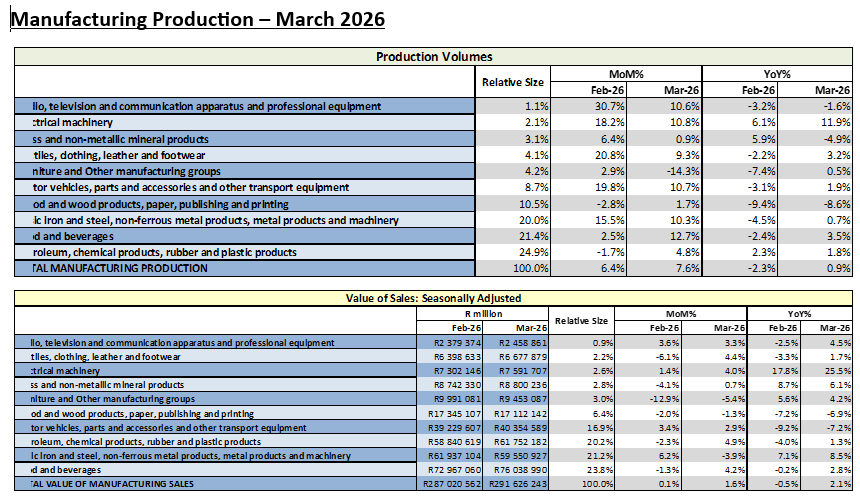
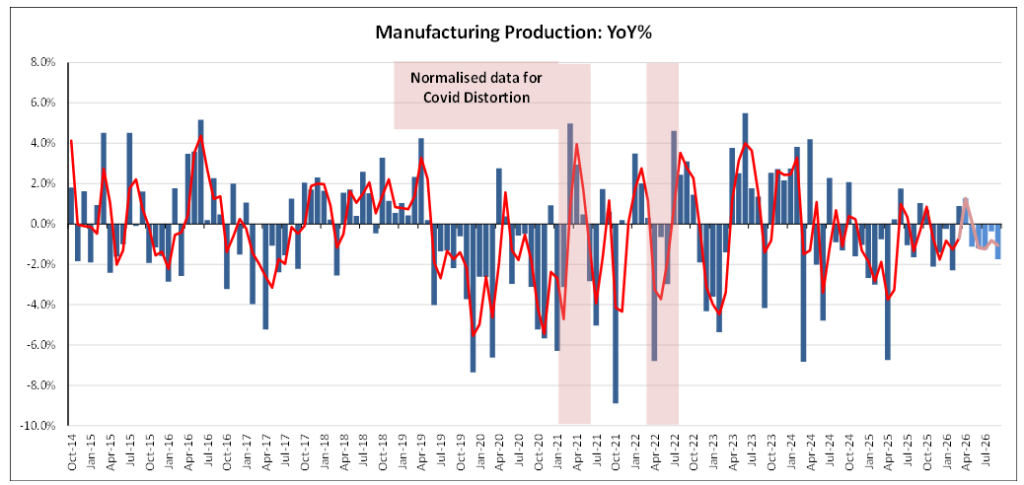
In March 2026, South Africa’s manufacturing output increased by 0.9%, following the 2.3% decline in February 2026. This increase is better than the 1.0% decline analysts forecast for February 2026. During the same period, the Purchasing Managers’ Index (PMI) increased 1.2 points, from 47.4 in February 2026 to 49.0 in March 2026. This indicates a positive view of the business environment as output expanded within the sector.

The food and beverages sector expanded by 3.5%, contributing 0.9 percentage points to the increase in overall manufacturing growth. Similarly, the petroleum, chemical products, rubber, and plastic products industry saw growth increase by 1.8%, adding an additional 0.4 percentage points, while the electrical machinery industry rose by 11.9%, adding an additional 0.3 percentage points towards manufacturing growth during this period. These sectors were significant contributors to the industry’s better-than-expected performance in March.

Seasonally adjusted manufacturing production decreased by 1.0% for the quarter ending March 2026 compared to the previous quarter. Out of ten sectors, five reported contractions during this period. Significant contractions included:

  • Basic iron and steel, non-ferrous metal products, metal products and machinery contracted by 1.4%, subtracting 0.3 percentage points from growth.
  • Petroleum, chemical products, rubber and plastic products, declined by 3.4%, subtracting 0.7 percentage points from growth.
  • Wood and wood products, paper, publishing and printing, which decreased by 2.4%, also contributed a 0.2 percentage point reduction.

Seasonally adjusted manufacturing sales increased by 0.4% during the quarter ending March 2026 compared to the previous quarter. Significant declines occurred in:

  • Basic iron and steel, non-ferrous metal products, metal products and machinery, which declined by 3.1%, adding 0.6 percentage points towards sales growth for the quarter.
  • The glass and non-metallic mineral products, which rose by 9.9%, added another 0.3 percentage points towards sales growth for the quarter under review.

Manufacturing is a critical component of South Africa’s economy, employing approximately 1.58 million people and accounting for 12.5% of the GDP in 2025. Employment slightly increased from 1.548 million in Q4 2025 to 1.587 million in Q1 2026. GDP figures for the fourth quarter indicate a 0.6% quarterly decrease in manufacturing output, suggesting that US trade tariffs since August 2025 have caused some distress in the manufacturing sector by eroding price competitiveness in the US market, driven by higher import prices from tariffs imposed on South African-produced export goods.

As a result of trade tariffs with the US and ongoing diplomatic tensions between Pretoria and Washington, business owners remain cautious, as evidenced by the March 2026 PMI data. However, companies are still maintaining substantial cash reserves of approximately R1.8 trillion, up from R1.1 trillion in the first quarter of 2025, according to the Reserve Bank. This reflects a prudent approach amid current domestic and global economic uncertainties in the short- to medium-term.


More Coverage

The case for holding interest rates is strong, as South Africa’s current inflation is being driven by global supply-side pressures like fuel prices, not excessive local spending. Raising rates now would place additional strain on already struggling consumers and businesses without addressing the real cause of inflation. With the Rand strengthening, oil prices stabilising, and diesel costs expected to decline, natural inflation relief is already emerging. Since inflation remains within the SARB’s target range, increasing borrowing costs could unnecessarily slow economic growth and job creation.
Amid a turbulent economic backdrop, South Africa’s retail sales surged by an unexpected 2.6% in March 2026, outpacing forecasts and signalling a fragile yet persistent recovery in the consumer market. While interest rate cuts have bolstered household spending, challenges such as rising inflation, potential interest rate hikes, and geopolitical tensions loom large. Despite these hurdles, sectors like “other retailers” and general dealers have notably contributed to this growth spurt, raising questions about the sustainability of this recovery. With business and consumer confidence indices displaying mixed signals, the future of South Africa’s retail strength hinges on international relations, fuel costs, and policy decisions. Explore the dynamics and implications of these developments in our detailed report.
In an insightful analysis of South Africa’s economic landscape in April 2026, the report delves into the notable 4.0% year-on-year increase in the Consumer Price Index, accentuated by surging costs in housing, utilities, transport, and financial services. Amid rising inflationary pressures fuelled by global uncertainties, including the Middle East conflict and climbing oil prices, the South African Reserve Bank faces critical decisions on interest rates to balance inflation and economic growth. As households grapple with diminished purchasing power, the precarity of reliance on short-term credit looms large, while international factors such as US-imposed tariffs and potential BRICS trade tensions threaten market stability. The report provides a comprehensive look at the delicate dance South Africa must perform to maintain price stability and safeguard the Rand amidst a challenging global backdrop.
Next week’s SARB decision could define South Africa’s economic trajectory: facing an external oil shock and runaway electricity tariffs that threaten to push April inflation past the central bank’s 4.0% ceiling, policymakers must weigh a technical inflation breach against a staggering surge in unemployment and collapsing investment, a choice between credibility and survival. With joblessness spiking and GDP growth stagnant, aggressive rate hikes would risk choking off the private investment the country urgently needs, while inaction could dent the new inflation-targeting framework. Read the full report for a detailed breakdown of the shocks driving this dilemma, the likely “hold” outcome from the May 28 MPC meeting, and what it means for businesses, households, and markets.
In March 2026, South Africa’s mining sector showed promising growth, with activity up 2.5%, driven primarily by substantial increases in platinum group metals (PGM) and gold production. This article delves into the remarkable statistics, including a staggering 113.5% surge in platinum sales and a robust 30.2% increase in nominal mining sales, highlighting the industry’s crucial role in generating employment and foreign exchange for the economy. However, amid positive growth trends, the sector faces significant challenges, including geopolitical tensions, tariff measures, and the potential impacts of a changing global market. Discover how these dynamics affect one of the country’s key economic contributors and the overall outlook for the mining industry as South Africa navigates through a complex landscape of opportunities and hurdles. Read on for an in-depth analysis of the mining sector’s performance and its implications for South Africa’s economic future.