Copyright © Aluma Capital (Pty) Ltd. All rights reserved.
Aluma Capital (Pty) Ltd is a registered Financial Services Provider (FSP 46449) in terms of The Financial Advisory and Intermediary Services Act (37 of 2002)
September 23, 2026

Consumer Inflation – August 2026
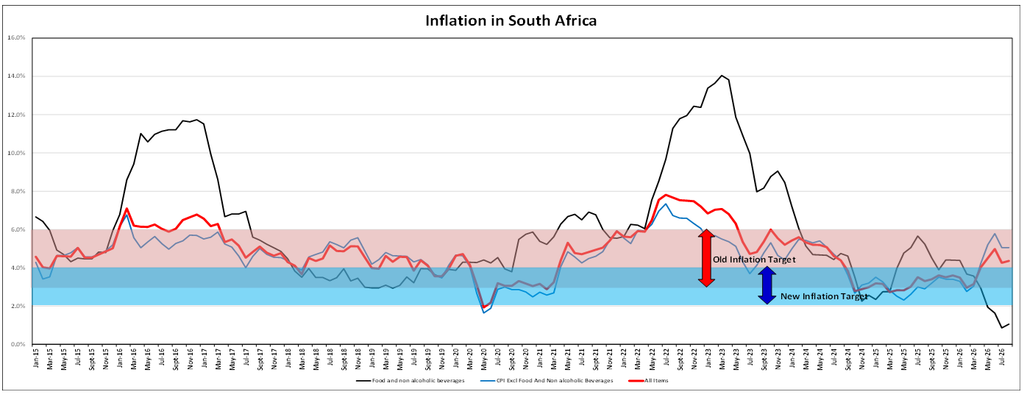
South Africa’s August 2026 inflation data present a complex outlook: headline CPI rose to 4.4%, remaining below market expectations yet above the upper limit of the inflation target range, while services inflation continued to climb, and fuel and transport costs exerted further pressure on households and businesses. With the economy contracting, international oil prices rising and global uncertainties, including Middle East tensions and tariff disputes, continuing to weigh on the rand and domestic prices, attention is now focused on the South African Reserve Bank’s next interest-rate decision. Read the full report for an analysis of the factors driving inflation, the risks facing the economy and what the latest developments could mean for consumers, businesses and monetary policy in the months ahead.

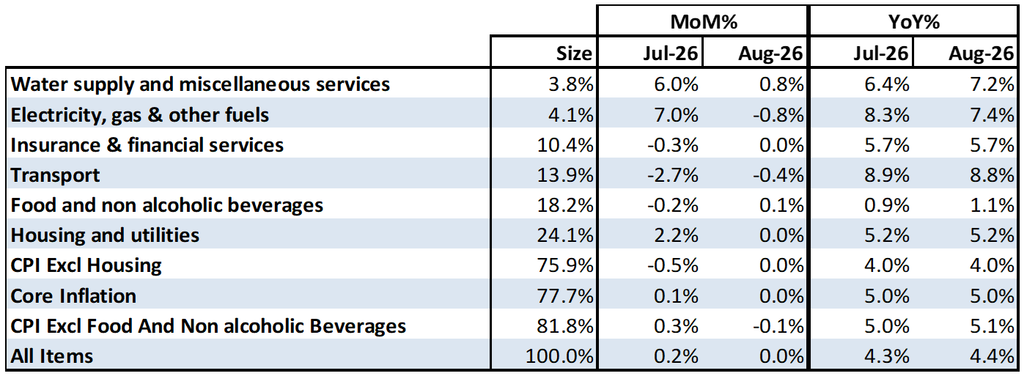
In August 2026, the Consumer Price Index (CPI) increased by 4.4% year on year, slightly higher than the 4.3% recorded in July but below the market expectation of 4.5% for the month under review. The increase in consumer prices was mainly driven by:

  • Housing and utilities: Increased by 5.2%, contributing 1.3 percentage points.
  • Transport: Increased by 8.8%, contributing 1.2 percentage points.
  • Insurance and financial services: Increased by 5.7%, contributing 0.6 percentage points.

Compared with August 2025, goods inflation increased by 3.3% in August 2026, down slightly from the 3.4% recorded in July. Services inflation, meanwhile, rose from 5.0% in July to 5.1% in August.

Goods inflation now falls within the South African Reserve Bank’s (SARB’s) new target range of 2% to 4%, while services inflation remains above the upper limit of 4.0%. This suggests that inflation is currently entering the economy primarily through the services channel.

The continued rise in inflation is eroding household purchasing power in South Africa. In addition, interest rates and fuel prices have not returned to their pre-Middle East conflict levels. As a result, many consumers and businesses are increasingly relying on short-term credit, leaving them vulnerable to changes in interest rates, exchange rates, global oil prices, and import costs. These factors, in turn, place further pressure on domestic prices.

These vulnerabilities have been exacerbated by the ongoing conflict in the Middle East and the significant increase in fuel prices between April and May. The recent escalation of the conflict has led to another rise in international oil prices, which does not bode well for fuel price reductions in the coming month.

Following its January 2026 meeting, the Monetary Policy Committee (MPC) decided to keep interest rates unchanged after considering the latest inflation figures and economic forecasts. However, the MPC increased the policy rate by 25 basis points at the end-of-May meeting in response to the inflationary spike arising from the Middle East conflict and the rise in international oil prices observed during April and May.

At its July meeting, the Reserve Bank again kept interest rates unchanged, contrary to market expectations. By then, financial markets had largely priced in a 25-basis-point increase. The MPC is scheduled to announce another interest-rate decision today, with market expectations split between a 25-basis-point increase and an unchanged decision. This uncertainty has been heightened by the 0.2% contraction in the South African economy during the second quarter of 2026.

Elevated fuel and transport costs are expected to continue influencing inflation expectations, particularly following the 4.4% inflation recorded in August, which remains above the upper limit of the target range. The Bank’s cautious approach is intended to maintain price stability amid ongoing domestic and international uncertainties. These include the higher tariffs imposed by the United States on South African exports, which have negatively affected the manufacturing sector, as reflected in the second-quarter 2026 GDP data. The latest unemployment, mining, and manufacturing data have also contributed to uncertainty about the economic outlook.

The increase in international oil prices over the past two weeks, together with inflation coming in below market expectations, may encourage the SARB to keep interest rates unchanged at the upcoming MPC meeting. Previous interest-rate cuts in late 2024, throughout 2025 and again in November 2025 were aimed at stimulating demand by increasing households’ disposable income after interest payments and supporting economic growth. However, rising fuel prices and a tightening monetary-policy stance could limit the extent to which these measures support economic activity.

Despite the 0.2% contraction in the economy during the second quarter of 2026, the Bank remains cautious because of persistent global uncertainties. Inflationary pressures, the US–China tariff dispute and the possibility of further tariffs on BRICS nations could all affect price stability. In addition, the Middle East conflict may keep international oil prices elevated if shipping safety through the Strait of Hormuz cannot be assured and the conflict lasts longer than markets anticipate.

Future interest-rate decisions are likely to take into account moderate inflation within the new target range, weak economic growth, improvements in electricity supply, some positive market sentiment and international tensions affecting oil prices. In conclusion, maintaining price stability and protecting the value of the rand remain key priorities for South Africa as the country navigates the remainder of 2026 amid ongoing international developments and related uncertainties.


More Coverage

South Africa’s August 2026 inflation data present a complex outlook: headline CPI rose to 4.4%, remaining below market expectations yet above the upper limit of the inflation target range, while services inflation continued to climb, and fuel and transport costs exerted further pressure on households and businesses. With the economy contracting, international oil prices rising and global uncertainties, including Middle East tensions and tariff disputes, continuing to weigh on the rand and domestic prices, attention is now focused on the South African Reserve Bank’s next interest-rate decision. Read the full report for an analysis of the factors driving inflation, the risks facing the economy and what the latest developments could mean for consumers, businesses and monetary policy in the months ahead.
The recent Electoral Court ruling dismissing the ANC’s bid to compel the IEC to accept late candidate submissions is a significant event with profound implications for the upcoming 4 November 2026 local government elections.
South Africa’s retail sector delivered a striking surprise in July 2026, with sales climbing 3.4% against market expectations of a 3.0% contraction, but the story beneath that headline number is far more nuanced than it first appears. This report unpacks the fragile balancing act facing local households: inflation easing to 4.3% yet still stubbornly above the SARB’s new 2–4% target band, administered prices and utility costs rising by more than 4.0%, wage growth lagging behind severe fuel shocks, and the lingering effect of May’s 25-basis-point rate hike prompted by inflationary pressures well beyond Pretoria’s control. We examine why business confidence firmed (SACCI up from 123.5 to 125.4) while consumer sentiment slumped sharply (FNB/BER down from -7 to -19), which categories, from “other retailers” to general dealers and household goods, actually carried the growth, and what the extension of AGOA to end-2027 means now that fresh visa tensions between Washington and Pretoria have placed South Africa’s eligibility squarely under the microscope. Read the full report to understand whether this recovery has the legs to survive higher fuel prices, a possible second rate increase, and a second-quarter contraction in economic activity — or whether July’s good news was simply borrowed from the easing cycle of 2024/25.
South Africa’s business profitability showed surprising resilience in the second quarter of 2026, outpacing inflation despite a 0.2% contraction in economic activity, higher oil and import prices, trade tariffs, and ongoing diplomatic tensions. While overall profit growth slowed from the first quarter, several sectors, including transport and logistics, mining, electricity and utilities, personal services, and trade, recorded substantial gains, offering important clues about where the economy’s strongest opportunities may lie. This report examines the forces shaping Gross Operating Surplus across key industries, explains the mounting pressures on company performance, and considers whether easing geopolitical tensions, lower oil prices, and greater policy certainty could unlock stronger economic activity, employment, and investment in the months and years ahead.
South Africa’s international liquidity position strengthened in August 2026, with net gold and foreign exchange reserves rising by USD 1,9 billion as the rand gained nearly 30c against the US dollar and the gold price climbed to USD 4 460/oz, some 30% higher than a year earlier. Yet beneath these encouraging headline figures lies a far more complex picture: the ongoing conflict in the Middle East and tensions around the Strait of Hormuz are keeping oil prices elevated, while shifting US tariff measures, a one-year AGOA extension and the Federal Reserve’s decision to hold rates steady all point to continued volatility for the rand. With the South African Reserve Bank’s third-quarter interest rate decisions hanging in the balance, this report unpacks what these commodity and currency movements mean for inflation, the mining sector and South Africa’s economic outlook for the remainder of the year.