

Employment Statistics in South Africa: 2026Q1
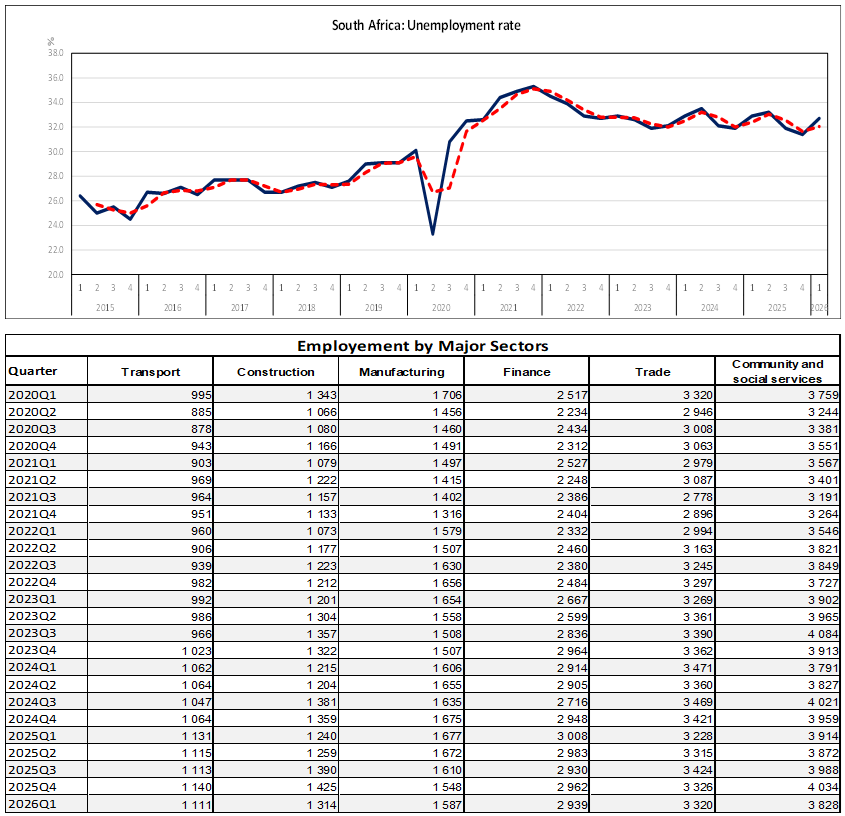
The employment statistics for the first quarter of 2026 largely paint a sombre picture across sectors, as shown in the preceding table, with most sectors losing employment opportunities except for the Manufacturing sector, where employment levels have improved slightly. The unemployment rate increased to 32.7% in the first quarter of 2026, exceeding market expectations of 32.3%, up from 31.4% in the last quarter of 2025. Similarly, the expanded unemployment rate increased from 42.1% to 43.7% during the first quarter of 2026.
In South Africa, total employment increased by 301,000, increasing from 17.1 million in the fourth quarter to 17.3 million by Q1 2026. Meanwhile, the number of unemployed individuals also increased by around 300,000, settling at approximately 8.1 million. The working-age population grew by about 121,000 in the first quarter, marking an increase of roughly 0.3%.
Employment rates fell in all provinces except KwaZulu-Natal, where employment increased by around 6,000 jobs, with notable decreases in the Northern West (-80,000), Gauteng (-67,000), North West (+36,000), and Mpumalanga (-54,000).
Overall, these employment figures are somewhat sombre, with the unemployment rate slightly worse than consensus forecasts and expectations. The decrease in employment can be attributed to declines in most sectors, although manufacturing was slightly better than expected. Ongoing international uncertainties, including the US tariff war against China and other countries, the conflict in the Middle East, and concerns about the future of the AGOA agreement beyond the 2026 extension, are likely to affect economic activity and job creation in South Africa in the short- to medium-term.


