Copyright © Aluma Capital (Pty) Ltd. All rights reserved.
Aluma Capital (Pty) Ltd is a registered Financial Services Provider (FSP 46449) in terms of The Financial Advisory and Intermediary Services Act (37 of 2002)
Credit demand in South Africa continued to grow in September 2026, but fell short of market expectations as households and businesses faced higher interest rates, rising living costs and persistently high debt levels. While mortgage advances and fixed-asset credit picked up, the property market’s recovery remains fragile, and consumers continue to rely on short-term borrowing to manage expenses. With inflation above the target range and energy and fuel costs adding to price pressures, the latest interest rate hike raises fresh questions about the outlook for credit and the wider economy. Read the full report for a closer look at the trends shaping borrowing across the country.

Private Sector Credit Extension (PSCE): September 2026
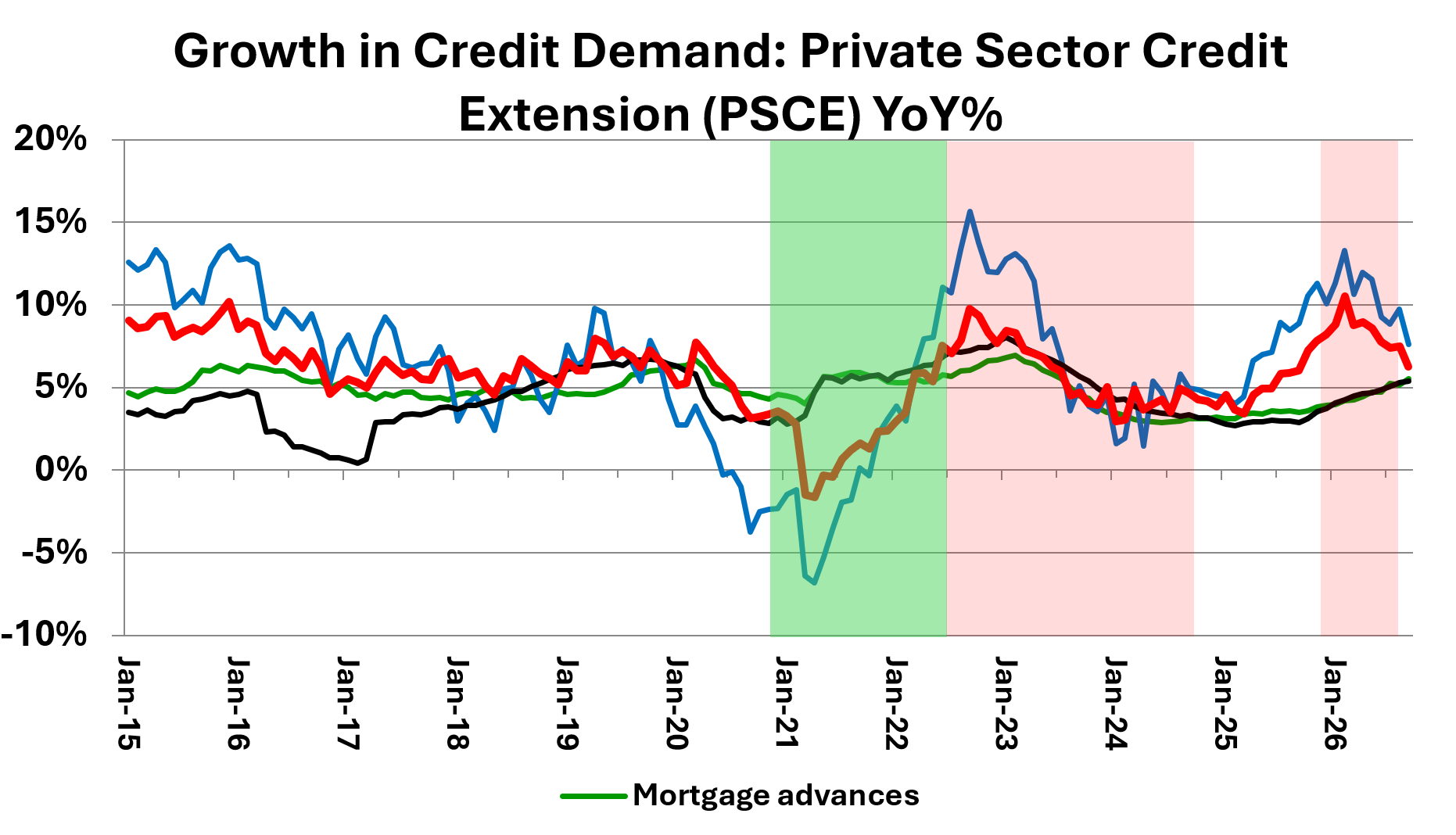
Line chart of year-on-year growth in South African private sector credit extension from January 2015 to September 2026, by credit category
Category % of Total Credit MoM% YoY%
Aug-26 Sept-26 Aug-26 Sept-26
Instalment sale credit 12.4%0.5%0.8%8.7%9.1%
Mortgage advances 39.4%0.4%0.6%5.1%5.5%
Other loans and advances 40.3%2.4%0.1%9.8%7.6%
Total credit extended to the private sector 100.0%1.5%0.2%7.5%6.2%

In September 2026, credit demand grew by 6.2%, well below market expectations of 7.5%. Since interest rate cuts began in September 2024, overall credit growth has accelerated, with most categories recording increases. September’s growth is notable, given that the South African Reserve Bank (SARB) has raised interest rates by 50 basis points since the start of the year. The latest increase followed a rise in domestic inflation, driven by higher energy costs and international oil prices amid the ongoing conflict in the Middle East and risks associated with the closure of the Strait of Hormuz.

Mortgage advances and credit for acquiring fixed assets grew by 5.5% in September, following a 5.1% increase in August. Recovery in the South African property market remains fragile and slow, reflecting low capital expenditure by households and businesses alike. The sector continues to face several headwinds, including the SARB’s interest rate increases, high consumer debt, slow wage growth and elevated living costs. These include household fuel costs, which have risen alongside international oil prices, as well as administered costs such as water, electricity, and municipal rates and taxes.

Instalment credit sales grew by just 0.8% in September, following a 0.5% increase the previous month, bringing annual growth to 9.1%. Over the past two years, consumers have become increasingly reliant on short-term credit to manage rising living costs. This is reflected in a further 7.6% increase in other loans and advances, although growth slowed from 9.8% the previous month amid higher interest rates following the latest increase.

With inflation still above the target range and fuel prices remaining elevated, energy costs continue to put upward pressure on prices across the economy. In response, the SARB raised interest rates again at its September 2026 Monetary Policy Committee (MPC) meeting.


More Coverage

Producer price inflation accelerated to 6.2% in September 2026, as higher fuel and energy costs continued to ripple through the economy. Although some cost increases have eased, producer prices remain above the South African Reserve Bank’s new target range, adding to concerns about consumer inflation and the outlook for interest rates. Read the full report for a closer look at the main cost pressures across manufacturing, mining and agriculture—and what they could mean for South African households and businesses in the months ahead.
Credit demand in South Africa continued to grow in September 2026, but fell short of market expectations as households and businesses faced higher interest rates, rising living costs and persistently high debt levels. While mortgage advances and fixed-asset credit picked up, the property market’s recovery remains fragile, and consumers continue to rely on short-term borrowing to manage expenses. With inflation above the target range and energy and fuel costs adding to price pressures, the latest interest rate hike raises fresh questions about the outlook for credit and the wider economy. Read the full report for a closer look at the trends shaping borrowing across the country.
Summary: Economic Insight: Why SA’s falling liquidation numbers hide a sharper corporate story “While Statistics South Africa’s September 2026 data shows an encouraging 12.3% year-on-year drop in total liquidations (and a 17.0% reduction for Q3), a closer inspection of the filings reveals a critical corporate divergence: voluntary business closures fell by 18.5%, but compulsory, court-ordered liquidations surged by 52.0% (and more than doubled for companies alone from 15 to 31 cases). This indicates that while panic-driven owner exits have peaked, creditor forbearance has ended, with banks and suppliers actively enforcing balance-sheet discipline. Paired with elevated business confidence near post-2011 highs (SACCI BCI at 134.3) alongside persistent operational margin pressure from record fuel and energy tariffs, corporate South Africa is not in an outright boom, but rather a ‘Great Repricing’, creating a compelling deployment window for private equity, turnaround capital, and structured private credit to back resilient operators and consolidate fragmented sectors.
Why Rising Global Food Prices Won’t Guarantee Prosperity for SA Farmers While international headlines react to the World Bank’s newly released Commodity Markets Outlook forecasting a 10%+ surge in global food commodity prices and sharp energy increases, South African commercial producers are navigating an acute margin squeeze that challenges popular market assumptions. Caught between domestic export parity pricing following a bumper 17.69-million-tonne harvest and double-digit surges in imported diesel and fertiliser benchmarks, local farmers face shrinking real returns despite elevated global retail food inflation. This macro paradox explains the recent Crop Estimates Committee (CEC) figures, where producers slashed intended maize plantings by 12.4% while pivoting aggressively into lower-capex sunflower seed, offering vital lessons for investors seeking sustainable returns and wealth preservation in high-conviction agricultural value chains. (Full opinion piece and press release attached).
Record Harvest, Rising Risk: Why SA Farmers Are Rethinking Maize? While South Africa’s forecast record commercial maize harvest of roughly 17.69 million tonnes suggests agricultural strength on paper, the Crop Estimates Committee’s 2027 summer-crop planting intentions reveal a sharp, defensive shift: total intended maize plantings are down 12.4% (−337,000 hectares), led by an 18.2% plunge in white maize, while sunflower seed has surged by 44.6% (+254,500 hectares). This divergence highlights a classic commodity paradox: record volumes have compressed local SAFEX prices toward export parity while input costs remain sticky, eroding farm-gate gross margins and prompting producers to reallocate capital into sunflowers to lower upfront working capital outlay and hedge against late-season climatic volatility. For agricultural financiers and private capital, the key lesson is clear: national crop volume does not equal farm profitability, and long-term value preservation depends on balance-sheet agility, crop diversification, and downstream beneficiation rather than sheer top-line production.