

Producer Price Inflation – September 2026
| MoM % | YoY % | |||
|---|---|---|---|---|
| Aug-26 | Sept-26 | Aug-26 | Sept-26 | |
| Final manufactured goods | -0.4% | 1.0% | 5.0% | 6.2% |
| Food products, beverages and tobacco products | -0.3% | 0.0% | 1.2% | 1.2% |
| Coke, petroleum, chemical, rubber and plastic products | 5.4% | 11.8% | 13.6% | 19.1% |
| Petrol | -12.3% | 8.0% | 7.3% | 16.2% |
| Diesel | -0.2% | -0.9% | 5.4% | 4.5% |
| Transport equipment | -0.5% | 0.0% | -1.7% | -1.0% |
| Motor vehicles | 1.5% | -0.3% | 5.9% | 3.8% |
| Parts for transport equipment | -0.5% | 0.0% | -1.7% | -1.0% |
| Electricity and water | -1.7% | -17.7% | 7.8% | 8.4% |
| Electricity | -2.0% | -20.5% | 8.5% | 8.4% |
| Water | 0.0% | 0.0% | 8.3% | 8.3% |
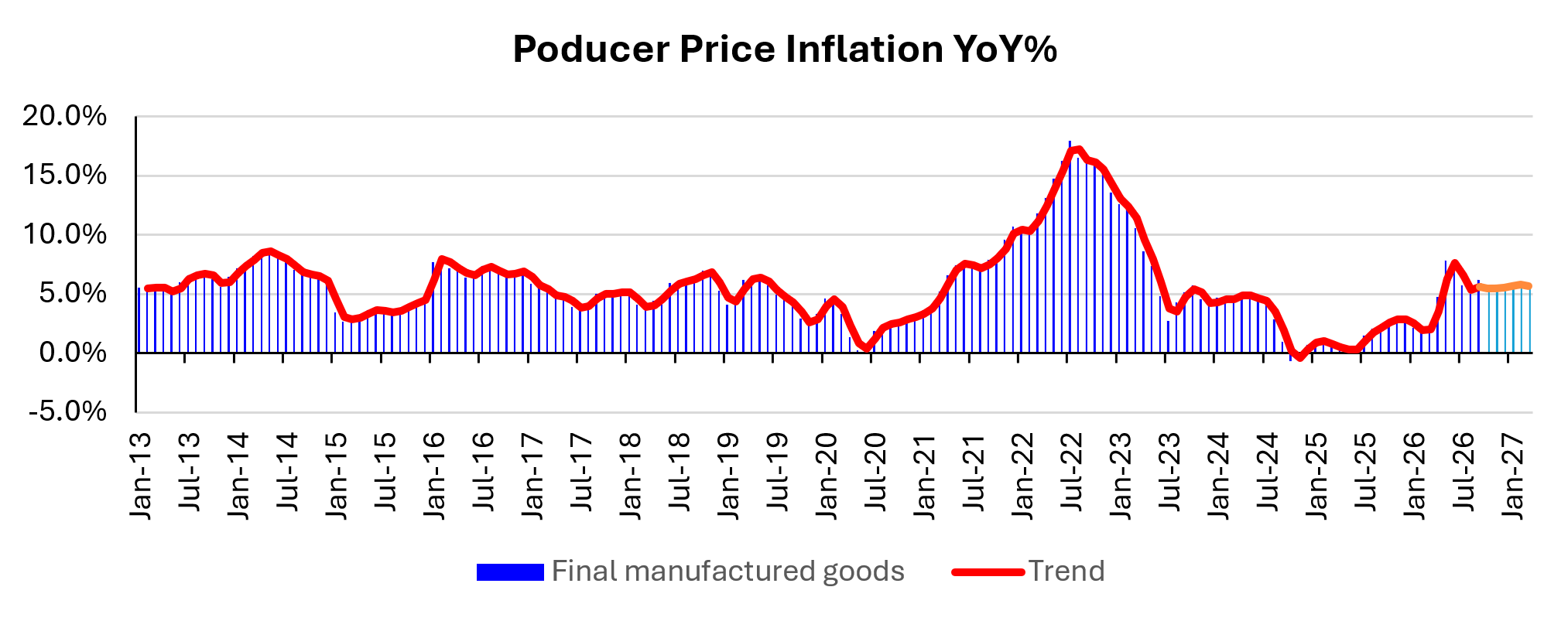
In September 2026, producer price inflation rose to 6.2% year on year, from 5.0% in August. Fuel-price shocks continued to feed through the economy, pushing up the prices of goods leaving the factory gate. Producer prices increased by 1.0% month on month in September. The annual increase was driven mainly by higher costs in the following categories:
- Coke, petroleum, chemical, rubber and plastic products: Prices rose by 19.1%, contributing 4.1 percentage points to annual producer price inflation.
- Metals, machinery, equipment and computing equipment: Prices increased by 3.4% year on year, contributing 0.5 of a percentage point.
The cost of intermediate goods rose by 7.8%, following an 8.8% increase in August 2026. This suggests that inflationary pressure remains, although the rate of increase has eased slightly. These increases still exceed the South African Reserve Bank’s (SARB) new inflation target range of 2% to 4%. Annual growth continues to be affected by higher fuel and energy prices linked to the conflict in the Middle East and the subsequent closure of the Strait of Hormuz.
In the primary sector, mining costs rose by 7.3% in September, matching the increase recorded in August. Costs in the agriculture sector increased by 2.5%.
Overall, producer price inflation remains above the SARB’s upper target, although the rate of increase in producer prices for final manufactured goods has slowed. This may put further pressure on consumer inflation and inflation expectations in South Africa in the short- to medium-term. Consumer inflation was 4.5% in August, still above the upper end of the new target range. Prices for some intermediate goods, particularly water and electricity, also continue to rise faster than the target range. Current figures suggest that consumer inflation is likely to remain elevated in the short- to medium-term as energy price shocks continue to ripple through the economy.
The Reserve Bank has raised the interest rate by 25 basis points. It will continue to assess inflation expectations using both the Consumer Price Index (CPI) and the Producer Price Index (PPI), as price stability remains central to its interest-rate decisions.


