Copyright © Aluma Capital (Pty) Ltd. All rights reserved.
Aluma Capital (Pty) Ltd is a registered Financial Services Provider (FSP 46449) in terms of The Financial Advisory and Intermediary Services Act (37 of 2002)
August 13, 2025

South Africa

Employment Statistics

2025 Q2
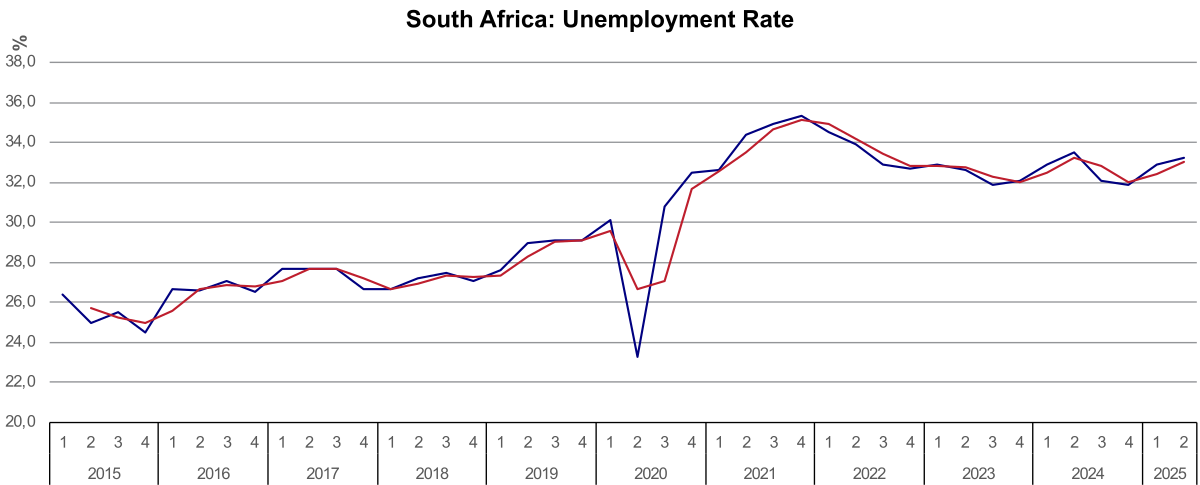
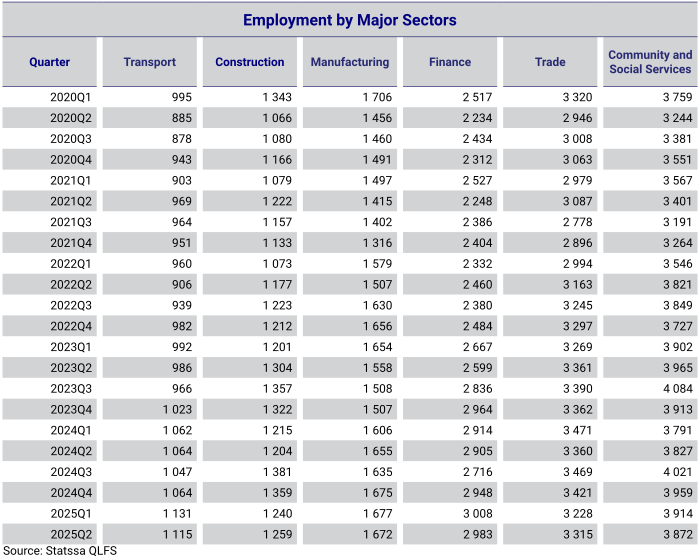
The employment statistics for the second quarter of 2025 show a varied landscape across different sectors, as illustrated in the table above. Certain sectors have experienced job growth compared to the first quarter of 2025, whereas others have seen a reduction in employment opportunities. The unemployment rate has increased slightly, moving from 32.9% in the previous quarter to 33.2% in the second quarter of 2025. However, the expanded unemployment rate has seen a slight decrease from 43.1% to 42.9% in the same period.

In South Africa, formal non-agricultural employment saw a modest increase of 34,000, rising from 11.434 million to 11.468 million. The combined total of formally unemployed individuals in non-agricultural and agricultural sectors rose by just 19,000, stabilising around 16.8 million across the country. The working-age population expanded by about 131,000 in the second quarter, reflecting an annual growth rate of approximately 1.3%.

Unemployment rates ascended in three out of the nine provinces, although Gauteng (+95,000), Eastern Cape (+89,000), and Limpopo (+27,000) reported employment rises. Notable employment gains were observed in the Trade, Construction, and Private Household sectors, despite the informal sector losing 34,000 jobs during the reviewed quarter.

Overall, these employment figures remain somewhat disheartening, with the unemployment rate surpassing the predicted 33.0% for the second quarter of 2025. This deceleration is partly due to persistent global uncertainties, including repercussions from the imposition of US trade tariffs announced in August. Uncertainties surrounding the future of the African Growth and Opportunity Act (AGOA) beyond September 2025 pose another challenge, as the South African government has yet to negotiate a new trade agreement with the current US administration.

Ongoing diplomatic tensions between Washington and Pretoria on various issues continue to impact economic confidence and investment decisions in South Africa. Consequently, many businesses are maintaining a cautious “wait-and-see” approach regarding expansion and hiring in the short term, particularly as they face the August 7 deadline for tariffs on exports to the US market.


More Coverage

South Africa’s story is shifting—from the frustration of load shedding to the emergence of a bold new opportunity. As we move through 2026, an unexpected partnership between energy and cryptocurrency is reshaping the economic landscape. With Eskom exploring ways to monetise surplus solar power and SAA embracing Bitcoin for transactions, the country is stepping into a new era where digital finance and energy innovation converge—unlocking fresh potential for businesses, investors, and growth.
Discover the dynamic shifts within South Africa’s mining sector with our latest analysis. In a remarkable February 2026 performance, mining activities surged by 9.7%, spearheaded by dramatic increases in PGM, chromium ore, manganese, and gold production. Despite a quarterly dip, February’s nominal sales skyrocketed by 58.3%, driven by remarkable gains in platinum and gold. As the backbone of South Africa’s economy, the sector faces evolving global challenges and opportunities, from new US tariff measures to geopolitical tensions affecting global trade and energy prices. Stay ahead with insights into the sector’s resilience and strategic importance. Read the full article to understand the trends shaping South Africa’s economic landscape.
Discover how South Africa is navigating the turbulent waters of global economic pressures and local inflation with a strategic fuel price adjustment and a major boost from a R415 billion investment windfall. As rising Brent Crude prices and a fluctuating Rand impact fuel costs and inflation forecasts, all eyes are on the South African Reserve Bank’s next move. Meanwhile, the Sixth South Africa Investment Conference has sparked optimism, with substantial commitments in the energy and technology sectors, promising a resilient economic future. Dive into the full article to explore the intricate balance between surviving immediate economic challenges and positioning South Africa as a hub for global investment amidst a world in flux.
South Africa’s reserves fell in USD terms in March 2026 as the Rand weakened amid Middle East tensions, though higher gold prices supported reserves in Rand terms. Rising oil prices and currency pressure point to higher inflation risks, while ongoing geopolitical tensions and US trade measures are likely to keep markets volatile.
A sudden global shift has delivered much-needed relief for South Africa. Following a Middle East ceasefire, oil prices have dropped sharply and the Rand has strengthened—easing pressure on fuel costs and inflation. While earlier price spikes still weigh on the outlook, this combined correction offers a critical window for economic stability, improved consumer confidence, and renewed growth momentum.