

Consumer Inflation – July 2026
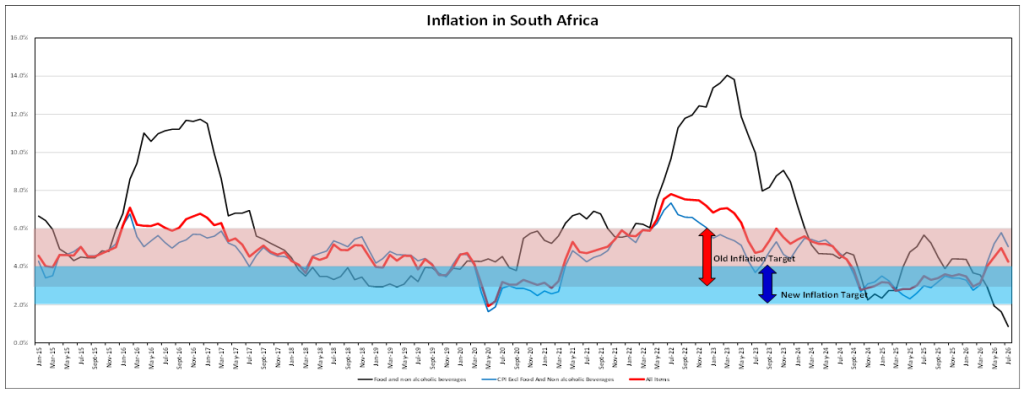
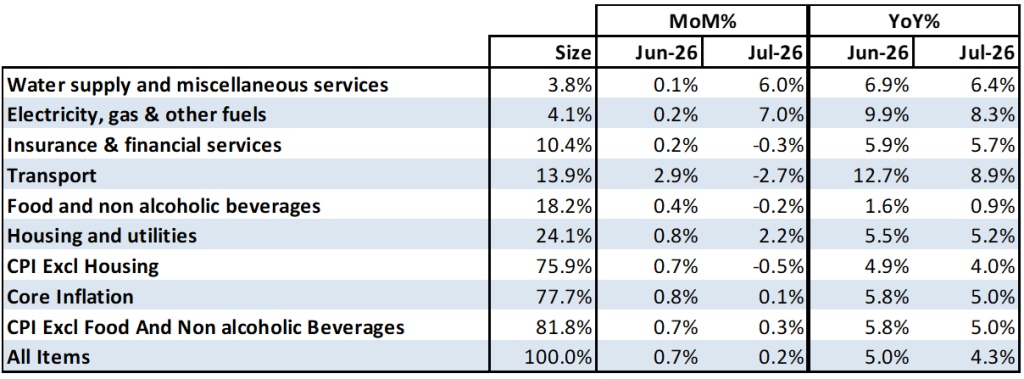
In July 2026, the Consumer Price Index (CPI) rose by 4.3% year-on-year, markedly lower than the 5.0% increase recorded in June and came in even below the market expectation of 4.5% for the month under review. This 4.3% increase in consumer prices, albeit lower than market expectation, was mainly due to:
- Housing and Utilities: Increased by 5.2%, contributing 1.3 percentage points.
- Transport: Increased by 8.9%, also contributing 1.2 percentage points.
- Insurance and Financial Services: Went up by 5.7%, adding 0.6 percentage points.
Compared with June, the year-on-year inflation rate for goods increased by another 3.4% in June 2026, down from the 4.8% increase recorded in June. Meanwhile, the pace in services inflation also came slightly down during July from 5.2% recorded in June to 5.0% in July. Notably, inflation for goods now falls within the SARB’s new target range of 2- to 4.0%, while services inflation has again surpassed the Reserve Bank’s upper limit of 4.0%, indicating that inflation is making its way into the economy primarily via the services channel at this stage. This inflationary rise continues to erode household purchasing power in South Africa, and higher interest rates and fuel prices have not returned to pre-Middle East conflict levels. Consequently, many consumers and businesses rely more on short-term credit, making them vulnerable to changes in interest rates, exchange rates, global oil prices, and import costs, which in turn affect domestic prices. These vulnerabilities have been exacerbated by the ongoing conflict in the Middle East and the significant increase in fuel prices from April to May. The recent escalation in the ongoing conflict has led to another rise in international oil prices, which doesn’t bode well for fuel price decreases in the coming month.
Following the Monetary Policy Committee (MPC) meeting in January 2026, the Reserve Bank chose to keep interest rates unchanged after reviewing January inflation figures and forecasts. However, there was a 25-basis-point increase at the end-of-May meeting due to the inflation spike, which stemmed from the Middle East conflict and rising international oil prices observed in April and May. The Reserve Bank decided at its July meeting to keep the interest rate unchanged, much to the market’s surprise, as a 25-basis-point increase was already priced in by July market forecasts and expectations.
Elevated fuel and transport costs remain high and are expected to influence current inflation expectations, especially given the 4.3% inflation recorded in July, which is still slightly above the upper limit of the inflation target range. The Bank’s cautious stance aims to maintain price stability amid ongoing economic and international uncertainties, including increased tariffs rates imposed by the US on South African exports, which have negatively impacted the manufacturing sector as reflected in the 2026Q1 GDP data as well as unemployment data coupled with mining and manufacturing data that was released for the month thus far
The increase in international oil prices over the last week and the increase in the inflation rate below market expectations might cause the South African Reserve Bank (SARB) to hold the interest rate unchanged, with the next Monetary Policy Committee (MPC) meeting scheduled for the 23rd of September when more data will become available before then. Prior interest rate cuts in late 2024, throughout 2025, and another in November 2025 were aimed at stimulating demand by increasing disposable income for households beyond interest payments, fostering economic growth. However, rising fuel prices and a tightening monetary policy stance may limit this growth potential.
Despite sustained economic growth of 0.5% in the first quarter of 2026, the Bank remains wary due to persistent global uncertainties. Factors such as inflation, the US-China tariff dispute, and the possibility of future tariffs on BRICS nations could affect price stability. Furthermore, the Middle East conflict may continue to keep international oil prices high if shipping safety cannot be assured through the Strait of Hormuz and the resumed conflict drags on longer than the market anticipates. Future interest rate decisions will likely consider moderate inflation within the new target band, slow economic growth, improvements in electricity supply, some positive market sentiment, and international tensions impacting oil prices.
In conclusion, maintaining price stability and protecting the Rand’s value are top priorities for South Africa as it navigates the coming months of 2026, amid current international developments and associated uncertainties.


