Copyright © Aluma Capital (Pty) Ltd. All rights reserved.
Aluma Capital (Pty) Ltd is a registered Financial Services Provider (FSP 46449) in terms of The Financial Advisory and Intermediary Services Act (37 of 2002)
September 2, 2026

Why Hiking Interest Rates on Imported Inflation Will Stifle South Africa’s Fragile Economy

South Africa’s latest inflation figures provide some welcome relief, but a renewed surge in global oil prices threatens to undermine this progress. With fuel prices rising sharply due to external geopolitical and supply-side pressures, the debate over whether the SARB should respond with higher interest rates has become increasingly important. This article argues that raising rates to combat imported inflation would risk doing more harm than good—placing further pressure on households, businesses and investment in an economy already facing weak growth, high unemployment and significant industrial challenges.

At first glance, South Africa’s latest inflation statistics offered a collective sigh of relief. The Producer Price Index (PPI) slowed to 5.7% year-on-year in July 2026, down notably from 7.5% in June. Similarly, headline consumer inflation (CPI) cooled from 5.0% in June to 4.3% in July, edging closer to the South African Reserve Bank’s (SARB) newly lowered target band of 2% to 4%.

However, this statistical reprieve is already being overshadowed by global geopolitical shocks. With renewed conflict in the Middle East and severe disruptions to maritime transit through the Strait of Hormuz, international crude oil prices have surged. Despite a resilient Rand holding near R16.10/$ against the US dollar, the Department of Mineral and Petroleum Resources gazetted aggressive fuel price hikes, effective 2 September 2026: +R1.34 per liter for petrol and over R2.90 to R3.15 per liter for diesel.

As the Monetary Policy Committee (MPC) prepares to convene on 23 September 2026, speculation is mounting that the SARB may hike the repo rate to defend its target range. Yet raising domestic interest rates in response to supply-side, imported energy shocks would be a serious policy misstep, one that risks choking an already struggling real economy.

The Imported Fuel Shock: A R56 Billion Blow

South Africa ranks among the hardest-hit nations globally by the current energy crisis, having paid an estimated extra R56.3 billion for imported fuel since the onset of the Middle East conflict.

  • The Supply Chain Mechanism: Because diesel powers freight rail alternatives, agricultural machinery, and long-haul food transport, a R3/litre diesel jump cascades through the entire value chain.
  • Cost-Push Pressures: Higher transportation costs affect nearly every price in the economy, eroding consumer purchasing power and compressing corporate margins.
  • Calls for Fiscal Relief: This heavy multiplier effect has prompted public sector unions to demand urgent petrol price tax relief to ease the burden on workers. Raising interest rates does not pump a single extra barrel of oil or reopen maritime shipping lanes; it merely penalizes domestic businesses and households already bearing an external energy tax.

A Fragile Real Economy Under Severe Pressure

A tightening monetary stance overlooks the severe distress inside the productive domestic economy:

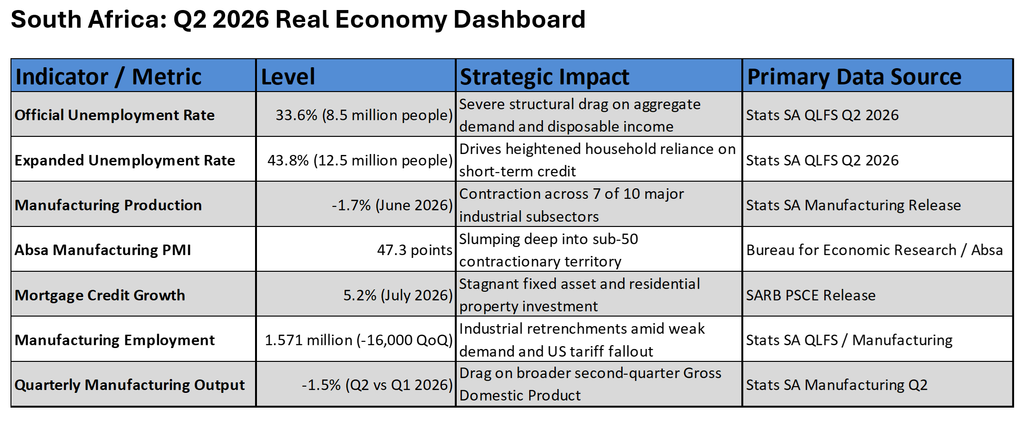
  • Crippling Unemployment: The official jobless rate climbed to 33.6% in Q2 2026 (expanded unemployment sits at 43.8%), with over 8.5 million South Africans locked out of work.
  • Industrial Contraction: Manufacturing output contracted 1.7% in June, while the Purchasing Managers’ Index (PMI) slumped to 47.3 points, deep in contractionary territory.
  • Factory Closures: Key industrial pillars, such as the automotive components sector, face factory closures and retrenchments amid high production costs, low vehicle sales, cheap foreign imports and restricted access to the US market.

Tepid Domestic Credit Demand: Private sector credit extension (PSCE) growth remains subdued. High borrowing costs and cost-of-living pressures have stymied mortgage advances (5.2%), while Gross Fixed Capital Formation (GFCF) remains depressed as businesses hesitate to fund expansion projects.
Trade Friction and the Need for Market Realism

Compounding domestic challenges are heightened trade headwinds. Following trade friction with Washington, South African exports to the United States have fallen roughly 56%. While the African Growth and Opportunity Act (AGOA) has been extended, South Africa’s eligibility remains subject to ongoing discretionary review.

At the same time, trade experts warn that South Africa is dropping the ball in trade negotiations with key partners such as China, India, Japan, and the Middle East, failing to secure the reciprocal market access needed for value-added goods. Protecting and expanding trade agreements is critical to restoring manufacturing and agricultural employment.

The Policy Verdict: Hold the Line on Rates

The South African Reserve Bank’s primary mandate is price stability, but monetary policy must distinguish between demand-driven overheating and supply-side external shocks.

South Africa’s current inflationary impulse is imported, driven by global conflict and petroleum logistics. Squeezing domestic demand with higher interest rates will not lower international oil prices. Instead, it will drive up the cost of capital, suppress fixed investment (GFCF), and accelerate corporate insolvencies in labour-heavy manufacturing and mining.

The sensible path for the MPC on 23 September is to look through the transitory fuel spike, hold interest rates steady, and allow structural economic reforms and trade diplomacy to support the recovery.


More Coverage

South Africa’s latest inflation figures provide some welcome relief, but a renewed surge in global oil prices threatens to undermine this progress. With fuel prices rising sharply due to external geopolitical and supply-side pressures, the debate over whether the SARB should respond with higher interest rates has become increasingly important. This article argues that raising rates to combat imported inflation would risk doing more harm than good—placing further pressure on households, businesses and investment in an economy already facing weak growth, high unemployment and significant industrial challenges.
Private sector credit growth remained resilient in July 2026, reflecting continued demand for financing despite elevated living costs and renewed interest rate uncertainty. While overall credit extension continues to benefit from the rate-cutting cycle that began in late 2024, subdued property activity and rising household reliance on short-term credit highlight ongoing pressure on consumers and businesses.
South Africa’s producer price inflation eased from 7.5% to 5.7% year-on-year in July 2026, but the slowdown offers little comfort as rising fuel, energy and intermediate-goods costs continue to reverberate through the economy. With petroleum-related products driving much of the increase, mining costs still elevated, and consumer inflation already above the South African Reserve Bank’s new target range, inflationary pressures remain firmly entrenched, even as monthly producer prices declined. This report examines the sectors driving the latest figures, the implications of ongoing Middle East-related energy shocks, and what the data could mean for consumer prices, inflation expectations, and the Reserve Bank’s upcoming interest-rate decision in September.
South Africa has received a much-needed inflation reprieve, with July headline inflation easing to 4.3% and giving the South African Reserve Bank room to hold interest rates steady, but monetary relief alone cannot rescue an economy facing contracting mining and manufacturing sectors, depressed investment, mass unemployment, and mounting pressure on export earnings. This report examines how a 12.5% US tariff and a 56% annualised plunge in exports are intensifying the country’s economic vulnerability, while diplomatic disputes over property rights, empowerment policy, rural safety, political rhetoric, and South Africa’s geopolitical alliances threaten access to the strategically vital US market. It also sets out the practical policy choices, from structural reform and infrastructure investment to pragmatic trade diplomacy, that could determine whether South Africa converts this brief moment of inflation stability into sustainable growth or slips deeper into stagnation
South Africa’s July 2026 inflation reading delivered a genuine surprise: consumer prices rose just 4.3% year-on-year, well below June’s 5.0% and under the 4.5% the market had pencilled in, yet the story beneath that headline is far more complicated than a simple cooling trend. Goods inflation has slipped into the SARB’s new 2–4% target band, but services inflation stubbornly holds at 5.0%, revealing that price pressure is now entering the economy through a channel monetary policy struggles to reach. Meanwhile, housing, transport, and financial services drove the bulk of the increase; fuel costs remain elevated amid the renewed Middle East conflict and rising oil prices; and households and businesses relying on short-term credit are dangerously exposed to any shift in rates, the rand, or import costs. Add US tariffs weighing on manufacturing, fragile 0.5% first-quarter growth, and a Reserve Bank that has already wrong-footed markets twice this year, and the run-up to the 23 September MPC meeting becomes anything but predictable. This report unpacks what the numbers actually signal, why the SARB is holding its nerve, and what it will take to tip the next rate decision either way.