Copyright © Aluma Capital (Pty) Ltd. All rights reserved.
Aluma Capital (Pty) Ltd is a registered Financial Services Provider (FSP 46449) in terms of The Financial Advisory and Intermediary Services Act (37 of 2002)
September 15, 2026

Mining Production and Sales for July 2026
South Africa’s mining sector is facing mounting pressure, with production falling 7.5% in July 2026 after a revised 4.3% decline in June, while the rolling three-month contraction reached 5.5% and nominal mining sales dropped 5.6%. Sharp declines in iron ore, coal, PGMs, gold, manganese, and nickel highlight the sector’s vulnerability, compounded by job losses, rising fuel and energy costs, policy uncertainty, property rights concerns, and growing trade barriers. Yet mining remains indispensable to the economy, supporting approximately 450,000 jobs, generating foreign exchange and contributing to growth. With elevated gold prices and temporary tariff exemptions offering limited relief, this report examines the forces reshaping South Africa’s mining industry—and whether these bright spots can withstand the sector’s deepening structural and geopolitical challenges.

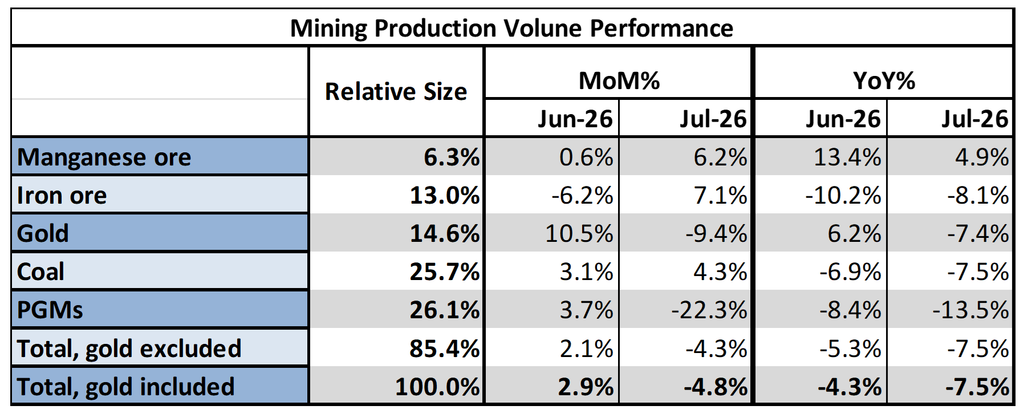
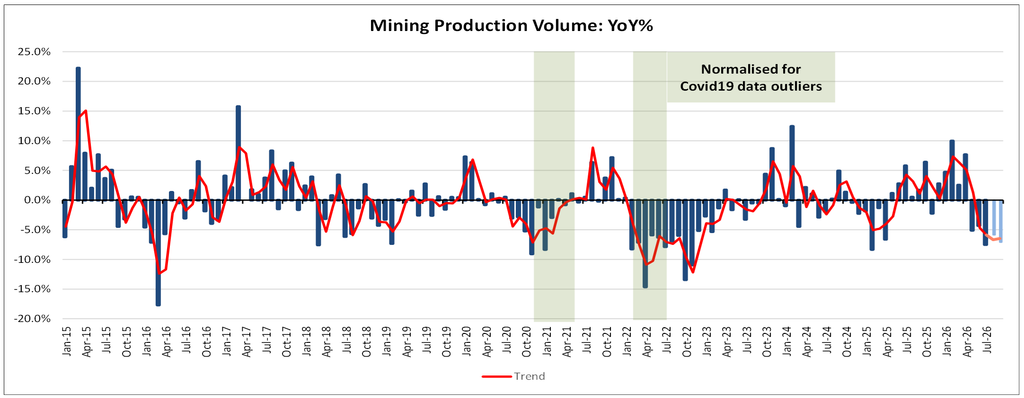
In July 2026, South Africa’s mining activity contracted by 7.5% following the revised 4.3% decrease recorded in June 2026. This contraction was predominantly driven by:

  • An 8.1% decrease in Iron ore mining production, which contributed -1.3 percentage points to the overall mining output for the month.
  • Coal production decreased by 7.5%% during July, while it subtracted 2.0 percentage points from mining production growth
  • An 8.1% contraction in PGM production, which stripped an additional 1.3 percentage points from total mining output growth for the month.

For the rolling quarter ending July 2026, compared with the rolling quarter ending April 2026, seasonally adjusted mining output decreased by 5.5%. This decrease was primarily due to:

  • A 6.7% decrease in manganese mining, which decreased total mining production by 0.5 percentage points,
  • A decrease in mining of PGMs, which contracted by 14.3% and subtracted 4.2 percentage points for the quarter under review,
  • Gold mining, which declined by 4.6% and subtracted an additional 0.4 percentage points from mining output for the quarter and,
  • A decrease in Iron ore mining, which contracted by 2.7% and subtracted 0.4 percentage points for the rolling quarter.

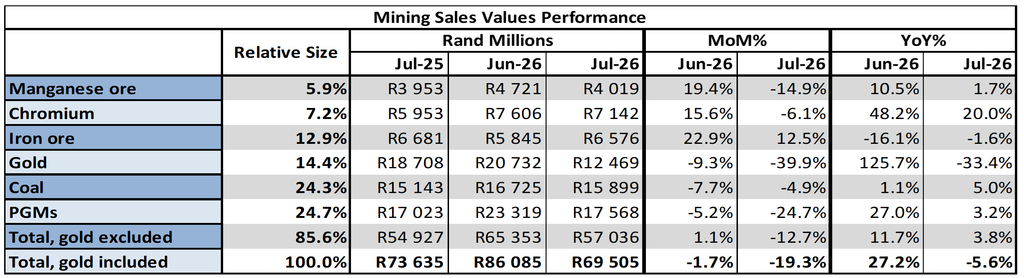
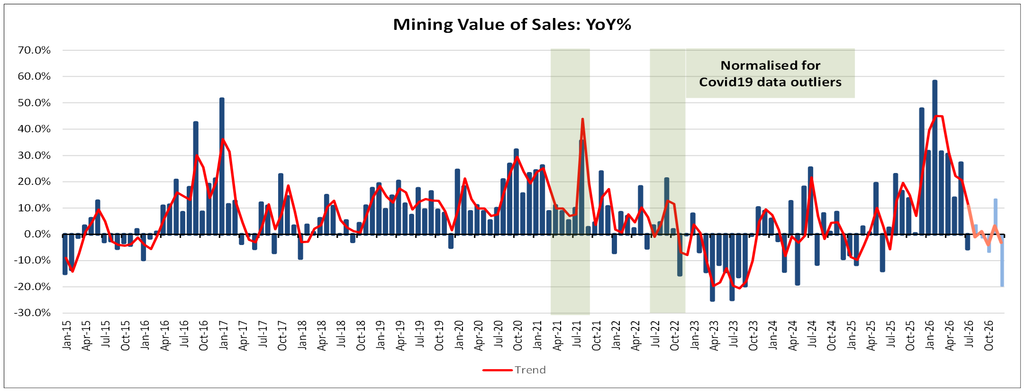
In July, nominal mining sales decreased by 5.6%. This contraction was notably driven by:

  • A decline of 26.0% in ‘other’ non-metallic minerals, which subtracted 0.7 percentage points from overall mining sales growth.
  • A contraction of 33.4% in gold sales, reducing total mining sales by 8.5 percentage points and
  • Nickel sales, which declined by 51.7% and subtracted another 0.4 percentage points from overall mining sales growth for July 2026.

The Mining Sector: Still Vital, But Under Pressure

The mining sector remains a cornerstone of South Africa’s economy, earning valuable foreign exchange and employing approximately 450 000 people. However, this figure represents a decline of around 26 000 jobs from the previous quarter, according to Stats SA’s labour statistics for the second quarter of 2026.

The latest GDP data paints a similar picture. Mining output contracted by 0,7% year on year and by 3,0% quarter on quarter in the second quarter of 2026. This contraction was not unexpected, given the job losses reported in the Quarterly Labour Force Survey, which showed that nearly 30 000 employment opportunities were lost over the period.

Rising costs and policy uncertainty

The ongoing conflict in the Middle East has pushed international oil prices higher, and the effects are now being felt in South Africa’s mining sector through rising energy and fuel costs. These cost pressures, combined with policy uncertainty, concerns over property rights and the latest BEE requirements under the Employment Equity Regulations, 2025, create a difficult operating environment. Together, they discourage mining houses from investing in existing operations, funding exploration or establishing new mines in South Africa.

Some relief from gold prices

On the positive side, the same geopolitical tensions have driven investors towards safe-haven assets such as gold, keeping gold prices relatively high for now. This helps to offset some of the cost increases the sector is currently facing. The sector’s importance to the economy cannot be overstated, given the number of people it employs directly and through related businesses, as well as its role in earning foreign reserves.

Trade challenges persist

Nonetheless, several challenges remain. These include:

  • Concerns over exports to the United States following new tariff measures introduced on 7 August
  • Proposed export tariffs on manganese
  • Import tariffs on South African steel entering the Eurozone
  • The loss of AGOA benefits in September
  • Ongoing uncertainty around the new Mining Charter

Geopolitical tensions and the Middle East conflict continue to disrupt global markets and limit trade, as reflected in data released since the conflict began.

A silver lining

There is some good news, however. Certain mining materials essential to steelmaking remain temporarily exempt from the higher US tariffs. This exemption offers welcome relief to a sector that remains vital to South Africa’s economy, providing jobs, earning foreign exchange and supporting overall growth.


More Coverage

South Africa’s mining sector is facing mounting pressure, with production falling 7.5% in July 2026 after a revised 4.3% decline in June, while the rolling three-month contraction reached 5.5% and nominal mining sales dropped 5.6%. Sharp declines in iron ore, coal, PGMs, gold, manganese, and nickel highlight the sector’s vulnerability, compounded by job losses, rising fuel and energy costs, policy uncertainty, property rights concerns, and growing trade barriers. Yet mining remains indispensable to the economy, supporting approximately 450,000 jobs, generating foreign exchange and contributing to growth. With elevated gold prices and temporary tariff exemptions offering limited relief, this report examines the forces reshaping South Africa’s mining industry—and whether these bright spots can withstand the sector’s deepening structural and geopolitical challenges.
South Africa’s economy faced renewed pressure in the second quarter of 2026, contracting by 0.2% amid high input costs, elevated fuel prices and challenging global conditions. While sectors such as agriculture and finance showed resilience, continued weakness in manufacturing, mining and trade highlights the structural challenges facing the economy. With unemployment remaining elevated and inflationary pressures still a concern, policy clarity, infrastructure investment and improved business confidence will be critical to supporting sustainable economic growth in the months ahead.
South Africa’s latest trade figures reveal a mixed economic picture: although the country recorded a R20.1 billion trade surplus in July 2026, export growth continues to rely heavily on raw materials such as metals, gold, and minerals, while imports remain concentrated in higher-value products including vehicles, chemicals, and machinery. Exports rose 8.3% over the first seven months of the year, outpacing the 6.0% increase in imports and highlighting subdued domestic demand among households and businesses. However, with higher fuel prices, imported inflation, and a potentially tighter monetary policy, including another expected interest-rate increase, economic activity and demand could weaken further in the months ahead. The full report examines what these trends mean for South Africa’s trade performance, domestic consumption, and growth prospects for the remainder of 2026.
South Africa’s latest inflation figures provide some welcome relief, but a renewed surge in global oil prices threatens to undermine this progress. With fuel prices rising sharply due to external geopolitical and supply-side pressures, the debate over whether the SARB should respond with higher interest rates has become increasingly important. This article argues that raising rates to combat imported inflation would risk doing more harm than good—placing further pressure on households, businesses and investment in an economy already facing weak growth, high unemployment and significant industrial challenges.
Private sector credit growth remained resilient in July 2026, reflecting continued demand for financing despite elevated living costs and renewed interest rate uncertainty. While overall credit extension continues to benefit from the rate-cutting cycle that began in late 2024, subdued property activity and rising household reliance on short-term credit highlight ongoing pressure on consumers and businesses.