Copyright © Aluma Capital (Pty) Ltd. All rights reserved.
Aluma Capital (Pty) Ltd is a registered Financial Services Provider (FSP 46449) in terms of The Financial Advisory and Intermediary Services Act (37 of 2002)
September 30, 2026

Private Sector Credit Extension (PSCE): August 2026
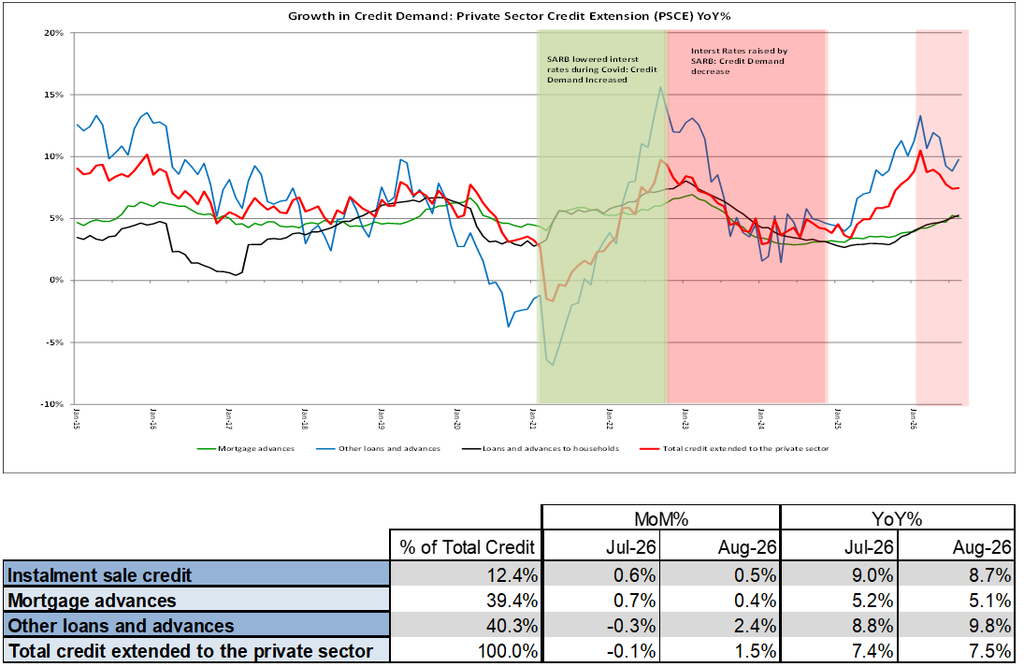
South Africa’s credit market is showing surprising resilience, with credit demand rising by 7.5% in August 2026 despite renewed interest-rate pressure, elevated inflation and mounting household costs. While mortgage advances continued to grow, the fragile recovery in the property market highlights the strain caused by subdued investment, high debt levels and rising municipal and energy expenses. At the same time, sluggish instalment credit growth and continued reliance on short-term borrowing reveal how consumers are navigating increasingly difficult financial conditions. With higher oil prices, geopolitical risks and further SARB tightening adding to the pressure, this report examines what the latest credit trends reveal about household finances, business confidence and the broader South African economy.

In August 2026, credit demand grew by 7.5%, slightly above market expectations of 7.1% for the month. Since interest rate cuts began in September 2024, overall credit growth has accelerated, with most subcategories experiencing increases; these increases for August still surprise, as the South African Reserve Bank has already increased the interest rate by 50 basis points since the start of the year. The latest increase came on the back of higher domestic inflation, driven by higher energy costs and higher international oil prices due to the ongoing conflict in the Middle East and risks associated with the closure of the Strait of Hormuz.

Mortgage advances and credit for acquiring fixed assets increased again by 5.1% in August following the 5.2% increase in July. Growth in the South African property market remains fragile and somewhat slow, reflecting low capital expenditure from both households and businesses. This sector’s recovery remains slow due to the increase in the interest rate by the SARB, continued high consumer debt levels, slow wage growth, and high living costs, especially household fuel expenditure due to high international oil prices, as well as high administered prices such as water, electricity, and municipal rates & taxes.

In August, instalment credit sales increased by only 0.5%, following a 0.6% increase the previous month, marking annual growth of 8.7%. Over the past two years, consumers have remained increasingly dependent on short-term credit to manage rising living costs, as shown by a 9.8% increase in other loans and advances, albeit notably down from 13.3% in the February 2026 figures due to the higher interest these loans carry after the interest rate increase the previous month.

With inflation still above the target range and fuel prices remaining elevated, energy costs continue to put upward pressure on prices throughout the entire economy. As a result, the SARB hiked interest rates again at the September 2026 MPC meeting.


More Coverage

South Africa’s producer price inflation eased to 5.0% year-on-year in August 2026, but persistent fuel and energy shocks continue to place pressure on the economy and keep inflation well above the South African Reserve Bank’s new 2%–4% target range. Although the pace of price increases has slowed, rising costs in petroleum, chemicals, metals, machinery, and intermediate goods, alongside elevated mining costs, suggest that inflationary pressures are still filtering through to businesses and consumers. With consumer inflation at 4.4% and the Reserve Bank having raised interest rates by 25 basis points, this report examines what the latest PPI trends mean for South Africa’s inflation outlook, interest-rate decisions, and the cost pressures likely to shape the economy in the months ahead.
When the South African Reserve Bank unexpectedly tightened monetary policy by 25 basis points to 7.25%, pushing the prime lending rate to 10.75%, it aimed to anchor inflation against imported oil shocks, but at what cost to an already bleeding real economy? With South Africa’s GDP contracting by 0.2%, unemployment climbing to 33.6%, and mining and manufacturing output in reverse, our economic challenge is not an overheated consumer base, but a severe supply-side squeeze. Raising the cost of capital cannot lower global crude prices; instead, it delivers a direct hit to strained household balance sheets and further stifles already anaemic Gross Fixed Capital Formation (GFCF). Dive into the full analysis to unpack why orthodox monetary tools miss the mark in an economy rationing out of necessity, what Governor Lesetja Kganyago’s latest guidance reveals about the interest rate path ahead, and how corporate leaders and investors must position their capital to navigate South Africa’s “higher-for-longer” reality.
South Africa’s August 2026 inflation data present a complex outlook: headline CPI rose to 4.4%, remaining below market expectations yet above the upper limit of the inflation target range, while services inflation continued to climb, and fuel and transport costs exerted further pressure on households and businesses. With the economy contracting, international oil prices rising and global uncertainties, including Middle East tensions and tariff disputes, continuing to weigh on the rand and domestic prices, attention is now focused on the South African Reserve Bank’s next interest-rate decision. Read the full report for an analysis of the factors driving inflation, the risks facing the economy and what the latest developments could mean for consumers, businesses and monetary policy in the months ahead.
The recent Electoral Court ruling dismissing the ANC’s bid to compel the IEC to accept late candidate submissions is a significant event with profound implications for the upcoming 4 November 2026 local government elections.
South Africa’s retail sector delivered a striking surprise in July 2026, with sales climbing 3.4% against market expectations of a 3.0% contraction, but the story beneath that headline number is far more nuanced than it first appears. This report unpacks the fragile balancing act facing local households: inflation easing to 4.3% yet still stubbornly above the SARB’s new 2–4% target band, administered prices and utility costs rising by more than 4.0%, wage growth lagging behind severe fuel shocks, and the lingering effect of May’s 25-basis-point rate hike prompted by inflationary pressures well beyond Pretoria’s control. We examine why business confidence firmed (SACCI up from 123.5 to 125.4) while consumer sentiment slumped sharply (FNB/BER down from -7 to -19), which categories, from “other retailers” to general dealers and household goods, actually carried the growth, and what the extension of AGOA to end-2027 means now that fresh visa tensions between Washington and Pretoria have placed South Africa’s eligibility squarely under the microscope. Read the full report to understand whether this recovery has the legs to survive higher fuel prices, a possible second rate increase, and a second-quarter contraction in economic activity — or whether July’s good news was simply borrowed from the easing cycle of 2024/25.