Copyright © Aluma Capital (Pty) Ltd. All rights reserved.
Aluma Capital (Pty) Ltd is a registered Financial Services Provider (FSP 46449) in terms of The Financial Advisory and Intermediary Services Act (37 of 2002)
December 12, 2025

A view on Demand in the Economy

Retail Sales Performance

October 2024

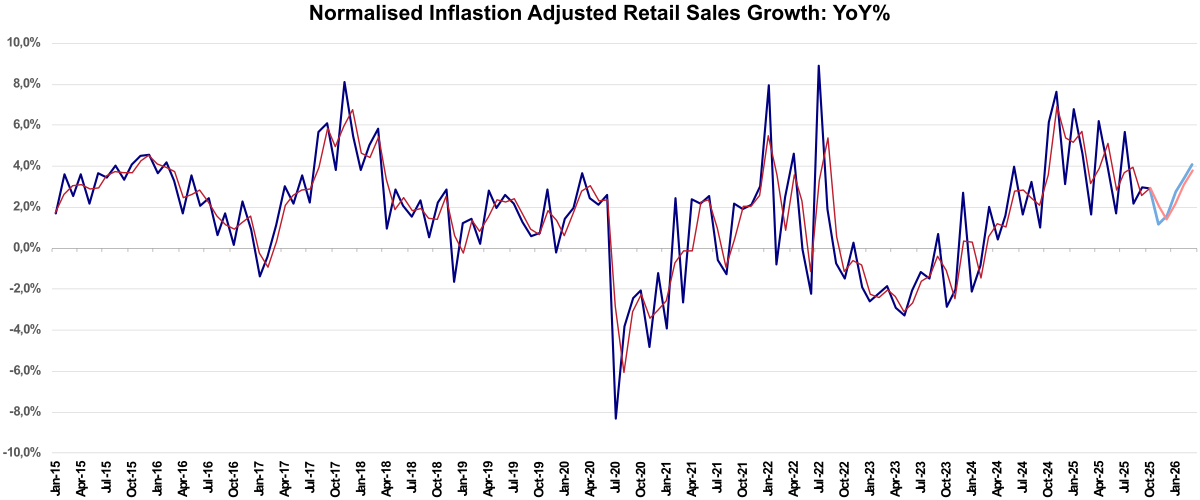
In October, retail sales in South Africa rose by 2.9%, surpassing the anticipated 2.3% growth forecasted by analysts. This growth highlights a continued recovery in consumer demand within the economy.

Despite this positive trend, households are navigating several challenges, including the rising cost of living reported by the South African Reserve Bank, sluggish wage growth due to limited economic expansion, and uncertainties concerning international trade relations with the United States. Ongoing diplomatic tensions between Washington and Pretoria, coupled with the lapse of the African Growth and Opportunity Act (AGOA) in September 2025, contribute to a cautious consumer spending environment.

October’s 2.9% increase reflects a continuous recovery trend from April to October, likely supported by interest rate cuts and monetary easing measures introduced from September 2024 to August 2025.

The South African Chamber of Commerce and Industry (SACCI) reported a slight uptick in business confidence, with its index rising from 121.1 in September to 123.8 in October 2025. However, the FNB/BER consumer confidence index dipped from -10 in the second quarter to -13 in the third quarter of 2025, highlighting consumers’ cautious spending approach. Although inflation remains low and the Reserve Bank lowered interest rates in January, July, and November 2025, these factors are gradually impacting consumer behaviour and spending.

September’s retail sales growth was driven by:

  • Other retailers: up 7.2%, contributing 0.7 percentage points
  • Retailers of textiles, clothing, footwear, and leather goods: up 5.8%, adding 1.0 percentage points
  • Retailers of household furniture, appliances, and equipment: up 13.0%, adding 0.5 percentage points
  • Retailers of hardware, paint, and glass: up 5.8%, adding 0.5 percentage points

October’s retail sales growth signals sustained momentum from July onwards, indicating a steady yet cautious recovery in consumer demand. Interest rate cuts between September 2024 and November 2025 have eased some financial pressures on households, supporting increased demand over the past four months and boosting recent retail sales figures. It is important to acknowledge that the impact of interest rate changes typically manifests within 12 to 24 months; therefore, current reductions are just beginning to yield results.

Sustaining this momentum is vital for the remainder of 2025, as consumer spending significantly contributes to South Africa’s economic growth and employment. This is particularly significant given the 0.5% GDP growth in the third quarter of 2025. The interest rate reduction in November 2025 is expected to further support consumer demand into late 2025 and early 2026.


More Coverage

In the face of South Africa’s proposed Draft Capital Flow Management Regulations, a transformative shift in how the country handles digital wealth is imminent. By redefining cryptocurrencies as “capital” and enforcing stringent penalties, South Africa aims to build a digital barrier around its economy. However, this “Regulatory Firewall” faces the immense challenge of controlling decentralised assets, akin to China’s struggle with the “Great Firewall.” The proposed measures could inadvertently push financial innovation underground, risking an unintended exodus of talent and investment to jurisdictions with a more favourable stance on digital finance. This article explores the critical implications of such regulatory hurdles, emphasising the need for a balanced, risk-based framework that supports transparency and innovation, averting the pitfalls of overly rigid controls.
In February 2026, South Africa witnessed a 1.6% rise in retail sales, signalling a fragile yet ongoing recovery in consumer demand, though falling short of the 4.8% expected by analysts. Despite challenges like rising administered prices and sluggish wage growth, this growth persists. Factors such as interest-rate cuts between September 2024 and November 2025 support the retail upswing, highlighted by a rise in both the South African Chamber of Commerce’s business confidence index and the FNB/BER consumer confidence index. Key contributors to the February increase include a 9.4% rise in sales from other retailers and a 3.9% uptick in textiles and apparel, indicating cautious but sustained recovery amidst economic uncertainties.
In March 2026, South Africa’s Consumer Price Index (CPI) rose 3.1% year-on-year, slightly above the previous month’s 3.0% and below the forecast of 4.1%. This was mainly driven by increases in housing, utilities, food, and financial services, pushing services inflation just over the Reserve Bank’s upper target limit. As rising inflation erodes purchasing power, many rely on short-term credit, increasing exposure to economic shifts. The Reserve Bank, cautious amid global uncertainties like the Middle East conflict and high fuel prices, maintained interest rates, although potential hikes loom to stabilise prices. Despite positive but modest economic growth, ongoing global tensions, notably the US-China tariff dispute and potential BRICS tariffs, alongside persistent high oil prices, threaten stability. The focus on maintaining price stability and safeguarding the Rand’s value remains paramount as South Africa navigates these challenges in 2026.
In “The Great Commodity Seesaw: How South Africa’s Gold Shield is Blunting the Oil Shock,” the South African economy stands precariously amidst soaring international oil prices and unprecedented gold values. While the country’s heavy reliance on imported fuel hurls motorists toward escalating costs, the shimmering promise of high gold prices provides a vital financial reprieve. This enrichment helps cushion the national accounts, aiding in balancing the trade surplus and reinforcing the currency during geopolitical unrest. Yet, with Eskom’s reliance on diesel to stabilize electricity supply, any unexpected outages could spell inflationary turmoil, rocking the economy’s already fragile state. As the country braces for potential fiscal challenges ahead, the question looms whether the golden buffer can truly shield the nation from impending economic turbulence
South Africa’s story is shifting—from the frustration of load shedding to the emergence of a bold new opportunity. As we move through 2026, an unexpected partnership between energy and cryptocurrency is reshaping the economic landscape. With Eskom exploring ways to monetise surplus solar power and SAA embracing Bitcoin for transactions, the country is stepping into a new era where digital finance and energy innovation converge—unlocking fresh potential for businesses, investors, and growth.