Copyright © Aluma Capital (Pty) Ltd. All rights reserved.
Aluma Capital (Pty) Ltd is a registered Financial Services Provider (FSP 46449) in terms of The Financial Advisory and Intermediary Services Act (37 of 2002)
April 22, 2026

Consumer Inflation – March 2026
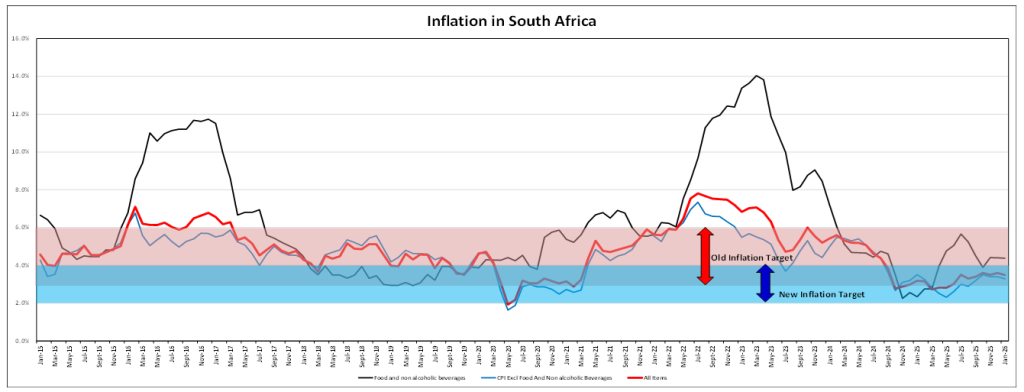
In March 2026, South Africa’s Consumer Price Index (CPI) rose 3.1% year-on-year, slightly above the previous month’s 3.0% and below the forecast of 4.1%. This was mainly driven by increases in housing, utilities, food, and financial services, pushing services inflation just over the Reserve Bank’s upper target limit. As rising inflation erodes purchasing power, many rely on short-term credit, increasing exposure to economic shifts. The Reserve Bank, cautious amid global uncertainties like the Middle East conflict and high fuel prices, maintained interest rates, although potential hikes loom to stabilise prices. Despite positive but modest economic growth, ongoing global tensions, notably the US-China tariff dispute and potential BRICS tariffs, alongside persistent high oil prices, threaten stability. The focus on maintaining price stability and safeguarding the Rand’s value remains paramount as South Africa navigates these challenges in 2026.

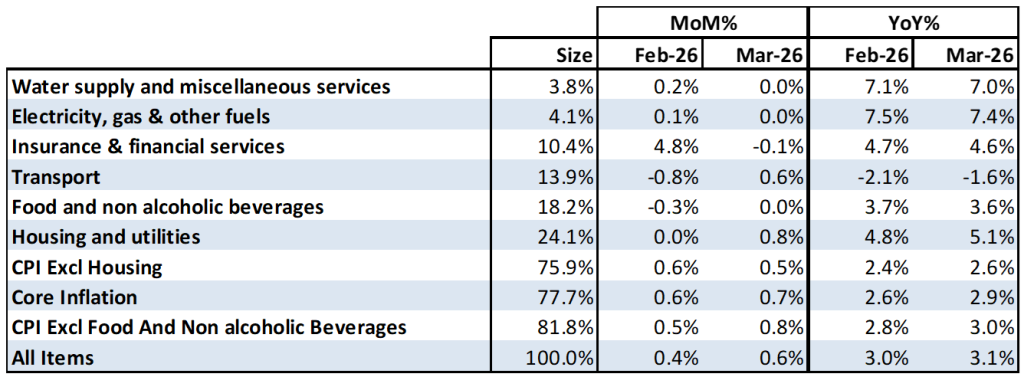
In March 2026, the Consumer Price Index (CPI) increased by 3.1% year-on-year, which is slightly higher than the 3.0% recorded in February and notably below analysts’ forecast of 4.1%. This rise in consumer prices was primarily driven by:

  • Housing and Utilities: Increased by 5.1%, contributing 1.2 percentage points.
  • Food and Non-Alcoholic Beverages: Increased by 3.6%, contributing 0.6 percentage points.
  • Insurance and Financial Services: Increased by 4.6%, contributing 0.5 percentage points.

Year-on-year, the inflation rate for goods rose by 1.8%, compared to 1.9% in February. Meanwhile, services inflation increased by 4.2%, up from 3.8% the previous month. Importantly, services inflation just rose above the Reserve Bank’s upper limit of 4.0% within the new inflation target range. This ongoing rise in services inflation, while just above the target limit, continues to diminish household purchasing power in South Africa. Consequently, many consumers and businesses remain dependent on short-term credit to sustain their consumption and liquidity, which exposes both groups to greater vulnerability to shifts in interest rates, exchange rates, international oil prices, and import costs, thereby affecting domestic prices. This is even more true with the ongoing conflict in the Middle East and the huge increase in fuel prices in April, which will likely cause inflationary pressure in the months to follow.

At the end of the January 2026 Monetary Policy Committee (MPC) meeting, the Reserve Bank decided to keep interest rates unchanged, having assessed inflation figures and forecasts for January. The Bank is anticipated to remain cautious about inflation, particularly in light of the Middle East conflict, the significant rise in international oil prices, and the resulting increase in fuel costs of R3 to R7 across the economy. These factors are likely to shape inflation expectations moving forward. The Bank’s prudent approach aims to uphold price stability amid ongoing economic and international uncertainties, including the 30% tariffs imposed by the US on South African exports, which have adversely affected the manufacturing sector, as indicated by Q4 GDP data. Such uncertainties may also impact the Rand’s exchange rate against the US dollar, even as the Rand depreciates, with investors shifting away from emerging-market assets in favour of safer, more stable investments amid the current Middle East conflict.

The South African Reserve Bank (SARB) may pause the rate-cutting cycle in light of persistently higher international fuel prices and may even raise interest rates this year to ensure price stability and keep inflation expectations grounded for as long as possible. The interest rate cuts, however, instituted in late 2024 and throughout 2025, along with a reduction in November 2025, are designed to stimulate demand by increasing disposable income for households after interest payments, thereby fostering economic growth. However, the surge in fuel prices may moderately hinder this potential.

Despite a continued positive growth, albeit slightly revised downwards for 2026, the Reserve Bank remains cautious due to persistent global uncertainties. Factors such as inflation, the US-China tariff dispute, and possible future tariffs on BRICS nations could affect price stability. Furthermore, the ongoing Middle East conflict may keep international oil prices elevated if safe passage for shipping cannot be guaranteed through the Strait of Hormuz or if the strait is completely closed as a result of conflict. Future interest rate decisions are likely to take into account moderate inflation within the new target band, sluggish economic growth, improvements in electricity supply, positive market sentiment, and international tensions that could influence oil prices.

In conclusion, sustaining price stability and safeguarding the value of the Rand are top priorities for South Africa as it navigates the early months of 2026, in light of current international developments and the uncertainties they bring.


More Coverage

In March 2026, South Africa’s Consumer Price Index (CPI) rose 3.1% year-on-year, slightly above the previous month’s 3.0% and below the forecast of 4.1%. This was mainly driven by increases in housing, utilities, food, and financial services, pushing services inflation just over the Reserve Bank’s upper target limit. As rising inflation erodes purchasing power, many rely on short-term credit, increasing exposure to economic shifts. The Reserve Bank, cautious amid global uncertainties like the Middle East conflict and high fuel prices, maintained interest rates, although potential hikes loom to stabilise prices. Despite positive but modest economic growth, ongoing global tensions, notably the US-China tariff dispute and potential BRICS tariffs, alongside persistent high oil prices, threaten stability. The focus on maintaining price stability and safeguarding the Rand’s value remains paramount as South Africa navigates these challenges in 2026.
In “The Great Commodity Seesaw: How South Africa’s Gold Shield is Blunting the Oil Shock,” the South African economy stands precariously amidst soaring international oil prices and unprecedented gold values. While the country’s heavy reliance on imported fuel hurls motorists toward escalating costs, the shimmering promise of high gold prices provides a vital financial reprieve. This enrichment helps cushion the national accounts, aiding in balancing the trade surplus and reinforcing the currency during geopolitical unrest. Yet, with Eskom’s reliance on diesel to stabilize electricity supply, any unexpected outages could spell inflationary turmoil, rocking the economy’s already fragile state. As the country braces for potential fiscal challenges ahead, the question looms whether the golden buffer can truly shield the nation from impending economic turbulence
South Africa’s story is shifting—from the frustration of load shedding to the emergence of a bold new opportunity. As we move through 2026, an unexpected partnership between energy and cryptocurrency is reshaping the economic landscape. With Eskom exploring ways to monetise surplus solar power and SAA embracing Bitcoin for transactions, the country is stepping into a new era where digital finance and energy innovation converge—unlocking fresh potential for businesses, investors, and growth.
Discover the dynamic shifts within South Africa’s mining sector with our latest analysis. In a remarkable February 2026 performance, mining activities surged by 9.7%, spearheaded by dramatic increases in PGM, chromium ore, manganese, and gold production. Despite a quarterly dip, February’s nominal sales skyrocketed by 58.3%, driven by remarkable gains in platinum and gold. As the backbone of South Africa’s economy, the sector faces evolving global challenges and opportunities, from new US tariff measures to geopolitical tensions affecting global trade and energy prices. Stay ahead with insights into the sector’s resilience and strategic importance. Read the full article to understand the trends shaping South Africa’s economic landscape.
Discover how South Africa is navigating the turbulent waters of global economic pressures and local inflation with a strategic fuel price adjustment and a major boost from a R415 billion investment windfall. As rising Brent Crude prices and a fluctuating Rand impact fuel costs and inflation forecasts, all eyes are on the South African Reserve Bank’s next move. Meanwhile, the Sixth South Africa Investment Conference has sparked optimism, with substantial commitments in the energy and technology sectors, promising a resilient economic future. Dive into the full article to explore the intricate balance between surviving immediate economic challenges and positioning South Africa as a hub for global investment amidst a world in flux.