

Private Sector Credit Extension (PSCE): January 2026

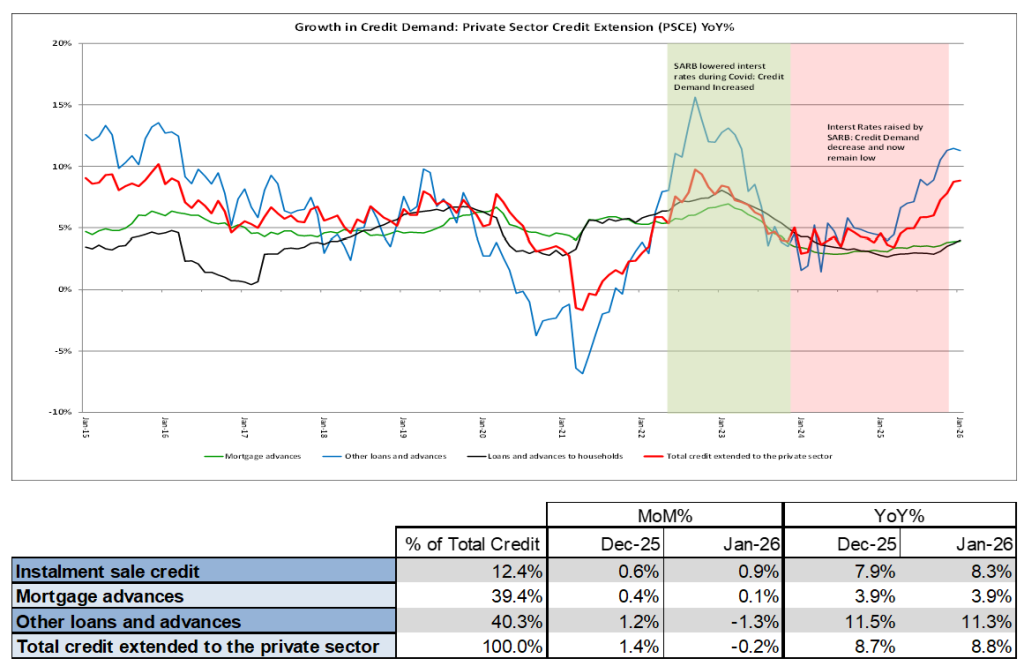
In January 2026, credit demand grew by 8.8%, slightly below the market’s expectation of 9.4%. Since interest rate cuts began in September 2024, overall credit growth has accelerated, with most subcategories experiencing increases, especially following the South African Reserve Bank’s decision to lower interest rates.
Despite these reductions, mortgage advances and credit aimed at acquiring fixed assets remain limited. The South African property market is sluggish, reflecting low capital expenditure from both households and businesses. This sector’s recovery remains slow due to high consumer debt levels, low wage growth, and rising living costs, especially administered prices such as water, electricity, and municipal rates & taxes. However, the benefits of lower interest rates are expected to become evident later in 2026, as household disposable income is boosted by positive market sentiment and the potential for further rate cuts by the South African Reserve Bank (SARB) if the spill-over effect of the Middle East conflict between the US and Iran remains contained.
In January, instalment credit sales increased again by 0.9% from the previous month, marking an annual growth of 8.3%. Over the past two years, consumers have increasingly relied on short-term credit to manage rising living costs, as shown by an 11.3% increase in other loans and advances, slightly down from 11.5% in December 2025 figures.
With inflation remaining under control for now, further rate cuts, if they materialise at all, are expected to boost disposable income, thereby supporting increased demand for goods and fixed assets in the first quarter of 2026 and beyond.


