Copyright © Aluma Capital (Pty) Ltd. All rights reserved.
Aluma Capital (Pty) Ltd is a registered Financial Services Provider (FSP 46449) in terms of The Financial Advisory and Intermediary Services Act (37 of 2002)
March 6, 2026

Producer Price Inflation – January 2026
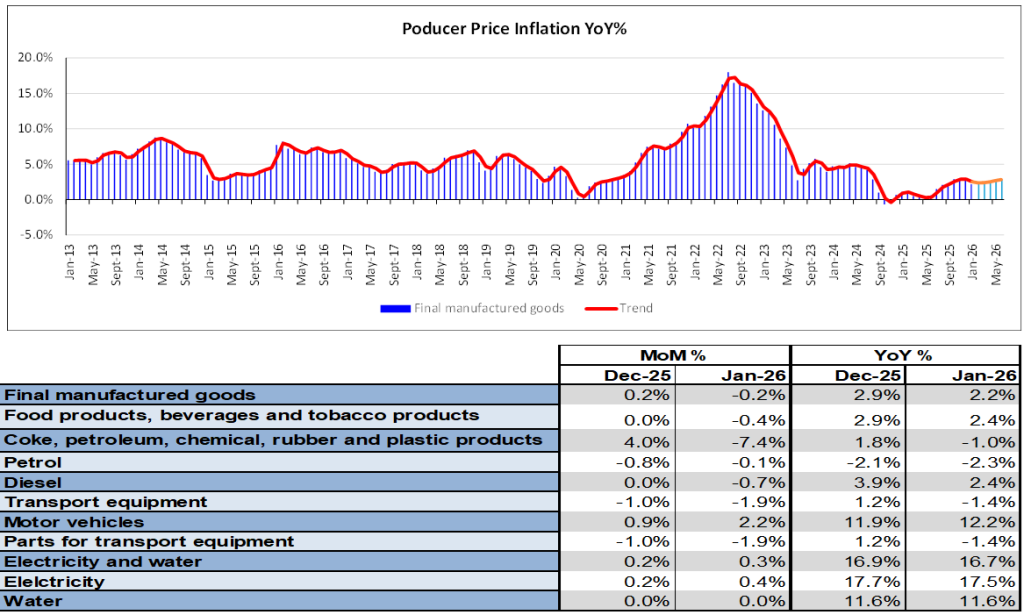
In January 2026, producer price inflation fell from 2.9% in December to 2.2% after minor revisions to producer price category weights. However, producer inflation fell by 0.2% month-on-month. Significant cost increases were noted in the following categories:

  • Food and Beverage Production: Increased by 2.2% and contributed 0.7 percentage point,
  • furniture and other manufacturing: Rose by 12.2% year-on-year while contributing 0.5 of a percentage point.

Production costs for intermediate goods rose by 10.5% in January, following a 10.1% increase in December. This indicates a clear inflationary trend that requires attention, as these increases exceed the South African Reserve Bank’s (SARB) new inflation target range of 2% to 4%. Annual growth is still significantly influenced by base effects from the 2024/25 data.

In the primary sector, mining costs climbed by 28.4% in January, following a 25.7% rise in December. In contrast, the agriculture sector experienced a further 5.8% decline, following a 5.0% decrease in December.

Overall, the trend in producer price inflation for final manufactured goods supports positive inflation expectations in South Africa for the short to medium term. Consumer inflation remains low at 3.5% for January, closely aligned with SARB’s target of 3%. While prices for certain intermediate goods—particularly water and electricity—exceed the target range, current figures suggest consumer inflation will likely remain low and stable in the near future.

This stability has allowed the Reserve Bank to lower interest rates at the November Monetary Policy Committee (MPC) meeting while keeping the rate unchanged during the January 2026 meeting, as both consumer and producer inflation expectations appear well-managed at this time. The Bank’s interest rate decision will consider both the Consumer Price Index (CPI) and Producer Price Index (PPI) when analysing inflation expectations for the first quarter of 2026.


More Coverage

South Africa’s story is shifting—from the frustration of load shedding to the emergence of a bold new opportunity. As we move through 2026, an unexpected partnership between energy and cryptocurrency is reshaping the economic landscape. With Eskom exploring ways to monetise surplus solar power and SAA embracing Bitcoin for transactions, the country is stepping into a new era where digital finance and energy innovation converge—unlocking fresh potential for businesses, investors, and growth.
Discover the dynamic shifts within South Africa’s mining sector with our latest analysis. In a remarkable February 2026 performance, mining activities surged by 9.7%, spearheaded by dramatic increases in PGM, chromium ore, manganese, and gold production. Despite a quarterly dip, February’s nominal sales skyrocketed by 58.3%, driven by remarkable gains in platinum and gold. As the backbone of South Africa’s economy, the sector faces evolving global challenges and opportunities, from new US tariff measures to geopolitical tensions affecting global trade and energy prices. Stay ahead with insights into the sector’s resilience and strategic importance. Read the full article to understand the trends shaping South Africa’s economic landscape.
Discover how South Africa is navigating the turbulent waters of global economic pressures and local inflation with a strategic fuel price adjustment and a major boost from a R415 billion investment windfall. As rising Brent Crude prices and a fluctuating Rand impact fuel costs and inflation forecasts, all eyes are on the South African Reserve Bank’s next move. Meanwhile, the Sixth South Africa Investment Conference has sparked optimism, with substantial commitments in the energy and technology sectors, promising a resilient economic future. Dive into the full article to explore the intricate balance between surviving immediate economic challenges and positioning South Africa as a hub for global investment amidst a world in flux.
South Africa’s reserves fell in USD terms in March 2026 as the Rand weakened amid Middle East tensions, though higher gold prices supported reserves in Rand terms. Rising oil prices and currency pressure point to higher inflation risks, while ongoing geopolitical tensions and US trade measures are likely to keep markets volatile.
A sudden global shift has delivered much-needed relief for South Africa. Following a Middle East ceasefire, oil prices have dropped sharply and the Rand has strengthened—easing pressure on fuel costs and inflation. While earlier price spikes still weigh on the outlook, this combined correction offers a critical window for economic stability, improved consumer confidence, and renewed growth momentum.