Copyright © Aluma Capital (Pty) Ltd. All rights reserved.
Aluma Capital (Pty) Ltd is a registered Financial Services Provider (FSP 46449) in terms of The Financial Advisory and Intermediary Services Act (37 of 2002)
July 1, 2026

Private Sector Credit Extension (PSCE): May 2026
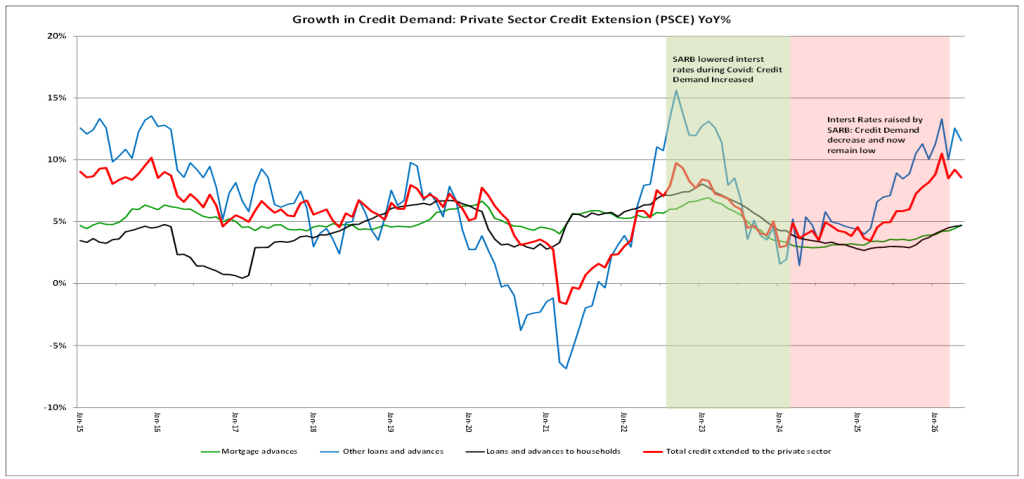

In a rapidly shifting economic landscape, May 2026 saw credit demand growth of 8.6%, falling short of the anticipated 9.4% forecast. Since interest rate cuts began in September 2024, credit growth has generally surged, particularly following strategic interest rate reductions by the South African Reserve Bank amidst global tensions and skyrocketing energy costs. However, the South African property market stagnates due to soaring consumer debts, muted wage increases, and escalating living expenses, notably in household fuel and utility prices. While instalment credit sales posted a modest rise, the reliance on short-term credit underscores consumer struggles with surging living costs. With inflation hovering above target and persistent high fuel prices, the anticipated interest rate hike in July could further suppress demand, adding pressure to the already challenging economic recovery. Discover the dynamics shaping South Africa’s financial climate in this insightful analysis.

In May 2026, credit demand grew by 8.6%, notably below the market’s expectation of 9.4%. Since interest rate cuts began in September 2024, overall credit growth has accelerated, with most subcategories experiencing increases, especially following the South African Reserve Bank’s decision to lower interest rates before the start of the conflict in the Middle East and subsequent increase in global energy costs and higher fuel prices.

Mortgage advances and credit for acquiring fixed assets remain low and have edged lower following a 25-basis-point increase in interest rates at the last meeting of the Monetary Policy Committee (MPC) in May 2026. The South African property market remains sluggish, reflecting low capital expenditure from both households and businesses. This sector’s recovery remains slow due to high consumer debt levels, low wage growth, and rising living costs, especially household fuel expenditure due to high international oil prices, as well as high administered prices such as water, electricity, and municipal rates & taxes.

In May, instalment credit sales increased again by 1.0% from the previous month, marking an annual growth of 9.3%. Over the past two years, consumers have remained increasingly dependent on short-term credit to manage rising living costs, as shown by an 11.5% increase in other loans and advances, slightly down from 12.6% in the April 2026 figures.

With inflation just above the target range and fuel prices remaining elevated despite a recent slight dip, energy costs continue to put upward pressure. As a result, the SARB may hike interest rates again at its next MPC meeting on July 23, 2026, which will likely further dampen consumer demand


More Coverage

In a rapidly shifting economic landscape, May 2026 saw credit demand growth of 8.6%, falling short of the anticipated 9.4% forecast. Since interest rate cuts began in September 2024, credit growth has generally surged, particularly following strategic interest rate reductions by the South African Reserve Bank amidst global tensions and skyrocketing energy costs. However, the South African property market stagnates due to soaring consumer debts, muted wage increases, and escalating living expenses, notably in household fuel and utility prices. While instalment credit sales posted a modest rise, the reliance on short-term credit underscores consumer struggles with surging living costs. With inflation hovering above target and persistent high fuel prices, the anticipated interest rate hike in July could further suppress demand, adding pressure to the already challenging economic recovery. Discover the dynamics shaping South Africa’s financial climate in this insightful analysis.
In May 2026, producer price inflation surged to 7.8%, driven by significant fuel price shocks that impacted goods leaving the factory gate. Important sectors saw remarkable price hikes, with Coke, petroleum, and chemical products alone rising by 22%. Meanwhile, mining costs soared by 28.1%, heightening concerns about ongoing inflationary pressures. With consumer inflation climbing to 4.5%, surpassing the South African Reserve Bank’s target of 2% to 4%, the economic landscape is becoming increasingly unstable. Readers will find critical insights into how these trends affect overall inflation expectations and the imminent interest rate decisions that could shape South Africa’s economic future. Dive into the full report for a comprehensive analysis of these pivotal issues and their implications.
Dive into “South Africa’s Crypto Crossroads: Modern Regulation or an Economic Time Machine?” an eye-opening exploration of South Africa’s latest Draft Capital Flow Management Regulations, 2026. As the South African government aims to modernise cross-border financial regulations and tighten digital currency controls, these proposed changes have sparked uproar among fintech leaders and legal experts. The draft threatens to overreach into constitutional rights, potentially stifling innovation and economic growth. With concerns over encroachments on privacy and powers to seize assets, critics argue that the regulations could deter investment and spark a talent exodus. As the public comment period extends, the country’s financial future hangs in the balance, poised between innovation and economic regression. Discover why industry stakeholders are on high alert and advocating for a careful recalibration of this legislative move.
In April 2026, South Africa’s manufacturing sector experienced a worrying 2.9% contraction, in stark contrast to earlier growth forecasts. While the Purchasing Managers’ Index (PMI) indicated slight optimism, with a rise to 52.6, the underlying data revealed significant declines in key industries, notably basic iron and steel and motor vehicles, which contributed heavily to the downturn. This article delves into the factors driving this decline, including the impact of US trade tariffs and ongoing diplomatic tensions, which have exacerbated the situation and led to a steep drop in exports. Despite these challenges, manufacturers have taken a cautious yet strategic approach, maintaining robust cash reserves amidst the turmoil. Explore the full report to understand the implications for South Africa’s economic landscape and the future of manufacturing in the region.
Discover the dynamics of South Africa’s retail landscape as April 2026 saw an unexpected 1.3% sales surge, surpassing analyst expectations and hinting at a delicate yet promising recovery in consumer demand. Unpack the complex backdrop of inflation concerns, interest rate adjustments by the South African Reserve Bank, and the broader economic challenges shaped by international tensions and rising costs. Despite the growth, households navigate a landscape of cautious spending, with recent interest rate hikes casting a shadow over future consumer spending and business confidence. This intriguing exploration offers insights into the driving forces behind the retail revival and the headwinds that may test its resilience.