Copyright © Aluma Capital (Pty) Ltd. All rights reserved.
Aluma Capital (Pty) Ltd is a registered Financial Services Provider (FSP 46449) in terms of The Financial Advisory and Intermediary Services Act (37 of 2002)
June 23, 2026

Manufacturing Production – April 2026
In April 2026, South Africa’s manufacturing sector experienced a worrying 2.9% contraction, in stark contrast to earlier growth forecasts. While the Purchasing Managers’ Index (PMI) indicated slight optimism, with a rise to 52.6, the underlying data revealed significant declines in key industries, notably basic iron and steel and motor vehicles, which contributed heavily to the downturn. This article delves into the factors driving this decline, including the impact of US trade tariffs and ongoing diplomatic tensions, which have exacerbated the situation and led to a steep drop in exports. Despite these challenges, manufacturers have taken a cautious yet strategic approach, maintaining robust cash reserves amidst the turmoil. Explore the full report to understand the implications for South Africa’s economic landscape and the future of manufacturing in the region.

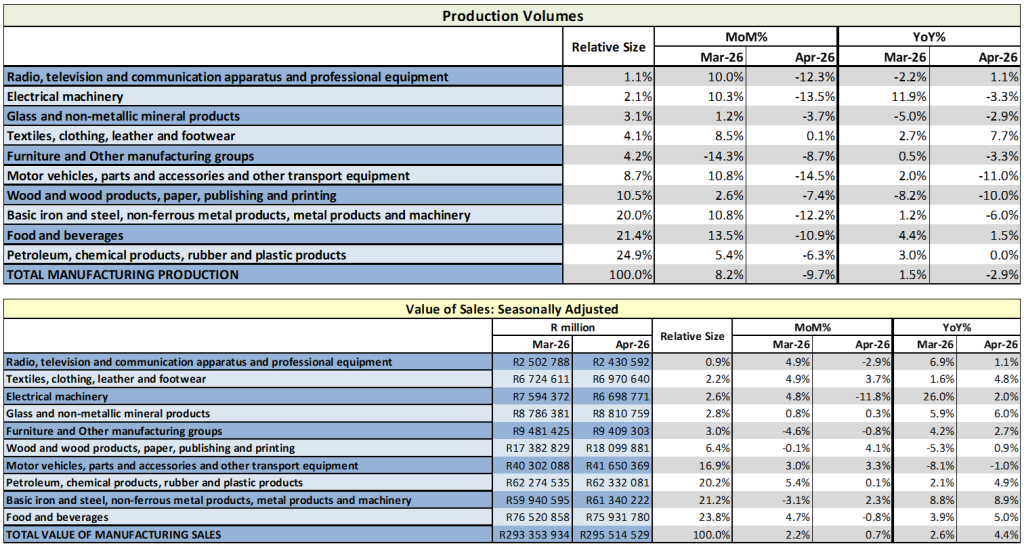
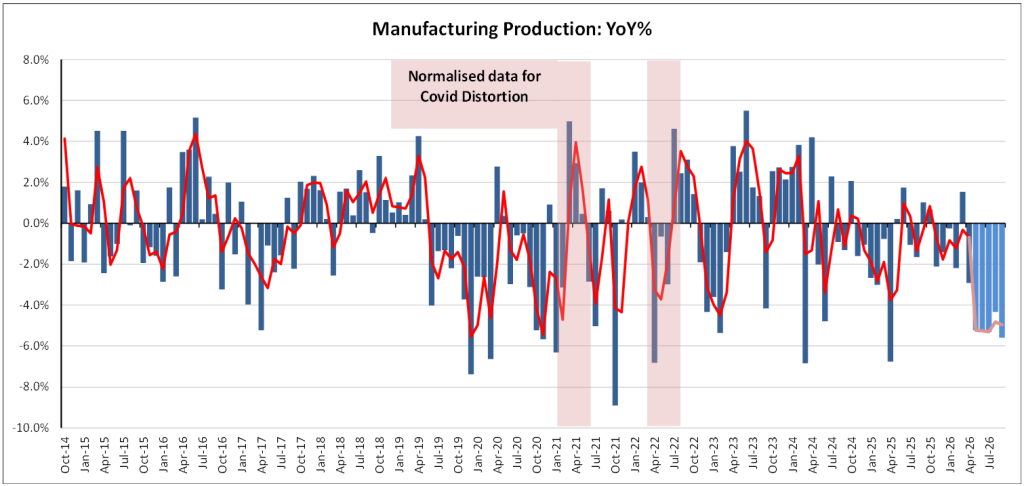
In April 2026, South Africa’s manufacturing output contracted by 2.9%, following the 1.5% increase in March 2026. This decrease is far worse than the 1.2% increase analysts forecast for April 2026. During the same period, the Purchasing Managers’ Index (PMI) increased 3.6 points, from 49.0 in March 2026 to 52.6 in April 2026. This indicates a positive view of the business environment as output expanded within the sector.

The contraction in manufacturing production during April was largely attributed to basic iron and steel, non-ferrous metal products, metal products, and machinery, which decreased by 6.0%, contributing -1.4 percentage points to the overall manufacturing decline. Similarly, the wood and wood products, paper, publishing and printing industry saw a growth decline of 10.0%, subtracting an additional 1.0 percentage points, while the motor vehicles, parts and accessories and other transport equipment industry contracted by 11.0%, subtracting an additional 0.9 percentage points towards manufacturing output during this period. These sectors were significant contributors to the industry’s underperformance in April.

Seasonally adjusted manufacturing production decreased by 1.3% for the rolling quarter ending April 2026 compared to the previous rolling quarter. Out of ten sectors, six reported contractions during this period. Significant contractions included:

  • Petroleum, chemical products, rubber and plastic products, declined by 3.5%, subtracting 0.8 percentage points from growth.
  • Wood and wood products, paper, publishing and printing, which decreased by 3.4%, also contributed a 0.3 percentage point reduction.

Seasonally adjusted manufacturing sales increased by 2.3% during the rolling quarter ending April 2026 compared to the previous rolling quarter. Significant increases occurred in:

  • Basic iron and steel, non-ferrous metal products, metal products and machinery, which increased by 5.7%, adding 1.2 percentage points towards sales growth for the quarter.
  • The motor vehicles, parts and accessories and other transport equipment division, which rose by 7.1%, added another 0.9 percentage points towards sales growth for the quarter under review.

Manufacturing is a critical component of South Africa’s economy, employing approximately 1.58 million people and accounting for 12.5% of the GDP in 2025. Employment slightly increased from 1.548 million in Q4 2025 to 1.587 million in Q1 2026. GDP figures for the fourth quarter indicate a 0.6% quarterly decrease in manufacturing output, suggesting that US trade tariffs since August 2025 have caused some distress in the manufacturing sector by eroding price competitiveness in the US market, driven by higher import prices due to tariffs on South African-produced export goods. It should, however, be noted that exports to the US market have declined by 56% since 2025 due to tariffs, trade tensions and diplomatic “disputes” between Pretoria and Washington.

As a result of trade tariffs with the US and ongoing diplomatic tensions between Pretoria and Washington, business owners remain cautious, as evidenced by the April 2026 PMI data, which is just above the positive 50-point threshold. However, companies are still maintaining substantial cash reserves of approximately R1.8 trillion, up from R1.1 trillion in the first quarter of 2025, according to the Reserve Bank. This reflects a prudent approach amid current domestic and global economic uncertainties in the short- to medium-term.


More Coverage

In April 2026, South Africa’s manufacturing sector experienced a worrying 2.9% contraction, in stark contrast to earlier growth forecasts. While the Purchasing Managers’ Index (PMI) indicated slight optimism, with a rise to 52.6, the underlying data revealed significant declines in key industries, notably basic iron and steel and motor vehicles, which contributed heavily to the downturn. This article delves into the factors driving this decline, including the impact of US trade tariffs and ongoing diplomatic tensions, which have exacerbated the situation and led to a steep drop in exports. Despite these challenges, manufacturers have taken a cautious yet strategic approach, maintaining robust cash reserves amidst the turmoil. Explore the full report to understand the implications for South Africa’s economic landscape and the future of manufacturing in the region.
Discover the dynamics of South Africa’s retail landscape as April 2026 saw an unexpected 1.3% sales surge, surpassing analyst expectations and hinting at a delicate yet promising recovery in consumer demand. Unpack the complex backdrop of inflation concerns, interest rate adjustments by the South African Reserve Bank, and the broader economic challenges shaped by international tensions and rising costs. Despite the growth, households navigate a landscape of cautious spending, with recent interest rate hikes casting a shadow over future consumer spending and business confidence. This intriguing exploration offers insights into the driving forces behind the retail revival and the headwinds that may test its resilience.
In the latest analysis on South Africa’s economic landscape, our article delves into the implications of the recent 4.5% year-on-year rise in the Consumer Price Index (CPI), highlighting critical factors behind this uptick, including significant increases in housing, transport, and financial services. As inflation continues to surpass the Reserve Bank’s target, the report examines the resulting strain on household purchasing power and the rising reliance on short-term credit amid fluctuating global conditions. The article further explores the complexities of recent monetary policy decisions, including the Reserve Bank’s cautious approach to interest rates in response to these economic pressures exacerbated by international conflicts and tariff impacts. With insights into future inflation expectations and their potential effects on South Africa’s economic stability, this comprehensive report offers valuable perspectives on navigating the challenges ahead. Don’t miss out on the full details that could shape your understanding of the current economic climate!
In April 2026, South Africa’s mining sector saw a significant resurgence, with an impressive 8.2% growth in activity driven by a remarkable 36.5% increase in platinum group metals (PGM) production. The industry’s vitality is evident in the rolling quarter growth of 2.4%, bolstered by surging platinum and gold outputs. With mining sales soaring by 30.3%, supported by a dramatic upswing in platinum and gold sales, the sector remains a cornerstone of South Africa’s economy, providing crucial employment and foreign exchange. Despite this historic success, challenges loom, such as geopolitical tensions, new tariffs, and the loss of key international trade benefits, threatening future stability. Discover how South Africa’s mining industry is navigating these turbulent times, seizing opportunities, and overcoming the obstacles posed by international and domestic pressures in this compelling report.
In the wake of interest rate cuts by the South African Reserve Bank since September 2024, credit demand saw an uptick of 8.5% in March 2026, narrowly missing market expectations. Despite the encouraging growth across various credit segments, the property market remains sluggish due to persistent high consumer debt, slow wage growth, and rising living costs, particularly driven by soaring international oil prices and high administered rates. As South Africans increasingly turn to short-term credit to cope with these pressures, an upward trend in instalment sales and other loans is evident, with an anticipation of future benefits from reduced interest rates potentially offset by looming inflationary threats linked to the ongoing Middle East conflict. Explore how these dynamics may unfold in the remainder of 2026 and influence South Africa’s economic landscape.