Copyright © Aluma Capital (Pty) Ltd. All rights reserved.
Aluma Capital (Pty) Ltd is a registered Financial Services Provider (FSP 46449) in terms of The Financial Advisory and Intermediary Services Act (37 of 2002)
July 30, 2026

Private Sector Credit Extension (PSCE): June 2026
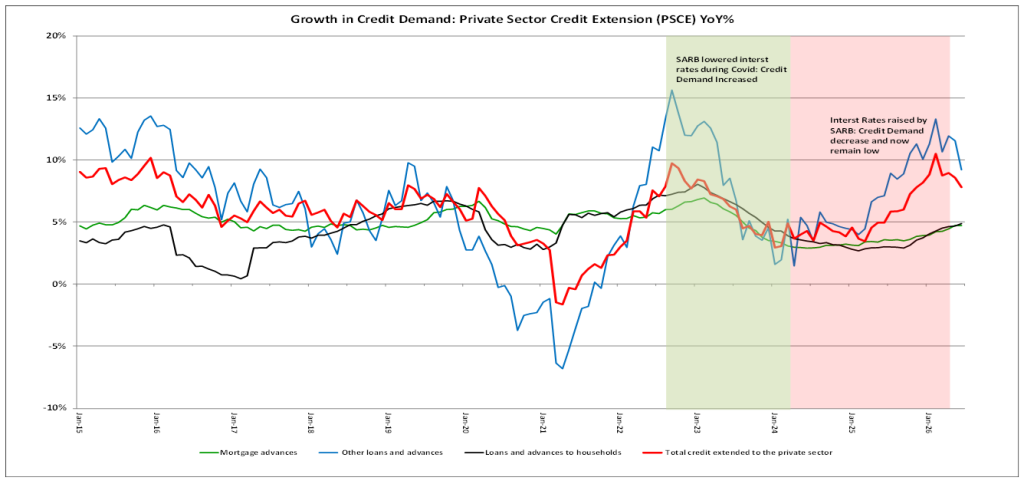

Explore the intricate dynamics of South Africa’s financial landscape in June 2026, where credit demand rose by 8.6%, falling short of market expectations, yet reflecting the broader impact of interest rate cuts since September 2024. This detailed examination reveals the interplay of mortgage stability amidst a sluggish property market, fuelled by high consumer debt and soaring living costs, particularly in energy. As instalment credit sales and short-term credit reliance mark notable shifts, delve into the potential for further interest rate hikes amidst persistent inflation and global energy challenges, informing strategic decisions in an uncertain economic climate. Discover the comprehensive insights and future implications in the full report.

In June 2026, credit demand grew by 8.6%, notably below the market’s expectation of 9.1%. Since interest rate cuts began in September 2024, overall credit growth has accelerated, with most subcategories experiencing increases, especially following the South African Reserve Bank’s decision to lower interest rates before the start of the conflict in the Middle East and subsequent increase in global energy costs and higher fuel prices.

Mortgage advances and credit for acquiring fixed assets remain unchanged at 4.7% from the previous month. The South African property market remains sluggish, reflecting low capital expenditure from both households and businesses. This sector’s recovery remains slow due to high consumer debt levels, low wage growth, and rising living costs, especially household fuel expenditure due to high international oil prices, as well as high administered prices such as water, electricity, and municipal rates & taxes.

In June, instalment credit sales increased by only 0.6% following the 1.0% from the previous month, marking an annual growth of 9.1%. Over the past two years, consumers have remained increasingly dependent on short-term credit to manage rising living costs, as shown by a 9.2% increase in other loans and advances, notably down from 11.5% in the May 2026 figures due to the higher interest these loans carry after the interest rate increase the previous month.

With inflation above the target range and fuel prices remaining elevated despite a recent slight dip, energy costs continue to put upward pressure. As a result, the SARB may hike interest rates again in the course of 2026 if inflation expectations persist above the upper threshold of the new target range of 4.0%.


More Coverage

The US Federal Reserve’s decision to keep interest rates unchanged at 3.50%–3.75%, alongside the South African Reserve Bank’s decision to hold the repo rate at 7.00%, has provided South Africa with valuable economic breathing room. By preserving investor confidence, supporting the Rand, and easing pressure on domestic borrowing costs, the coordinated pause has helped shield the economy from global uncertainty while creating a more stable environment for businesses, consumers, and long-term economic recovery.
In a surprising yet calculated move, the South African Reserve Bank’s Monetary Policy Committee opted to hold the repo rate steady at 7.00%, defying market predictions of a rate hike amidst rising inflation concerns. With a 4–2 split vote, the Committee’s decision reflects a strategic balance between tackling global inflationary pressures caused by external supply shocks and addressing domestic economic fragilities. The SARB aims to protect South Africa’s growth by preserving liquidity and avoiding additional burdens on consumers and SMEs, who are already grappling with local infrastructure challenges and municipal dysfunction. Despite recognising persistent inflation, especially in services, the Bank remains cautious but data-driven, addressing risks while betting on economic recovery momentum in late 2026. Discover why this prudent approach may well be the key to steering South Africa through current economic uncertainties.
In “The SARB’s Dilemma: Why a 25-Basis-Point Rate Hike Would Be the Wrong Medicine for South Africa,” the article highlights the crucial choice facing the South African Reserve Bank (SARB) amid rising inflation, driven primarily by external factors like global oil volatility. As the Monetary Policy Committee prepares to meet, the piece argues against the anticipated 25-basis-point increase in the repo rate, asserting that such action would unfairly burden households and businesses already grappling with financial strain. Instead, the article advocates for a hold position, emphasizing that this approach would preserve liquidity in a struggling economy, support private sector growth, and allow for necessary structural reforms to take root. Readers will find compelling insights on the economic implications of SARB’s decision and the importance of distinguishing between domestic demand and external pressures.
In June 2026, the Consumer Price Index (CPI) saw a significant increase of 5.0% year-on-year, overtaking May’s 4.5% rise and exceeding market predictions. The surge, driven by notable upticks in housing, utilities, transport, and financial services, signals a persistent inflationary trend that has once again breached the Reserve Bank’s upper target limit. This economic pressure is eroding household purchasing power in South Africa, exacerbated by enduring high interest rates and elevated fuel prices due to ongoing global conflicts. As businesses and consumers increasingly lean on short-term credit, they face heightened vulnerability to volatile interest rates, exchange rates, and import costs. This report delves into the multifaceted impact of these economic challenges, painting a vivid picture of South Africa’s current inflation dynamics and its implications for the future.
With inflation largely driven by global supply-side pressures rather than strong consumer demand, another SARB interest rate hike may do little to reduce price increases while placing additional strain on already financially stretched South African households. Although higher rates may help anchor inflation expectations and support the Rand, they risk slowing economic growth, increasing loan defaults, and further weakening consumer spending.