Copyright © Aluma Capital (Pty) Ltd. All rights reserved.
Aluma Capital (Pty) Ltd is a registered Financial Services Provider (FSP 46449) in terms of The Financial Advisory and Intermediary Services Act (37 of 2002)
July 30, 2026

Strategic Breathing Room: How the US Fed Rate Hold Anchors South Africa’s Economic Recovery

The US Federal Reserve’s decision to keep interest rates unchanged at 3.50%–3.75%, alongside the South African Reserve Bank’s decision to hold the repo rate at 7.00%, has provided South Africa with valuable economic breathing room. By preserving investor confidence, supporting the Rand, and easing pressure on domestic borrowing costs, the coordinated pause has helped shield the economy from global uncertainty while creating a more stable environment for businesses, consumers, and long-term economic recovery.

The decision by the US Federal Reserve to hold its benchmark interest rate steady at 3.50%–3.75% has turned out to be a welcome development for South Africa’s economy. Coming closely on the heels of the South African Reserve Bank’s (SARB) decision to keep the local repo rate unchanged at 7.00% (prime at 10.50%), the Fed’s pause has stabilised capital flows, defended the Rand, and preserved much-needed domestic market liquidity.

1. Protecting the Interest Rate Differential and Capital Flows

In global finance, capital flows toward risk-adjusted yield. When the US central bank raises interest rates, the interest rate differential, the gap between South African and US yields, narrows. Had the Federal Reserve tightened further, global investors would have moved capital out of emerging markets and back into lower-risk US Dollar assets, triggering a sharp sell-off in South African securities.

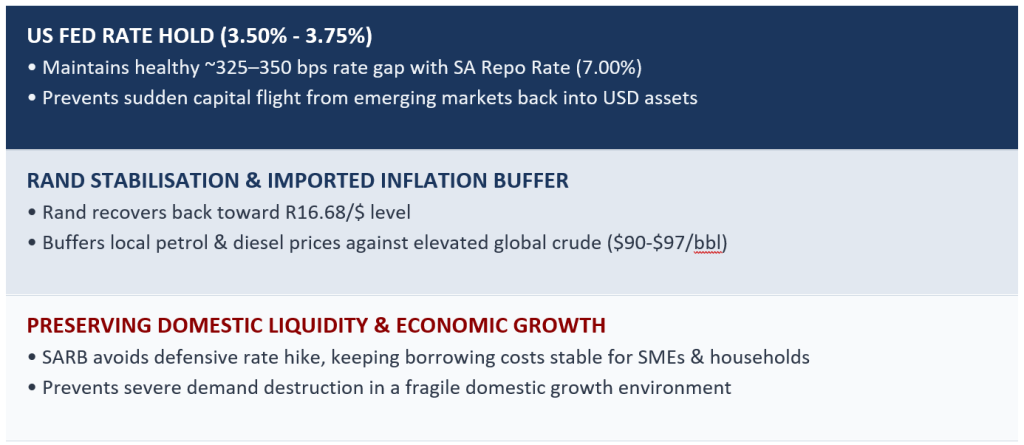
By holding rates steady, the Fed preserved a comfortable 325-to-350 basis-point spread. Combined with high real yields on South African Government Bonds (SAGBs), where benchmark 10-year yields trade near 8.50%, foreign investors retained their appetite for Rand-denominated income assets. This sustained inflow helped the Rand recover from its initial post-MPC volatility near R16.98/$, steadying back toward R16.68–R16.80/$.
2. Buffering South Africa Against Global Oil Shocks

The currency recovery provides vital insulation against external inflation. Ongoing geopolitical conflict in the Middle East and shipping disruptions around the Strait of Hormuz have kept Brent crude prices elevated between $90 and $97 per barrel. Because oil is priced in US Dollars, a weakening Rand would have magnified local fuel price increases at the pump, spilling over into transport logistics, food inflation, and consumer basket costs.

The steadying Rand acts as a critical shock absorber, softening the blow of expensive energy imports and containing second-round inflationary pressure across domestic supply chains.

3. Preserving Domestic Liquidity and Supporting Local Businesses

Perhaps the greatest benefit of this policy alignment is that it spared South African households and businesses from another interest rate hike. Had the Fed raised rates, the SARB might have felt compelled to execute a defensive 25-basis-point hike to defend the Rand, raising prime lending rates to 10.75%.

With domestic consumer and business confidence already subdued, further rate tightening would have drained critical liquidity from the market, increasing debt servicing burdens for SMEs and stifling discretionary household demand. By holding rates steady, monetary authorities avoided compounding domestic friction, giving the real economy room to navigate structural challenges such as municipal debt recovery and infrastructure bottlenecks.

The Bottom Line

The decision by both central banks to maintain interest rate stability has granted South Africa much-needed operational space. While global energy costs and geopolitical risks remain persistent, preserving local market liquidity and capital inflows ensures the domestic economy remains resilient without sacrificing underlying growth capacity.


More Coverage

South Africa’s retail sector delivered a striking surprise in July 2026, with sales climbing 3.4% against market expectations of a 3.0% contraction, but the story beneath that headline number is far more nuanced than it first appears. This report unpacks the fragile balancing act facing local households: inflation easing to 4.3% yet still stubbornly above the SARB’s new 2–4% target band, administered prices and utility costs rising by more than 4.0%, wage growth lagging behind severe fuel shocks, and the lingering effect of May’s 25-basis-point rate hike prompted by inflationary pressures well beyond Pretoria’s control. We examine why business confidence firmed (SACCI up from 123.5 to 125.4) while consumer sentiment slumped sharply (FNB/BER down from -7 to -19), which categories, from “other retailers” to general dealers and household goods, actually carried the growth, and what the extension of AGOA to end-2027 means now that fresh visa tensions between Washington and Pretoria have placed South Africa’s eligibility squarely under the microscope. Read the full report to understand whether this recovery has the legs to survive higher fuel prices, a possible second rate increase, and a second-quarter contraction in economic activity — or whether July’s good news was simply borrowed from the easing cycle of 2024/25.
South Africa’s business profitability showed surprising resilience in the second quarter of 2026, outpacing inflation despite a 0.2% contraction in economic activity, higher oil and import prices, trade tariffs, and ongoing diplomatic tensions. While overall profit growth slowed from the first quarter, several sectors, including transport and logistics, mining, electricity and utilities, personal services, and trade, recorded substantial gains, offering important clues about where the economy’s strongest opportunities may lie. This report examines the forces shaping Gross Operating Surplus across key industries, explains the mounting pressures on company performance, and considers whether easing geopolitical tensions, lower oil prices, and greater policy certainty could unlock stronger economic activity, employment, and investment in the months and years ahead.
South Africa’s international liquidity position strengthened in August 2026, with net gold and foreign exchange reserves rising by USD 1,9 billion as the rand gained nearly 30c against the US dollar and the gold price climbed to USD 4 460/oz, some 30% higher than a year earlier. Yet beneath these encouraging headline figures lies a far more complex picture: the ongoing conflict in the Middle East and tensions around the Strait of Hormuz are keeping oil prices elevated, while shifting US tariff measures, a one-year AGOA extension and the Federal Reserve’s decision to hold rates steady all point to continued volatility for the rand. With the South African Reserve Bank’s third-quarter interest rate decisions hanging in the balance, this report unpacks what these commodity and currency movements mean for inflation, the mining sector and South Africa’s economic outlook for the remainder of the year.
South Africa’s mining sector is facing mounting pressure, with production falling 7.5% in July 2026 after a revised 4.3% decline in June, while the rolling three-month contraction reached 5.5% and nominal mining sales dropped 5.6%. Sharp declines in iron ore, coal, PGMs, gold, manganese, and nickel highlight the sector’s vulnerability, compounded by job losses, rising fuel and energy costs, policy uncertainty, property rights concerns, and growing trade barriers. Yet mining remains indispensable to the economy, supporting approximately 450,000 jobs, generating foreign exchange and contributing to growth. With elevated gold prices and temporary tariff exemptions offering limited relief, this report examines the forces reshaping South Africa’s mining industry—and whether these bright spots can withstand the sector’s deepening structural and geopolitical challenges.
South Africa’s economy faced renewed pressure in the second quarter of 2026, contracting by 0.2% amid high input costs, elevated fuel prices and challenging global conditions. While sectors such as agriculture and finance showed resilience, continued weakness in manufacturing, mining and trade highlights the structural challenges facing the economy. With unemployment remaining elevated and inflationary pressures still a concern, policy clarity, infrastructure investment and improved business confidence will be critical to supporting sustainable economic growth in the months ahead.