Copyright © Aluma Capital (Pty) Ltd. All rights reserved.
Aluma Capital (Pty) Ltd is a registered Financial Services Provider (FSP 46449) in terms of The Financial Advisory and Intermediary Services Act (37 of 2002)
July 23, 2026

Prudence Over Panic: Why the SARB’s Surprise Rate Hold Was the Right Call for South Africa

In a surprising yet calculated move, the South African Reserve Bank’s Monetary Policy Committee opted to hold the repo rate steady at 7.00%, defying market predictions of a rate hike amidst rising inflation concerns. With a 4–2 split vote, the Committee’s decision reflects a strategic balance between tackling global inflationary pressures caused by external supply shocks and addressing domestic economic fragilities. The SARB aims to protect South Africa’s growth by preserving liquidity and avoiding additional burdens on consumers and SMEs, who are already grappling with local infrastructure challenges and municipal dysfunction. Despite recognising persistent inflation, especially in services, the Bank remains cautious but data-driven, addressing risks while betting on economic recovery momentum in late 2026. Discover why this prudent approach may well be the key to steering South Africa through current economic uncertainties.

In a move that caught most financial analysts off guard, the South African Reserve Bank’s (SARB) Monetary Policy Committee (MPC) announced today that it is keeping the repo rate unchanged at 7.00% (leaving the prime lending rate at 10.50%). Heading into the meeting, market consensus leaned heavily toward a 25-basis-point increase, especially after Statistics South Africa reported that June headline inflation accelerated to 5.0%. However, in a split 4–2 vote, the MPC opted for policy stability.

Given the mounting geopolitical storm clouds abroad and structural fragilities at home, holding rates steady was not merely a pragmatic compromise, it was the most sensible policy choice for South Africa’s immediate economic future.

1. Looking Through External Supply Shocks

The decision directly addresses a core reality of our current economic backdrop: today’s inflationary pressures are imported. The ongoing conflict in the Middle East continues to disrupt global energy markets, keeping crude oil prices elevated. Crucially, lingering bottlenecks around the Strait of Hormuz, a central choke point for maritime oil shipments, continue to pose severe logistics challenges for international energy trade.
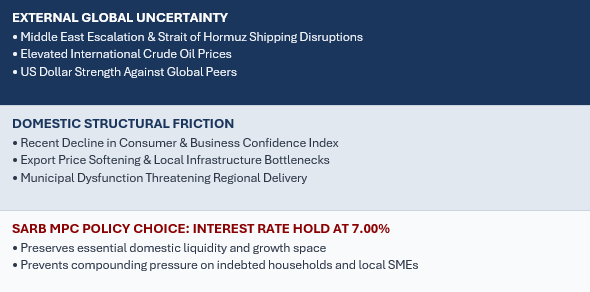
Monetary policy cannot unblock international shipping lanes or lower global oil spot prices. Squeezing South African consumers and businesses with higher borrowing costs to offset a global supply shock would simply punish the domestic market without fixing the root cause. While the Reserve Bank noted that world economic growth and global inflation expectations have remained roughly unchanged, it also observed key currency divergence: the US Dollar has strengthened against most global peers, whereas the Rand gained modest ground against the Euro, offering a slight domestic buffer.

2. Respecting Domestic Growth and Local Fragilities

While economic activity in South Africa surprised to the upside in the first quarter of 2026, recent indicators signal that momentum remains fragile. Recent monthly readings show a clear decline in both Consumer Confidence and Business Confidence, alongside a slight softening in export prices for key South African commodities.

  • Infrastructure Bottlenecks: Import and export logistics hurdles continue to restrict operational efficiency and throughput for local producers.
  • Municipal Dysfunction: Deteriorating service delivery across poorly managed municipalities requires urgent intervention to support regional commerce and protect local balance sheets.

Had the Reserve Bank added another 25 basis points to local borrowing costs, it would have intensified financial strain on households and small-to-medium enterprises (SMEs) already navigating operational disruptions.

3. Inflation Outlook: High, Sticky, but Improving

The Reserve Bank’s decision is not a sign of complacency regarding inflation. The MPC explicitly acknowledged that headline inflation is expected to remain high and sticky into 2027, with services inflation staying elevated over the coming months. However, there were encouraging signals in the details:

  • Food Inflation Moderation: Food price pressures eased slightly, providing vital relief to low- and middle-income households.
  • Improved Medium-Term Trajectory: Overall, the medium-term inflation outlook looks slightly better than it did during the previous meeting.
  • Upside Risks: The SARB sees clear upside risks on the horizon and emphasised that all future rate decisions will remain strictly data-driven.

The Bottom Line

The SARB expects economic recovery to regain traction in the latter stages of 2026. By choosing to hold the repo rate steady at 7.00% today, the Monetary Policy Committee successfully struck a balance between maintaining a cautious, inflation-aware stance and providing the real economy with the room it desperately needs to breathe, invest, and rebuild.


More Coverage

What Hong Kong’s 24/7 Tokenised Deposit Pilot Means for South African Banking & Capital Markets. Today’s announcement by the Hong Kong Monetary Authority, launching live 24/7 interbank settlement of tokenised commercial bank deposits backed by central bank money, marks a pivotal transition away from speculative crypto debates toward true institutional financial convergence. In our latest market analysis, we unpack how uniting commercial bank balance sheets with programmable blockchain rails eliminates trapped working capital, cuts reconciliation friction, and resolves the structural limitations of conventional operating hours. Crucially for South Africa, we examine the practical opportunities this shift creates to modernise corporate treasury, deepen secondary liquidity for private credit, and solidify the Rand’s role as the primary settlement gateway for intra-African trade under the AfCFTA, while highlighting where domestic regulatory and payments infrastructure must now transition from sandbox trials to live wholesale deployment.
Despite Binance confirming that it has replenished or covered 95% of the $6.36 billion stolen in last week’s historic cyberattack, verified market data reveals that customers pulled an extraordinary $3.64 billion in net outflows (processing $4.65 billion in gross withdrawals against $1.01 billion in deposits) within hours of withdrawal rails reopening on Sunday, 1 November. In my latest opinion piece, “Binance Replaced the Billions. So Why Are Investors Still Leaving?”, I unpack the critical economic disconnect between balance-sheet solvency, operational liquidity, and investor confidence, demonstrating why corporate treasury bailouts and functioning redemption queues cannot cure the psychological erosion caused by breached custodial architecture. For South Africa’s financial institutions and regulators (SARB and FSCA), these events, compounded by Polymarket’s simultaneous third-party vendor compromise, serve as an urgent wake-up call: domestic fintechs lack multi-billion-dollar treasury buffers, making statutory bankruptcy-remote custody, continuous on-chain proof-of-reserves, and real-time public-private threat circuit breakers essential if South Africa is to turn institutional trust into its greatest competitive economic moat.
The unprecedented security shocks that struck global digital asset markets this week, most notably an estimated $6.36 billion drain across Binance wallets attributed to state-backed cyber syndicates and a client-side vendor intrusion at Polymarket, deliver a blunt reality check to the financial sector: base-layer blockchain mathematics did not fail, but platform custody, access controls, and outsourced third-party software did. In my latest opinion piece, “The Billion-Dollar Wake-Up Call: Why Digital Finance Must Put Security Before Innovation”, I examine why Silicon Valley’s rapid feature velocity has dangerously outrun institutional governance, and why ad hoc balance-sheet reimbursements cannot substitute for fiduciary resilience. For South Africa’s banking, fintech, and regulatory leaders, these breaches highlight the urgency of tightening software supply-chain audits, mandating distributed multi-party custody, and deploying real-time threat coordination, presenting a strategic opportunity for South Africa to leverage institutional trust and rigorous oversight as our primary competitive edge in attracting long-term global digital investment.
Producer price inflation accelerated to 6.2% in September 2026, as higher fuel and energy costs continued to ripple through the economy. Although some cost increases have eased, producer prices remain above the South African Reserve Bank’s new target range, adding to concerns about consumer inflation and the outlook for interest rates. Read the full report for a closer look at the main cost pressures across manufacturing, mining and agriculture—and what they could mean for South African households and businesses in the months ahead.
Credit demand in South Africa continued to grow in September 2026, but fell short of market expectations as households and businesses faced higher interest rates, rising living costs and persistently high debt levels. While mortgage advances and fixed-asset credit picked up, the property market’s recovery remains fragile, and consumers continue to rely on short-term borrowing to manage expenses. With inflation above the target range and energy and fuel costs adding to price pressures, the latest interest rate hike raises fresh questions about the outlook for credit and the wider economy. Read the full report for a closer look at the trends shaping borrowing across the country.