Copyright © Aluma Capital (Pty) Ltd. All rights reserved.
Aluma Capital (Pty) Ltd is a registered Financial Services Provider (FSP 46449) in terms of The Financial Advisory and Intermediary Services Act (37 of 2002)
October 21, 2026
South Africa’s inflation rose to 4.5% in September 2026, with higher housing, transport and service costs adding to pressure on household budgets. Against a backdrop of elevated fuel prices, global uncertainty and weak economic growth, the South African Reserve Bank faces difficult choices about interest rates and price stability. Read the full report for an in-depth look at what is driving inflation, how recent policy decisions may affect consumers and businesses, and what could shape the economic outlook for the rest of 2026.

Consumer Inflation – September 2026

Category Weight MoM % YoY %
Aug-26 Sept-26 Aug-26 Sept-26
Water supply and miscellaneous services3.8%0.8%0.2%7.2%7.4%
Electricity, gas & other fuels4.1%-0.8%0.0%7.4%7.9%
Insurance & financial services10.4%0.0%-0.4%5.7%5.4%
Transport13.9%-0.4%2.0%8.8%10.8%
Food and non-alcoholic beverages18.2%0.1%-0.1%1.1%1.2%
Housing and utilities24.1%0.0%0.5%5.2%5.2%
CPI excl. housing75.9%0.0%0.4%4.0%4.4%
Core inflation77.7%0.0%0.5%5.0%5.3%
CPI excl. food and non-alcoholic beverages81.8%-0.1%0.6%5.1%5.3%
All items100.0%0.0%0.4%4.4%4.5%
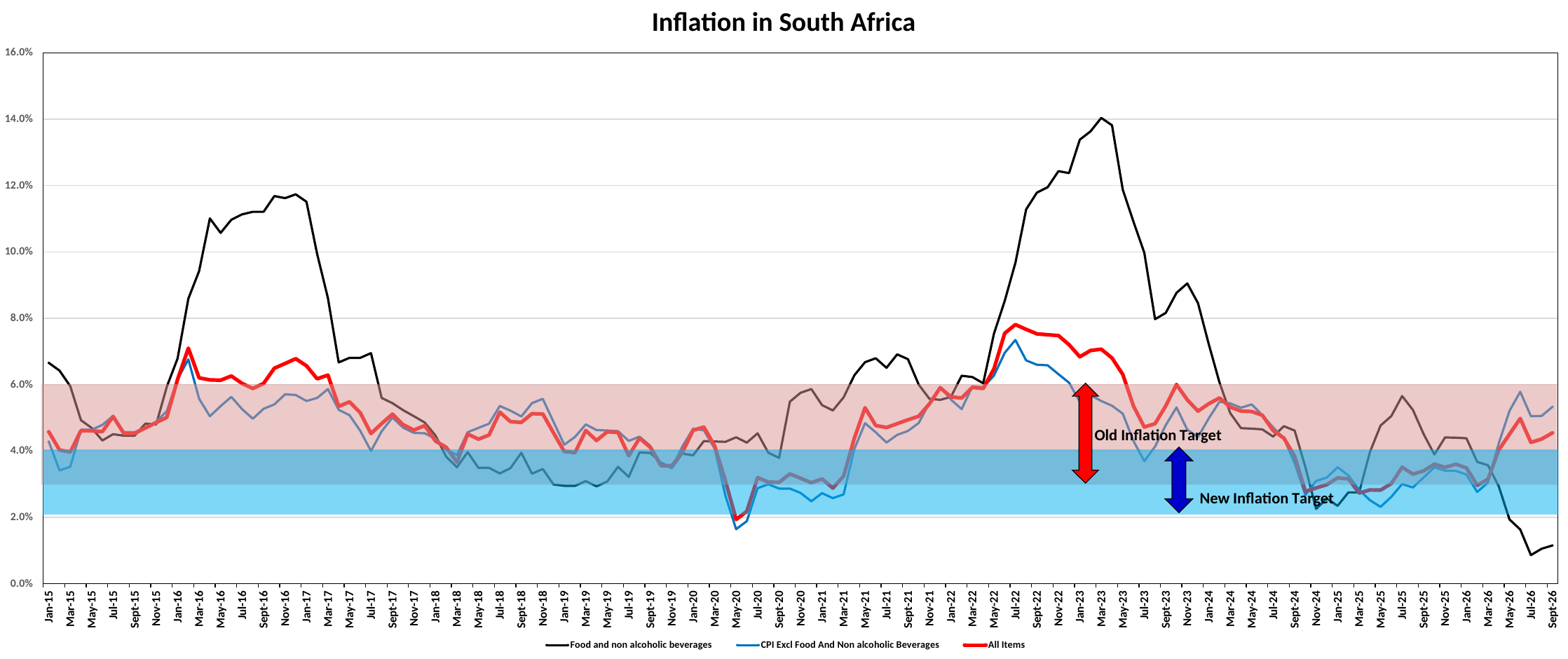
Line chart of South African inflation from January 2015 to September 2026, showing food and non-alcoholic beverages, CPI excluding food and non-alcoholic beverages, and all items, against the old 3–6% and new inflation target ranges.
Inflation in South Africa, January 2015 – September 2026

In September 2026, the Consumer Price Index (CPI) rose by 4.5% year on year. This was slightly higher than the 4.4% recorded in August, but below the market expectation of 4.7%. The main contributors to the increase were:

  • Housing and utilities: rose by 5.2%, contributing 1.5 percentage points.
  • Transport: rose by 10.8%, contributing 1.5 percentage points.
  • Insurance and financial services: rose by 5.4%, contributing 0.6 percentage points.

Goods inflation rose to 4.4% in September 2026, from 3.3% in August. Services inflation was 4.9%, up from 5.1% in August 2026.

Goods inflation has once again moved above the South African Reserve Bank’s (SARB’s) new target range of 2% to 4%. Services inflation also remains above the upper limit of 4%. This suggests that services are currently the main channel through which inflationary pressures are entering the economy.

Rising inflation continues to erode household purchasing power in South Africa. Interest rates and fuel prices have also yet to return to their levels before the Middle East conflict. As a result, many consumers and businesses are increasingly relying on short-term credit, leaving them vulnerable to changes in interest rates, exchange rates, global oil prices, and import costs. These factors place further pressure on domestic prices.

These vulnerabilities have been compounded by the ongoing Middle East conflict and significant fuel-price increases between April and May, followed by further increases from August to September as the conflict escalated. The latest escalation has pushed international oil prices higher, reducing the likelihood of fuel-price relief in the coming month.

After its January 2026 meeting, the Monetary Policy Committee (MPC) kept interest rates unchanged, taking the latest inflation data and economic forecasts into account. At the end of May, however, the MPC raised the policy rate by 25 basis points in response to the inflationary spike linked to the Middle East conflict and higher international oil prices in April and May.

At its July meeting, the Reserve Bank again held interest rates steady, contrary to market expectations. By then, financial markets had largely priced in a 25-basis-point increase. The MPC raised interest rates again in late August 2026. The decision dealt a further blow to consumers already struggling with higher fuel and product prices, particularly as the economy contracted by 0.2% in the second quarter of 2026.

High fuel and transport costs are expected to continue shaping inflation expectations, particularly after September’s 4.5% inflation reading, which remains above the top of the target range. The Bank’s cautious approach is intended to support price stability amid ongoing domestic and international uncertainty. This includes higher tariffs imposed by the United States on South African exports, which have affected the manufacturing sector, as reflected in second-quarter 2026 GDP data. Recent data on unemployment, mining, and manufacturing have also added to uncertainty about the economic outlook.

International oil prices rose during the latter part of September, while inflation came in slightly below market expectations. Together, these developments may encourage the SARB to keep interest rates unchanged at the next MPC meeting. Previous interest-rate cuts—in late 2024, during 2025, and again in November 2025—were intended to stimulate demand by increasing household disposable income after interest payments and to support economic growth. However, rising fuel prices and a tighter monetary-policy stance could limit the effect of these measures on economic activity.

Despite the 0.2% economic contraction in the second quarter of 2026, the Bank remains cautious amid persistent global uncertainty. Inflationary pressures, the US–China tariff dispute and the possibility of further tariffs on BRICS nations could all affect price stability. The Middle East conflict could also keep international oil prices elevated if safe shipping through the Strait of Hormuz cannot be assured and the conflict lasts longer than markets expect.

Future interest-rate decisions are likely to reflect a range of factors, including inflation relative to the new target range, weak economic growth, improvements in electricity supply, positive market sentiment and the effect of international tensions on oil prices.

Maintaining price stability and protecting the value of the rand remain key priorities for South Africa as the country navigates the rest of 2026 amid ongoing international developments and uncertainty.


More Coverage

What Hong Kong’s 24/7 Tokenised Deposit Pilot Means for South African Banking & Capital Markets. Today’s announcement by the Hong Kong Monetary Authority, launching live 24/7 interbank settlement of tokenised commercial bank deposits backed by central bank money, marks a pivotal transition away from speculative crypto debates toward true institutional financial convergence. In our latest market analysis, we unpack how uniting commercial bank balance sheets with programmable blockchain rails eliminates trapped working capital, cuts reconciliation friction, and resolves the structural limitations of conventional operating hours. Crucially for South Africa, we examine the practical opportunities this shift creates to modernise corporate treasury, deepen secondary liquidity for private credit, and solidify the Rand’s role as the primary settlement gateway for intra-African trade under the AfCFTA, while highlighting where domestic regulatory and payments infrastructure must now transition from sandbox trials to live wholesale deployment.
Despite Binance confirming that it has replenished or covered 95% of the $6.36 billion stolen in last week’s historic cyberattack, verified market data reveals that customers pulled an extraordinary $3.64 billion in net outflows (processing $4.65 billion in gross withdrawals against $1.01 billion in deposits) within hours of withdrawal rails reopening on Sunday, 1 November. In my latest opinion piece, “Binance Replaced the Billions. So Why Are Investors Still Leaving?”, I unpack the critical economic disconnect between balance-sheet solvency, operational liquidity, and investor confidence, demonstrating why corporate treasury bailouts and functioning redemption queues cannot cure the psychological erosion caused by breached custodial architecture. For South Africa’s financial institutions and regulators (SARB and FSCA), these events, compounded by Polymarket’s simultaneous third-party vendor compromise, serve as an urgent wake-up call: domestic fintechs lack multi-billion-dollar treasury buffers, making statutory bankruptcy-remote custody, continuous on-chain proof-of-reserves, and real-time public-private threat circuit breakers essential if South Africa is to turn institutional trust into its greatest competitive economic moat.
The unprecedented security shocks that struck global digital asset markets this week, most notably an estimated $6.36 billion drain across Binance wallets attributed to state-backed cyber syndicates and a client-side vendor intrusion at Polymarket, deliver a blunt reality check to the financial sector: base-layer blockchain mathematics did not fail, but platform custody, access controls, and outsourced third-party software did. In my latest opinion piece, “The Billion-Dollar Wake-Up Call: Why Digital Finance Must Put Security Before Innovation”, I examine why Silicon Valley’s rapid feature velocity has dangerously outrun institutional governance, and why ad hoc balance-sheet reimbursements cannot substitute for fiduciary resilience. For South Africa’s banking, fintech, and regulatory leaders, these breaches highlight the urgency of tightening software supply-chain audits, mandating distributed multi-party custody, and deploying real-time threat coordination, presenting a strategic opportunity for South Africa to leverage institutional trust and rigorous oversight as our primary competitive edge in attracting long-term global digital investment.
Producer price inflation accelerated to 6.2% in September 2026, as higher fuel and energy costs continued to ripple through the economy. Although some cost increases have eased, producer prices remain above the South African Reserve Bank’s new target range, adding to concerns about consumer inflation and the outlook for interest rates. Read the full report for a closer look at the main cost pressures across manufacturing, mining and agriculture—and what they could mean for South African households and businesses in the months ahead.
Credit demand in South Africa continued to grow in September 2026, but fell short of market expectations as households and businesses faced higher interest rates, rising living costs and persistently high debt levels. While mortgage advances and fixed-asset credit picked up, the property market’s recovery remains fragile, and consumers continue to rely on short-term borrowing to manage expenses. With inflation above the target range and energy and fuel costs adding to price pressures, the latest interest rate hike raises fresh questions about the outlook for credit and the wider economy. Read the full report for a closer look at the trends shaping borrowing across the country.