

A view on Demand in the Economy
Retail Sales Performance
October 2024

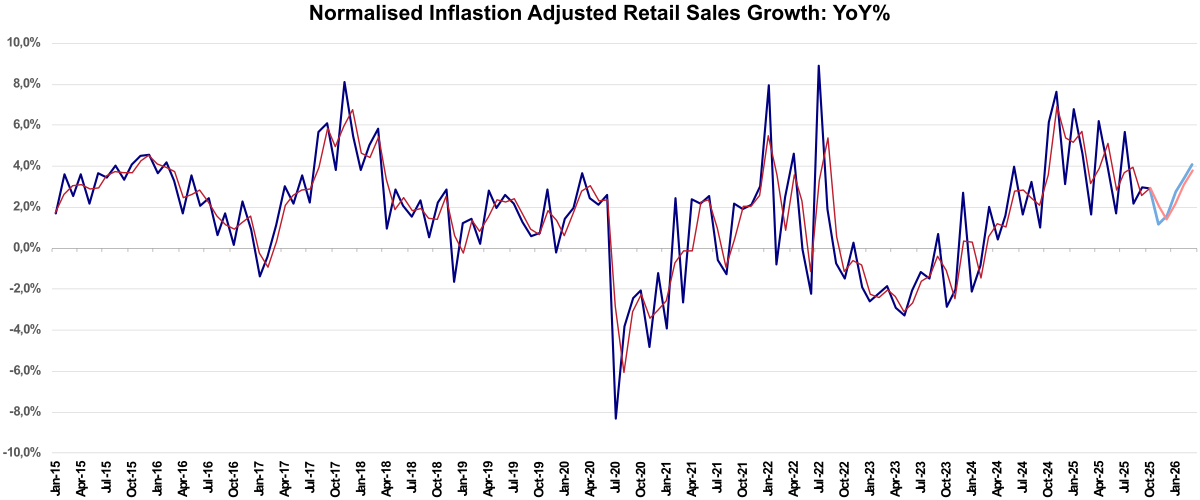
Despite this positive trend, households are navigating several challenges, including the rising cost of living reported by the South African Reserve Bank, sluggish wage growth due to limited economic expansion, and uncertainties concerning international trade relations with the United States. Ongoing diplomatic tensions between Washington and Pretoria, coupled with the lapse of the African Growth and Opportunity Act (AGOA) in September 2025, contribute to a cautious consumer spending environment.
October’s 2.9% increase reflects a continuous recovery trend from April to October, likely supported by interest rate cuts and monetary easing measures introduced from September 2024 to August 2025.
The South African Chamber of Commerce and Industry (SACCI) reported a slight uptick in business confidence, with its index rising from 121.1 in September to 123.8 in October 2025. However, the FNB/BER consumer confidence index dipped from -10 in the second quarter to -13 in the third quarter of 2025, highlighting consumers’ cautious spending approach. Although inflation remains low and the Reserve Bank lowered interest rates in January, July, and November 2025, these factors are gradually impacting consumer behaviour and spending.
September’s retail sales growth was driven by:
- Other retailers: up 7.2%, contributing 0.7 percentage points
- Retailers of textiles, clothing, footwear, and leather goods: up 5.8%, adding 1.0 percentage points
- Retailers of household furniture, appliances, and equipment: up 13.0%, adding 0.5 percentage points
- Retailers of hardware, paint, and glass: up 5.8%, adding 0.5 percentage points
October’s retail sales growth signals sustained momentum from July onwards, indicating a steady yet cautious recovery in consumer demand. Interest rate cuts between September 2024 and November 2025 have eased some financial pressures on households, supporting increased demand over the past four months and boosting recent retail sales figures. It is important to acknowledge that the impact of interest rate changes typically manifests within 12 to 24 months; therefore, current reductions are just beginning to yield results.
Sustaining this momentum is vital for the remainder of 2025, as consumer spending significantly contributes to South Africa’s economic growth and employment. This is particularly significant given the 0.5% GDP growth in the third quarter of 2025. The interest rate reduction in November 2025 is expected to further support consumer demand into late 2025 and early 2026.


