Copyright © Aluma Capital (Pty) Ltd. All rights reserved.
Aluma Capital (Pty) Ltd is a registered Financial Services Provider (FSP 46449) in terms of The Financial Advisory and Intermediary Services Act (37 of 2002)
July 22, 2026

Consumer Inflation – June 2026
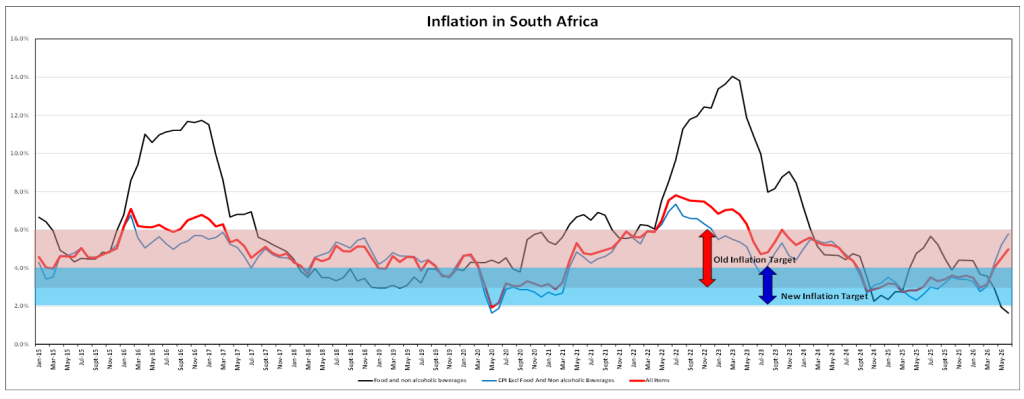
In June 2026, the Consumer Price Index (CPI) saw a significant increase of 5.0% year-on-year, overtaking May’s 4.5% rise and exceeding market predictions. The surge, driven by notable upticks in housing, utilities, transport, and financial services, signals a persistent inflationary trend that has once again breached the Reserve Bank’s upper target limit. This economic pressure is eroding household purchasing power in South Africa, exacerbated by enduring high interest rates and elevated fuel prices due to ongoing global conflicts. As businesses and consumers increasingly lean on short-term credit, they face heightened vulnerability to volatile interest rates, exchange rates, and import costs. This report delves into the multifaceted impact of these economic challenges, painting a vivid picture of South Africa’s current inflation dynamics and its implications for the future.

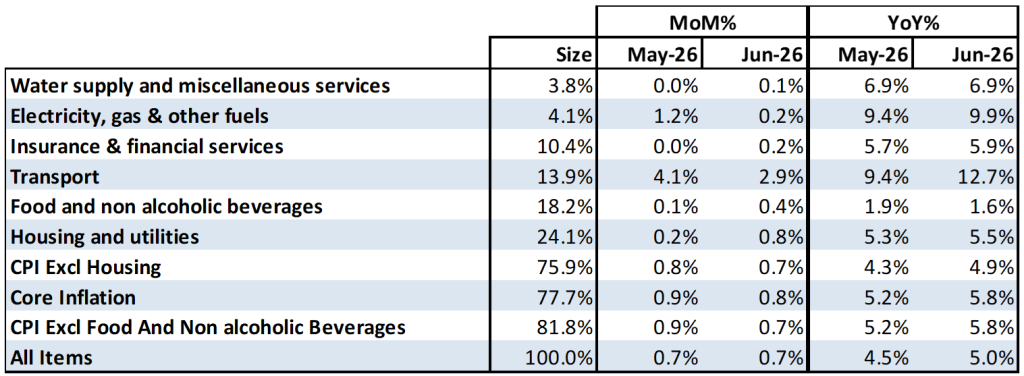
In June 2026, the Consumer Price Index (CPI) rose by 5.0% year-on-year, notably higher than the 4.5% increase recorded in May and above the market’s forecast of 4.7%. This uptick in consumer prices was mainly due to:

  • Housing and Utilities: Increased by 5.9%, contributing 1.3 percentage points.
  • Transport: Increased by 12.4%, also contributing 1.7 percentage points.
  • Insurance and Financial Services: Went up by 5.9%, adding 0.6 percentage points.

Compared to May, the year-on-year inflation rate for goods climbed from 4.4% to 4.8%. Meanwhile, services inflation rose notably from 4.7% to 5.2% in June. Notably, inflation for both goods and services has again surpassed the Reserve Bank’s upper limit of 4.0% within the new target range, which show that inflation is making its way into the economy via goods and services channels separately. This inflationary rise continues to erode household purchasing power in South Africa coupled with a higher interest rate and fuel prices which have not returned to levels pre-Middle East conflict levels. Consequently, many consumers and businesses rely more on short-term credit, making them vulnerable to changes in interest rates, exchange rates, global oil prices, and import costs, which in turn affect domestic prices. These vulnerabilities have been exacerbated by the ongoing conflict in the Middle East and the significant increase in fuel prices from April to May. The recent escalation in the ongoing conflict has seen international oil prices rise again, which doesn’t bode well for fuel price decreases in the coming month.  

Following the Monetary Policy Committee (MPC) meeting in January 2026, the Reserve Bank chose to keep interest rates unchanged after reviewing January inflation figures and forecasts. However, there was a 25 basis-point increase at the end-of-May meeting due to the inflation spike, which stems from the Middle East conflict and rising international oil prices observed in April and May. The elevated fuel and transport costs are anticipated to influence current inflation expectations going forward, especially in the 5.0% inflation recorded for June. The Bank’s cautious stance aims to maintain price stability amid ongoing economic and international uncertainties, including increased tariffs rates imposed by the US on South African exports, which have negatively impacted the manufacturing sector as reflected in the 2026Q1 GDP data. Such uncertainties could also affect the Rand’s value against the US dollar, with expected volatility, particularly with the potential peace deal between the US and Iran and the reopening of the Strait of Hormuz on the horizon.

Due to the increase in the international oil prices over the last week and increase in the inflation rate above market expectations might cause the South African Reserve Bank (SARB) to increase the Repo rate by another 25 basis points tomorrow to combat higher than expected inflation and to temper inflation expectations going forward. Prior interest rate cuts in late 2024, throughout 2025, and another in November 2025 were aimed at stimulating demand by increasing disposable income for households beyond interest payments, fostering economic growth. However, rising fuel prices and a tightening monetary policy stance may limit this growth potential.

Despite sustained economic growth of 0.5% in the first quarter of 2026, the Bank remains wary due to persistent global uncertainties. Factors such as inflation, the US-China tariff dispute, and the possibility of future tariffs on BRICS nations could affect price stability. Furthermore, the Middle East conflict may continue to keep international oil prices high if shipping safety cannot be assured through the Strait of Hormuz and the resumed conflict drag longer out than anticipated by the market. Future interest rate decisions will likely consider moderate inflation within the new target band, slow economic growth, improvements in electricity supply, some positive market sentiment, and international tensions impacting oil prices.

In conclusion, maintaining price stability and protecting the Rand’s value are top priorities for South Africa as it navigates the coming months of 2026, amid current international developments and associated uncertainties.


More Coverage

In June 2026, the Consumer Price Index (CPI) saw a significant increase of 5.0% year-on-year, overtaking May’s 4.5% rise and exceeding market predictions. The surge, driven by notable upticks in housing, utilities, transport, and financial services, signals a persistent inflationary trend that has once again breached the Reserve Bank’s upper target limit. This economic pressure is eroding household purchasing power in South Africa, exacerbated by enduring high interest rates and elevated fuel prices due to ongoing global conflicts. As businesses and consumers increasingly lean on short-term credit, they face heightened vulnerability to volatile interest rates, exchange rates, and import costs. This report delves into the multifaceted impact of these economic challenges, painting a vivid picture of South Africa’s current inflation dynamics and its implications for the future.
With inflation largely driven by global supply-side pressures rather than strong consumer demand, another SARB interest rate hike may do little to reduce price increases while placing additional strain on already financially stretched South African households. Although higher rates may help anchor inflation expectations and support the Rand, they risk slowing economic growth, increasing loan defaults, and further weakening consumer spending.
In May 2026 South Africa’s mining sector slipped into contraction, down 5.4% month on month after April’s revised 8.0% gain — driven by steep declines in iron ore ( 12.7), coal ( 6.1) and PGMs ( 4.4) that together shaved several percentage points off output; mining output for the rolling quarter fell 1.7%, led by drops in manganese, other metallics and coal. Yet nominal mining sales surged 13.9% on a 70.5% jump in platinum, stronger gold and coal receipts, underscoring a split between weaker physical production and firmer export earnings. With the sector employing roughly 476,000 people, having expanded in Q1 2026 amid higher gold and platinum prices, the industry remains central to South Africa’s economy, even as it grapples with new trade tariffs (including US and proposed manganese measures), the loss of AGOA preferences, and uncertainty around the Mining Charter. Read the full report for detailed drivers, regional implications, and policy paths to stabilise output and sustain foreign earnings resilience
In “South Africa’s Inflation Dilemma: Why Bleeding an Anaemic Patient Won’t Cure the Illness,” the article navigates the precarious economic landscape facing South Africa amidst rising inflation and stagnant growth. With consumer demand faltering due to slow wage growth, recent fuel price hikes, and increased municipal fees, the country stands at a critical junction. The looming threat of another interest rate hike by the South African Reserve Bank could further cripple an already fragile economy, likened to an anaemic patient, with potential long-term repercussions for job creation and corporate investment. However, recent geopolitical developments offer a flicker of hope, as a ceasefire in the US-Iran conflict has led to a decline in global oil prices, promising immediate relief for consumers and a slower inflation trajectory. The article argues that maintaining the current repo rate is essential to allow this relief to translate into economic growth and stability. Dive into the full report to explore how South Africa can navigate these turbulent waters without sacrificing its fragile economic health.
In a rapidly shifting economic landscape, May 2026 saw credit demand growth of 8.6%, falling short of the anticipated 9.4% forecast. Since interest rate cuts began in September 2024, credit growth has generally surged, particularly following strategic interest rate reductions by the South African Reserve Bank amidst global tensions and skyrocketing energy costs. However, the South African property market stagnates due to soaring consumer debts, muted wage increases, and escalating living expenses, notably in household fuel and utility prices. While instalment credit sales posted a modest rise, the reliance on short-term credit underscores consumer struggles with surging living costs. With inflation hovering above target and persistent high fuel prices, the anticipated interest rate hike in July could further suppress demand, adding pressure to the already challenging economic recovery. Discover the dynamics shaping South Africa’s financial climate in this insightful analysis.