

Squeezing a Stone: Why the SARB’s Blunt-Force Rate Hike Threat Misses the Mark for Squeezed Consumers
The South African Reserve Bank (SARB) is facing an intense debate as its Monetary Policy Committee (MPC) prepares for its next interest rate decision on 23 July 2026.
With the Rand showing signs of vulnerability at R16.45/$, Producer Price Inflation (PPI) climbing to 7.8%, and Consumer Price Inflation (CPI) ticking up to 4.5%, market expectations are heavily leaning toward another 25-basis-point hike to the repo rate, which currently sits at 7.00% (10.50% Prime).
Yet, for news-oriented and investment-driven market participants, the burning question is not whether they will do it, but rather: Is this the right economic medicine, or are we simply trying to squeeze blood from a stone?
The Blunt Instrument vs. The Structural Sickness
The fundamental critique of further monetary tightening in South Africa lies in the nature of our current inflation. Interest rate hikes are designed to combat demand-pull inflation, when an economy is growing too quickly, and excess cash is chasing too few goods.
However, South Africa is suffering from a textbook case of cost-push inflation, driven by factors entirely outside the SARB’s sphere of influence:
- Geopolitical Oil Spikes: The recent escalation in the Middle East has kept Brent Crude highly volatile. No amount of domestic rate hikes can alter OPEC supply policies or secure shipping corridors.
- Factory-Gate Pressures: The 7.8% PPI print shows that input costs are rising long before goods reach retail shelves. Squeezing consumer liquidity does not lower the cost of raw materials or industrial chemicals on global markets.
- The Diesel Under-Recovery Threat: While temporary petrol over-recoveries offered a brief respite, massive daily under-recoveries in diesel (~R1.90/l) signal that structural transport and logistics costs are set to remain elevated, adding a persistent tax on local business operations.
A Middle Class Running on Empty
Draining further liquidity from the domestic system is highly problematic given the health of the average South African consumer.
The latest TransUnion Q2 2026 Consumer Pulse Study paints a stark picture of the domestic credit climate:

These metrics tell us that the domestic savings buffer has been completely decimated. Draining more liquidity from households that are already running on empty will not stop them from driving to work or buying food. It will simply increase the rate of non-performing loans, erode banking book quality, and severely stall South Africa’s fragile GDP growth trajectory.
The Governor’s Dilemma: Controlling the Uncontrollable
If a rate hike is so economically destructive to the local consumer, why is Governor Lesetja Kganyago still widely expected to pull the trigger? The answer lies in the narrow, rigid mandate of inflation targeting.
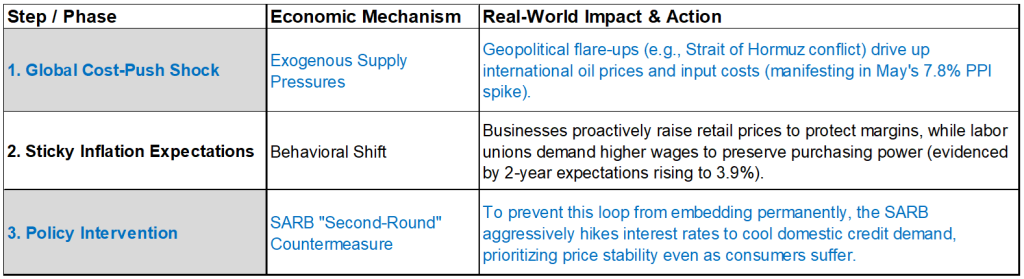
The SARB Hikes Rates to “Break” this Expectation Loop
While the SARB knows it cannot print oil, it is deeply concerned about second-round inflation expectations. According to the latest Bureau for Economic Research (BER) survey, two-year-ahead inflation expectations have risen to 3.9%.
If local businesses and labour unions begin pricing in a permanent 4% to 5% inflation baseline, high prices will become structurally embedded in the economy. By raising rates, the central bank is effectively trying to shock local “price-setters” into keeping their prices low, even if it means triggering a domestic slowdown.
Ultimately, while the SARB’s hawkishness aims to protect the Rand and anchor long-term expectations, it is a blunt tool for a delicate job. Squeezing a dry consumer is a high-risk policy path that will test the resilience of South African investments in the second half of 2026.


