July 30, 2026

Private Sector Credit Extension (PSCE): June 2026
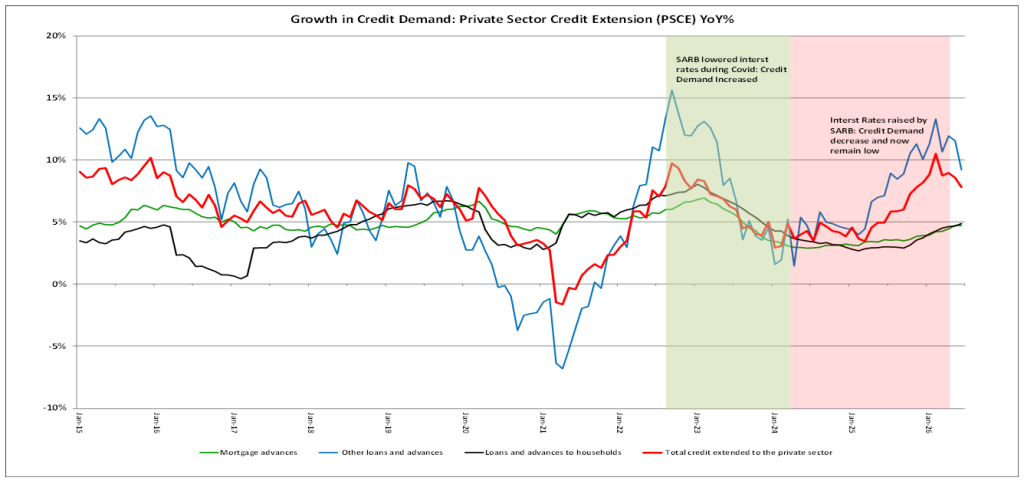

Explore the intricate dynamics of South Africa’s financial landscape in June 2026, where credit demand rose by 8.6%, falling short of market expectations, yet reflecting the broader impact of interest rate cuts since September 2024. This detailed examination reveals the interplay of mortgage stability amidst a sluggish property market, fuelled by high consumer debt and soaring living costs, particularly in energy. As instalment credit sales and short-term credit reliance mark notable shifts, delve into the potential for further interest rate hikes amidst persistent inflation and global energy challenges, informing strategic decisions in an uncertain economic climate. Discover the comprehensive insights and future implications in the full report.

In June 2026, credit demand grew by 8.6%, notably below the market’s expectation of 9.1%. Since interest rate cuts began in September 2024, overall credit growth has accelerated, with most subcategories experiencing increases, especially following the South African Reserve Bank’s decision to lower interest rates before the start of the conflict in the Middle East and subsequent increase in global energy costs and higher fuel prices.

Mortgage advances and credit for acquiring fixed assets remain unchanged at 4.7% from the previous month. The South African property market remains sluggish, reflecting low capital expenditure from both households and businesses. This sector’s recovery remains slow due to high consumer debt levels, low wage growth, and rising living costs, especially household fuel expenditure due to high international oil prices, as well as high administered prices such as water, electricity, and municipal rates & taxes.

In June, instalment credit sales increased by only 0.6% following the 1.0% from the previous month, marking an annual growth of 9.1%. Over the past two years, consumers have remained increasingly dependent on short-term credit to manage rising living costs, as shown by a 9.2% increase in other loans and advances, notably down from 11.5% in the May 2026 figures due to the higher interest these loans carry after the interest rate increase the previous month.

With inflation above the target range and fuel prices remaining elevated despite a recent slight dip, energy costs continue to put upward pressure. As a result, the SARB may hike interest rates again in the course of 2026 if inflation expectations persist above the upper threshold of the new target range of 4.0%.


More Coverage

Pretoria’s newly announced 15% irrigation allocation cut across the Western Cape Water Supply System, more than double the 7% reduction applied to domestic and industrial users, signals a structural shift in South African agricultural risk that goes far beyond impending El Niño weather forecasts. In our latest research briefing, “South Africa’s Next Agricultural Crisis May Not Be About Rainfall — But Who Gets the Water,” we examine how asymmetric water rationing compounds existing export margin compression, impending January 2027 AGOA tariff headwinds, and R200+ billion in sector debt to create a two-tier repricing of Western Cape farmland and renewed 2027 food inflation pressures. Crucially, just as Eskom tariff shocks catalysed on-farm solar microgrids, this policy shift marks the emergence of private water-security infrastructure, “Water-as-a-Service,” off-scheme balancing dams, high-density cultivar conversions, and downstream cold-chain assets, as one of the most compelling risk-adjusted investment frontiers in South African agribusiness today
Why Another SARB Rate Hike Risks Hurting South Africa’s Fragile Recovery With South Africa’s economy still reeling from a 0.2% second-quarter GDP contraction, rising unemployment at 33.7%, and sharp September production declines in both manufacturing (-3.5%) and mining (-10.7%), another anticipated 25-basis-point interest rate hike by the South African Reserve Bank this Thursday threatens to administer the wrong medicine to an already strained economy. While headline inflation is projected to tick up from 4.5% to 4.7% in October, this pressure is driven by external supply shocks beyond the SARB’s control, specifically elevated Brent crude oil prices amid ongoing Middle East conflict and Rand volatility, rather than overheating domestic demand, as reflected in slowing retail sales, weaker private credit growth, and PPC’s interim results showing the cement maker generating higher operating profits in Zimbabwe than in South Africa and Botswana combined. Tightening domestic liquidity further will not lower global fuel or shipping costs, but will instead raise working capital expenses for distressed businesses and squeeze household cash flows, making a hold at 7.25% the most prudent course for the Monetary Policy Committee this week.
When AI Starts Moving Your Money, Who Is Actually in Control? Following US Federal Reserve Governor Michael Barr’s stark warning today about the systemic risks posed by autonomous AI agents in finance, the latest article — “When AI Starts Moving Your Money, Who Is Actually in Control?” — examines what this shift from advisory chatbots to self-directed financial software means for South Africa. While instant payment rails like PayShap and AI-driven fintechs are expanding financial inclusion, removing transactional friction also introduces a “velocity paradox,” where autonomous yield-seeking agents could accelerate deposit flight, amplify cyber and vendor-concentration risks, and test consumer trust if algorithmic decisions go wrong. As regulators advance the Conduct of Financial Institutions (COFI) Bill and Open Finance frameworks, the institutions and investors that thrive will be those pairing intelligent automation with transparent governance, clear liability rules, and robust human-in-the-loop safeguards.
While headline figures released today by the Citrus Growers’ Association show a seemingly modest 1.5% decline in South Africa’s 2026 citrus exports, settling at 201 million actual cartons compared to 204 million in 2025 and 4% below initial pre-season estimates, commercial growers and agricultural investors are absorbing a far steeper financial blow beneath the surface. Conflict-driven shipping disruptions to the Middle East (which typically absorbs 20% of South African citrus exports), severe flooding across Western and Eastern Cape orchards, and looming tariff pressures following South Africa’s AGOA exclusion have sharply inflated logistics costs and stretched working capital cycles. Our latest commentary examines how these pressures are compressing farm-gate margins, why agribusiness investors must rethink capital allocation ahead of projected export volume growth, and four practical financial strategies growers can deploy to build resilience against global shocks beyond their control.
South Africa’s manufacturing sector is sending mixed signals: output fell more sharply than expected in September, while the PMI edged higher but remained below the level that signals confidence. The latest figures reveal which industries drove the decline, how quarterly sales and employment moved in the opposite direction, and why manufacturers remain cautious amid US tariffs and shrinking export access. With manufacturing supporting millions of livelihoods and a significant share of the economy, the full report unpacks what these trends could mean for growth, jobs and business resilience.