Copyright © Aluma Capital (Pty) Ltd. All rights reserved.
Aluma Capital (Pty) Ltd is a registered Financial Services Provider (FSP 46449) in terms of The Financial Advisory and Intermediary Services Act (37 of 2002)
August 14, 2026

Mining Production and Sales for June 2026
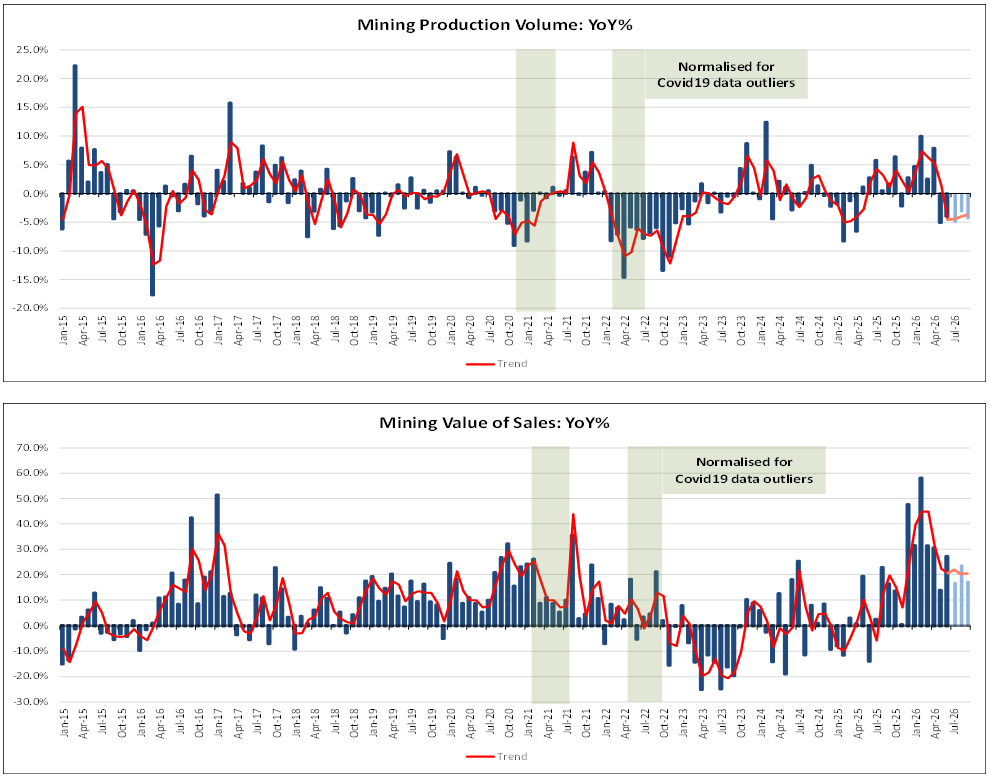
South Africa’s mining sector faced renewed pressure in June 2026, with production declining 4.0% amid sharp contractions in iron ore, coal and platinum-group metals, while second-quarter output fell 2.7% as manganese, PGMs, gold and iron ore all weakened. Yet soaring commodity prices, particularly for gold, platinum and chromium, drove a 27.2% increase in nominal mining sales, highlighting the sector’s resilience and continued importance as a source of employment, foreign exchange and economic growth. Against this mixed backdrop, the report examines the industry’s mounting challenges, including job losses, proposed export and import tariffs, the loss of AGOA benefits, uncertainty surrounding the Mining Charter, rising energy costs and geopolitical tensions affecting global trade and shipping. It also considers whether temporary tariff exemptions for key steelmaking minerals can provide much-needed relief to an industry navigating an increasingly volatile global economy.

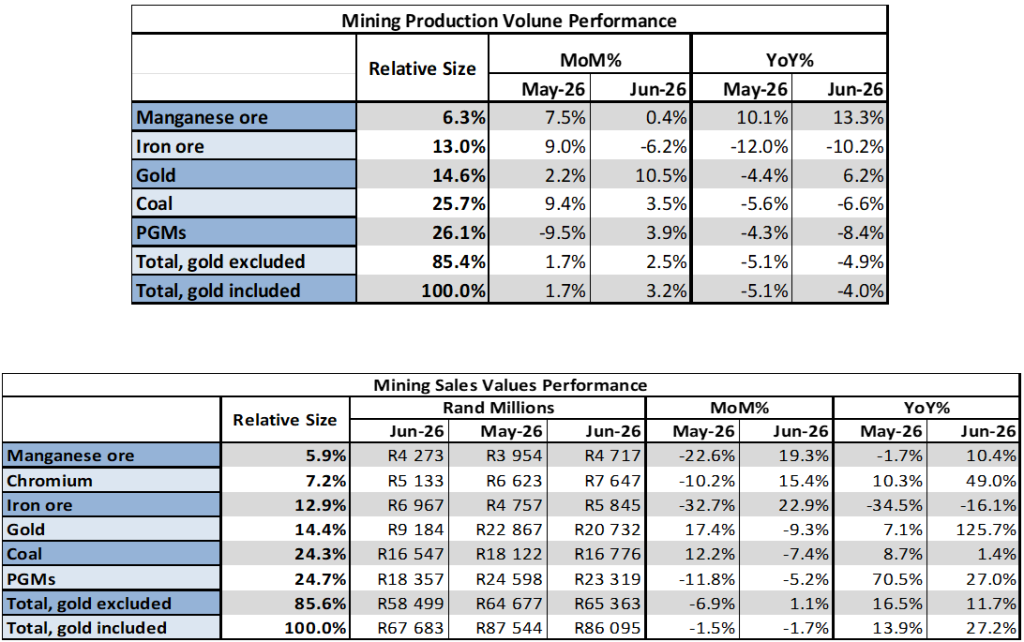
In June 2026, South Africa’s mining activity contracted by 4.0% following the revised 5.1% decrease recorded in May 2026. This contraction was predominantly driven by:

  • A 10.2% decrease in Iron ore mining production, which contributed -1.5 percentage points to the overall mining output for the month.
  • Coal production decreased by 6.6%% during June, while it subtracted 1.7 percentage points from mining production growth and
  • A 8.4% contraction in PGM production, which stripped an additional 2.4 percentage points from total mining output growth for the month.

For the 2nd quarter of 2026, compared with the previous quarter, seasonally adjusted mining output decreased by 2.7%. This decrease was primarily due to:

  • A 5.3% decrease in manganese mining, which decreased total mining production by 0.4 percentage points,
  • A decrease in mining of PGMs, which contracted by 6.4% and subtracted 1.8 percentage points for the quarter under review,
  • Gold mining, which declined by 3.2% and subtracted an additional 0.3 percentage points from mining output for the quarter and,
  • A decrease in Iron ore mining, which contracted by 2.0% and subtracted 0.3 percentage points for the 2nd quarter.

In June, nominal mining sales rose 27.2%. This positive trend was notably supported by:

  • A 27.0% surge in platinum sales, which added 7.3 percentage points to overall mining sales growth.
  • Another 125.7% rise in gold sales, contributing 17.1 percentage points and
  • Chromium ore sales, which grew by 49.0% and added another 3.7 percentage points towards overall mining sales growth for May 2026.

The mining sector remains vital to South Africa’s economy, generating foreign exchange and employing approximately 450,000 people, an decrease of around 26,000 from the previous quarter, according to StatsSA labour statistics for the second quarter of 2026. According to the latest GDP data, the mining sector grew by 5.7% during the first quarter of 2026, driven by a notable increase in global gold and platinum prices due to the ongoing conflict in the Middle East and the subsequent flight to safe-haven assets such as gold. This sector remains crucial for the South African economy due to the number of people employed within it and in associated auxiliary businesses, and its importance in earning foreign reserves.

However, challenges persist, including concerns over exports to the US following new tariff measures introduced on 7 August, proposed export tariffs on manganese, and import tariffs on steel exports to the Eurozone. The sector also faces challenges related to the loss of AGOA benefits in September and ongoing issues with the new Mining Charter.

Internationally, continued tensions between the US and China are rising, primarily due to trade disputes and tariff wars. These issues are further complicated by the ongoing conflict in the Middle East, particularly between the US, Israel, and Iran, as well as transit challenges for ships navigating through the Strait of Hormuz. This situation continues to keep international oil prices above the 80$ per barrel of oil, which ultimately drives up costs for South Africa’s manufacturing and mining sectors in the short- to medium-term, at least.

These geopolitical challenges and the conflict in the Middle East are disrupting global markets and limiting trade, as evidenced by data released since the conflict began. However, there is some good news: certain mining materials essential to steelmaking remain temporarily exempt from high US tariffs. This exemption offers some relief to the mining sector, which is vital to South Africa’s economy, providing jobs and foreign exchange and supporting overall growth.


More Coverage

South Africa’s international liquidity position reveals a complex economic landscape shaped by global geopolitical tensions, commodity price dynamics, and evolving trade relationships. While Net Gold and Foreign Exchange Reserves showed modest growth in July 2026, buoyed by historically elevated gold prices and strategic central bank interventions, underlying pressures, including Middle East conflict-driven fuel costs, currency volatility, and shifting US trade policies, threaten inflation stability and monetary policy decisions in the months ahead. This comprehensive analysis examines how commodity trends, Reserve Bank operations, and international developments are converging to shape South Africa’s economic trajectory, offering critical insights into what investors, policymakers, and businesses should monitor as the country navigates tariff uncertainties, geopolitical risks, and the critical third-quarter interest rate decisions that could define economic performance for the remainder of 2026.
South Africa’s manufacturing sector came under renewed pressure in June 2026, with production declining by 1.7% following strong growth in May. The contraction was driven mainly by weaker output in food and beverages, wood products, and motor vehicles and transport equipment. Manufacturing production also fell by 1.5% in the second quarter, with seven of ten sectors recording declines. Despite subdued production, manufacturing sales increased by 0.6% during the quarter, supported by stronger sales in chemicals, petroleum, rubber and plastics, as well as motor vehicles. However, declining employment and a PMI below the 50-point threshold highlight growing caution among manufacturers. Ongoing US trade tariffs and diplomatic tensions are adding further pressure, while businesses continue to maintain high cash reserves as they navigate domestic and global economic uncertainty.
South Africa’s latest employment figures highlight the continued fragility of the country’s labour market, with unemployment rising and overall employment edging lower in the second quarter of 2026. While some sectors recorded modest gains, significant job losses in manufacturing and mining, alongside weaker employment in key provinces, point to persistent structural and economic pressures. Against a backdrop of global trade tensions, geopolitical uncertainty and questions surrounding future access to key export markets, the latest data underscores the challenges facing South Africa’s economic growth and job-creation prospects.
South Africa’s Expropriation Act sits at the intersection of constitutional rights, economic confidence, and the country’s long-term growth prospects. While intended to address the complex legacy of land dispossession and advance the public interest, the Act has raised significant questions about the scope of state power, the protection of property rights, and the potential economic consequences of uncertainty. This article examines the legislation through both a legal and economic lens, considering how its provisions may affect investor confidence, capital formation, access to credit, key productive sectors, and South Africa’s international trade relationships. At its core is a fundamental question: how can South Africa pursue meaningful transformation while preserving the certainty and property rights necessary for a growing, inclusive economy?
Explore the intricate dynamics of South Africa’s financial landscape in June 2026, where credit demand rose by 8.6%, falling short of market expectations, yet reflecting the broader impact of interest rate cuts since September 2024. This detailed examination reveals the interplay of mortgage stability amidst a sluggish property market, fuelled by high consumer debt and soaring living costs, particularly in energy. As instalment credit sales and short-term credit reliance mark notable shifts, delve into the potential for further interest rate hikes amidst persistent inflation and global energy challenges, informing strategic decisions in an uncertain economic climate. Discover the comprehensive insights and future implications in the full report.