

Producer Price Inflation – July 2026
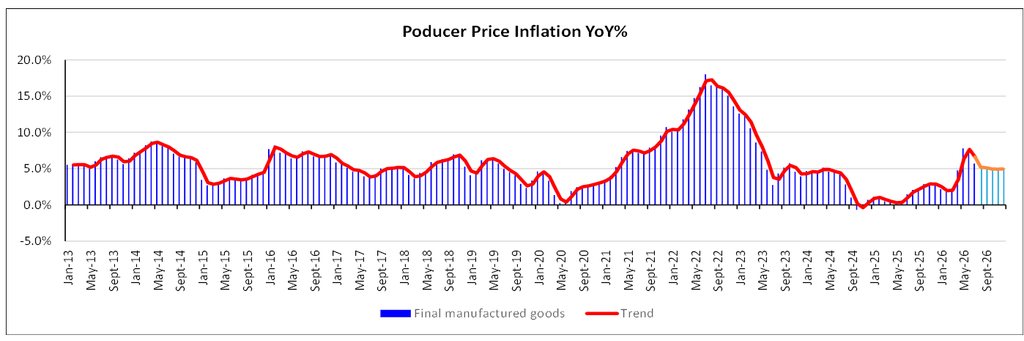
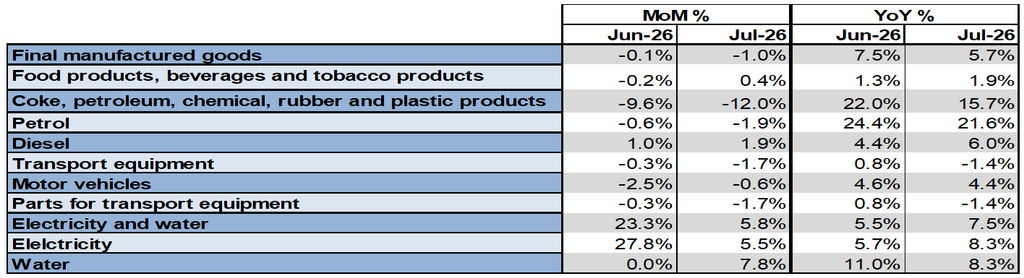
In July 2026, producer price inflation increased by 5.7% year-on-year, down from 7.5% in June, as fuel price shocks trickled through the economy into the prices of goods leaving the factory gate. However, producer inflation decreased by 1.0% monthly during July, while the annual increase was mostly due to cost increases in the following categories:
- Coke, petroleum, chemical, rubber and plastic products: Increased by 15.7% and contributed 3.4 percentage points,
- Food and Beverage Production: Increased by 1.9% and contributed 0.6 percentage points,
- Metals, machinery, equipment and computing equipment: Rose by 3.8% year-on-year while contributing 0.6 of a percentage point.
Production costs for intermediate goods rose by another 9.8% following the 12.4% in June 2026. This indicates that a clear inflationary trend is still ongoing, even though the pace of escalation is slowing a bit. These increases still greatly exceed the South African Reserve Bank’s (SARB) new inflation target range of 2% to 4%. Annual growth is still significantly influenced by increases in fuel and energy prices resulting from the conflict in the Middle East and the subsequent closure of the Strait of Hormuz.
In the primary sector, mining costs climbed by 9.6% in July, following a 18.4% rise in June. In contrast, the agriculture sector experienced a further 4.5% decline, following a 7.9% decrease the previous month.
Overall, the trend in producer price inflation remains above the SARB’s upper target, albeit at a slower rate of escalation in producer prices for final manufactured goods, and this does not bode well for general consumer inflation and inflation expectations in South Africa in the short to medium term. Consumer inflation still exceeds the upper band of the new target range, at 4.3% in July. While prices for certain intermediate goods—particularly water and electricity—continue to exceed the target range, current figures suggest consumer inflation will likely remain elevated in the short- to medium-term, as energy price shocks continue to reverberate throughout the economy.
The Reserve Bank’s upcoming interest rate decision will consider both the Consumer Price Index (CPI) and the Producer Price Index (PPI) when analysing inflation expectations, as price stability remains the key concern for the Bank in making interest rate decisions for South Africa.


