Copyright © Aluma Capital (Pty) Ltd. All rights reserved.
Aluma Capital (Pty) Ltd is a registered Financial Services Provider (FSP 46449) in terms of The Financial Advisory and Intermediary Services Act (37 of 2002)
August 31, 2026

Private Sector Credit Extension (PSCE): July 2026
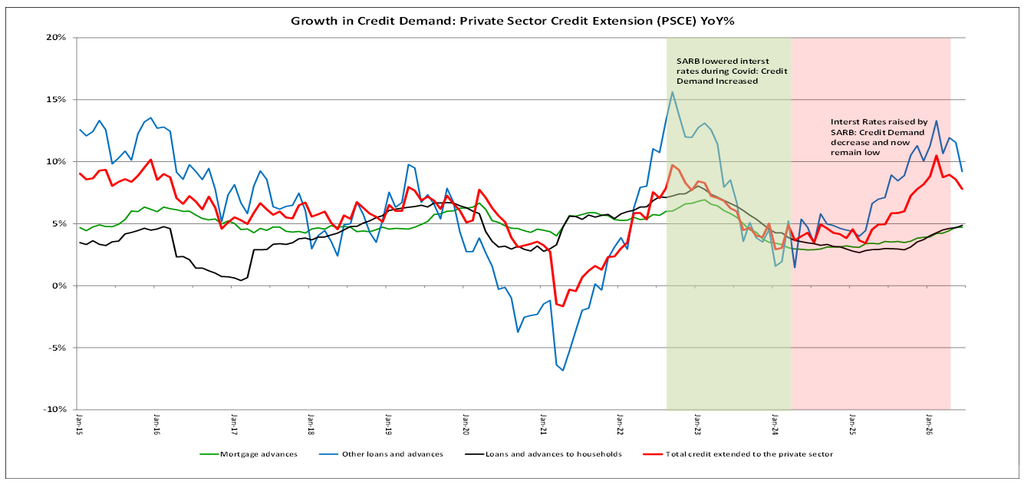

Private sector credit growth remained resilient in July 2026, reflecting continued demand for financing despite elevated living costs and renewed interest rate uncertainty. While overall credit extension continues to benefit from the rate-cutting cycle that began in late 2024, subdued property activity and rising household reliance on short-term credit highlight ongoing pressure on consumers and businesses.

In July 2026, credit demand grew by 7.4%, in line with market expectations. Since interest rate cuts began in September 2024, overall credit growth has accelerated, with most subcategories experiencing increases, especially following the South African Reserve Bank’s decision to lower interest rates before the start of the conflict in the Middle East and subsequent increase in global energy costs and higher fuel prices.

Mortgage advances and credit for acquiring fixed assets increased slightly, to 5.2% in July, following a 4.7% increase in June. Growth in the South African property market remains slow, reflecting low capital expenditure from both households and businesses. This sector’s recovery remains slow due to high consumer debt levels, slow wage growth, and high living costs, especially household fuel expenditure due to high international oil prices, as well as high administered prices such as water, electricity, and municipal rates & taxes.

In July, instalment credit sales increased by only 0.6%, following a 0.6% increase the previous month, marking annual growth of 9.0%. Over the past two years, consumers have remained increasingly dependent on short-term credit to manage rising living costs, as shown by an 8.8% increase in other loans and advances, notably down from 11.5% in the May 2026 figures due to the higher interest these loans carry after the interest rate increase the previous month.

With inflation still above the target range and fuel prices remaining elevated despite a recent slight dip, energy costs continue to put upward pressure. As a result, the SARB may hike interest rates again in September 2026 if inflation expectations remain above the upper threshold of the new target range of 4.0% in the short- to medium term.


More Coverage

South Africa’s producer price inflation eased from 7.5% to 5.7% year-on-year in July 2026, but the slowdown offers little comfort as rising fuel, energy and intermediate-goods costs continue to reverberate through the economy. With petroleum-related products driving much of the increase, mining costs still elevated, and consumer inflation already above the South African Reserve Bank’s new target range, inflationary pressures remain firmly entrenched, even as monthly producer prices declined. This report examines the sectors driving the latest figures, the implications of ongoing Middle East-related energy shocks, and what the data could mean for consumer prices, inflation expectations, and the Reserve Bank’s upcoming interest-rate decision in September.
South Africa has received a much-needed inflation reprieve, with July headline inflation easing to 4.3% and giving the South African Reserve Bank room to hold interest rates steady, but monetary relief alone cannot rescue an economy facing contracting mining and manufacturing sectors, depressed investment, mass unemployment, and mounting pressure on export earnings. This report examines how a 12.5% US tariff and a 56% annualised plunge in exports are intensifying the country’s economic vulnerability, while diplomatic disputes over property rights, empowerment policy, rural safety, political rhetoric, and South Africa’s geopolitical alliances threaten access to the strategically vital US market. It also sets out the practical policy choices, from structural reform and infrastructure investment to pragmatic trade diplomacy, that could determine whether South Africa converts this brief moment of inflation stability into sustainable growth or slips deeper into stagnation
South Africa’s July 2026 inflation reading delivered a genuine surprise: consumer prices rose just 4.3% year-on-year, well below June’s 5.0% and under the 4.5% the market had pencilled in, yet the story beneath that headline is far more complicated than a simple cooling trend. Goods inflation has slipped into the SARB’s new 2–4% target band, but services inflation stubbornly holds at 5.0%, revealing that price pressure is now entering the economy through a channel monetary policy struggles to reach. Meanwhile, housing, transport, and financial services drove the bulk of the increase; fuel costs remain elevated amid the renewed Middle East conflict and rising oil prices; and households and businesses relying on short-term credit are dangerously exposed to any shift in rates, the rand, or import costs. Add US tariffs weighing on manufacturing, fragile 0.5% first-quarter growth, and a Reserve Bank that has already wrong-footed markets twice this year, and the run-up to the 23 September MPC meeting becomes anything but predictable. This report unpacks what the numbers actually signal, why the SARB is holding its nerve, and what it will take to tip the next rate decision either way.
South Africa’s mining sector faced renewed pressure in June 2026, with production declining 4.0% amid sharp contractions in iron ore, coal and platinum-group metals, while second-quarter output fell 2.7% as manganese, PGMs, gold and iron ore all weakened. Yet soaring commodity prices, particularly for gold, platinum and chromium, drove a 27.2% increase in nominal mining sales, highlighting the sector’s resilience and continued importance as a source of employment, foreign exchange and economic growth. Against this mixed backdrop, the report examines the industry’s mounting challenges, including job losses, proposed export and import tariffs, the loss of AGOA benefits, uncertainty surrounding the Mining Charter, rising energy costs and geopolitical tensions affecting global trade and shipping. It also considers whether temporary tariff exemptions for key steelmaking minerals can provide much-needed relief to an industry navigating an increasingly volatile global economy.
South Africa’s international liquidity position reveals a complex economic landscape shaped by global geopolitical tensions, commodity price dynamics, and evolving trade relationships. While Net Gold and Foreign Exchange Reserves showed modest growth in July 2026, buoyed by historically elevated gold prices and strategic central bank interventions, underlying pressures, including Middle East conflict-driven fuel costs, currency volatility, and shifting US trade policies, threaten inflation stability and monetary policy decisions in the months ahead. This comprehensive analysis examines how commodity trends, Reserve Bank operations, and international developments are converging to shape South Africa’s economic trajectory, offering critical insights into what investors, policymakers, and businesses should monitor as the country navigates tariff uncertainties, geopolitical risks, and the critical third-quarter interest rate decisions that could define economic performance for the remainder of 2026.