Copyright © Aluma Capital (Pty) Ltd. All rights reserved.
Aluma Capital (Pty) Ltd is a registered Financial Services Provider (FSP 46449) in terms of The Financial Advisory and Intermediary Services Act (37 of 2002)
May 14, 2025

Employment Statistics in South Africa

Q1 2025
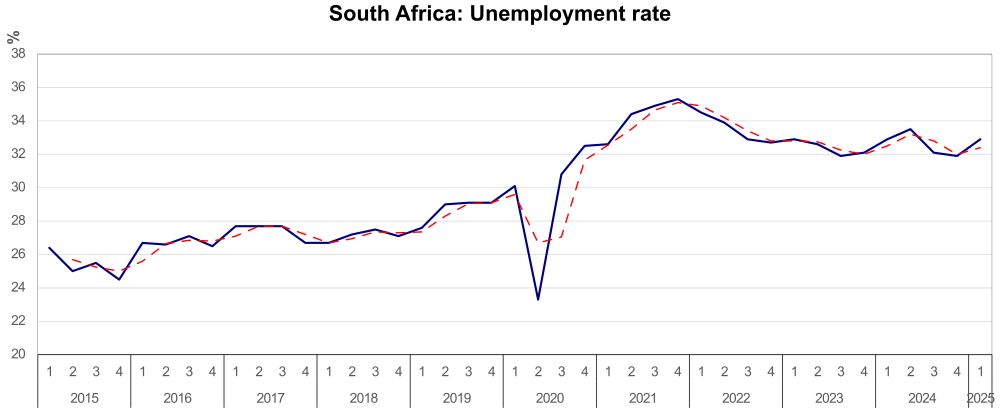
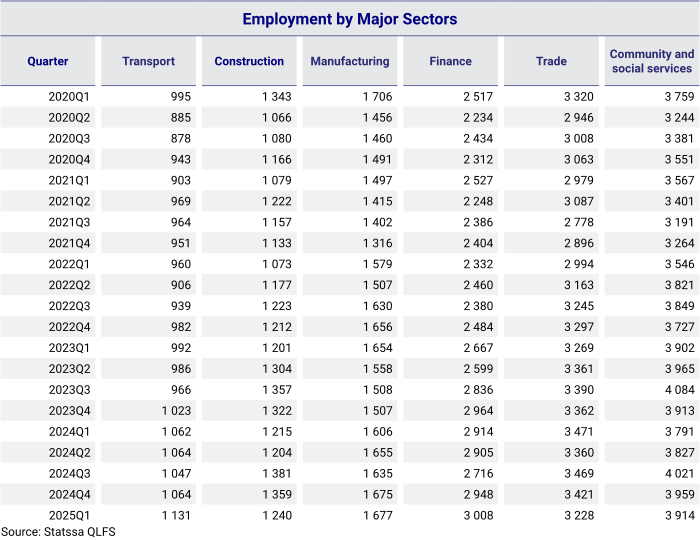
The employment statistics for the first quarter of 2025 present a mixed picture across different sectors, as detailed in the table above. Some sectors experienced increased employment compared to the fourth quarter of 2024, while others saw a decline in job opportunities during this period. Overall, the unemployment rate edged higher from 31.9% in the previous quarter to 32.9% in Q1 2025. Meanwhile, the expanded unemployment rate decreased slightly from 41.1% to 40.3% during the same timeframe.

In South Africa, formal non-agricultural employment declined by 291,000, dropping from 17.1 million in the fourth quarter to 16.8 million in Q1 2025. Conversely, the number of unemployed individuals increased by 237,000, stabilizing around 8.2 million. The working-age population grew by approximately 532,000 in the first quarter, representing an increase of about 1.3%.

Unemployment rates rose in six of the nine provinces, although Gauteng (+9,000), Western Cape (+49,000), and the Free State (+4,000) experienced employment increases. Decreases were observed in sectors such as Trade, Community and Social Services, Construction, Mining, and Manufacturing. Conversely, employment grew in the Transport, Finance, and Utility sectors. Notably, the informal sector added 17,000 jobs.

Overall, these employment figures are somewhat discouraging, with the unemployment rate surpassing the consensus forecast of 32.4% for Q1 2025. This slowdown can be attributed to ongoing international uncertainties, including the US tariff war against China and other nations, as well as concerns regarding the future of the AGOA agreement beyond September 2025. Diplomatic tensions between Washington and Pretoria related to various issues have also weighed on economic confidence. Consequently, many businesses appear to have adopted a cautious “wait-and-see” approach regarding expansion and hiring in the short term. However, the recent 90-day suspension of the US-China tariff war could positively influence both local and global markets, potentially boosting employment figures in the upcoming quarters.


More Coverage

A sudden global shift has delivered much-needed relief for South Africa. Following a Middle East ceasefire, oil prices have dropped sharply and the Rand has strengthened—easing pressure on fuel costs and inflation. While earlier price spikes still weigh on the outlook, this combined correction offers a critical window for economic stability, improved consumer confidence, and renewed growth momentum.
South Africa finds itself balancing global energy shocks with decisive local action. As rising oil prices threaten to strain consumers and key industries, government intervention has softened the immediate impact—highlighting both the urgency of the moment and the need for smarter, more resilient fiscal tools to manage future volatility.
The South African Reserve Bank has opted for a “hawkish hold,” maintaining the repo rate at 6.75% despite headline inflation hitting a milestone low of 3.0%. Governor Lesetja Kganyago emphasised that while the inflation target has been met, the MPC remains wary of a potential “energy tax” on the economy, driven by global oil prices surging above $100 per barrel. Consequently, the Bank has adopted a cautious, forward-looking stance, slightly lowering the 2026 GDP growth forecast to 1.1% to account for these external shocks and ensure long-term currency stability.
South Africa faces renewed inflation risks despite brief market relief, driven by rising fuel costs and import dependence. The SARB is likely to hold interest rates to protect price stability.
This morning, South Africans received what should have been a crowning achievement for the South African Reserve Bank (SARB). Data from Stats SA revealed that the Consumer Price Index (CPI) cooled to 3.0% in February, down from 3.5% in January. This lands the country perfectly on the SARB’s new, more ambitious inflation target.