Copyright © Aluma Capital (Pty) Ltd. All rights reserved.
Aluma Capital (Pty) Ltd is a registered Financial Services Provider (FSP 46449) in terms of The Financial Advisory and Intermediary Services Act (37 of 2002)
May 21, 2025

Consumer Inflation

April 2025
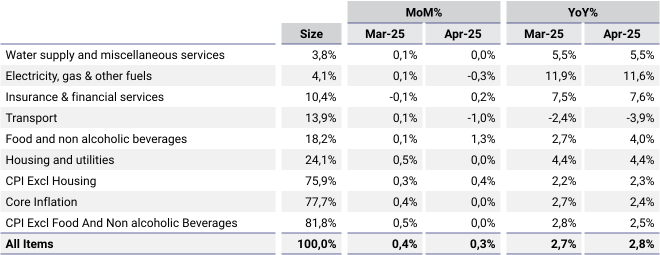
In April 2025, the Consumer Price Index (CPI) increased marginally from 2.7% in March to 2.8%. This was slightly below the 2.9% forecasted by analysts for the month.

The 2.8% rise in CPI was primarily driven by:

  • Housing and Utilities: Up 4.4%, contributing 1.0 percentage point.
  • Food and Non-Alcoholic Beverages: Up 4.0%, adding 0.7 percentage point.
  • Alcoholic Beverages and Tobacco: Up 4.7%, contributing 0.2 percentage point.
  • Restaurants and Accommodation Services: Up 3.0%, adding another 0.2 percentage point.

Year-over-year, inflation for goods declined to 1.7%, down from 2.0% in March. Similarly, services inflation was slightly up from 3.5% in March to 3.8% in April. Despite the slower pace of price increases, inflation continues to erode household purchasing power across South Africa. Many households remain reliant on short-term credit, which increases their vulnerability to interest rate fluctuations.

On a positive note, the Monetary Policy Committee (MPC) appears to be considering another interest rate cut in the near future. This outlook is supported by relatively low inflation levels, a significantly improved Rand/Dollar exchange rate, and lower international oil prices over the past few months. Such an interest rate reduction could boost demand within the economy by increasing household disposable income after interest payments and potentially support economic growth overall.

However, the Reserve Bank remains cautious. Concerns about inflation and the potential impact of the US-China tariff war on price stability persist, despite current favourable exchange rates and lower oil prices. Factors such as moderate inflation, slow economic growth, improved electricity supply, and positive market sentiment will influence future interest rate decisions. Ultimately, price stability remains a primary focus, guiding the Bank’s policy approach as 2025 progresses.


More Coverage

In February 2026, South Africa witnessed a 1.6% rise in retail sales, signalling a fragile yet ongoing recovery in consumer demand, though falling short of the 4.8% expected by analysts. Despite challenges like rising administered prices and sluggish wage growth, this growth persists. Factors such as interest-rate cuts between September 2024 and November 2025 support the retail upswing, highlighted by a rise in both the South African Chamber of Commerce’s business confidence index and the FNB/BER consumer confidence index. Key contributors to the February increase include a 9.4% rise in sales from other retailers and a 3.9% uptick in textiles and apparel, indicating cautious but sustained recovery amidst economic uncertainties.
In March 2026, South Africa’s Consumer Price Index (CPI) rose 3.1% year-on-year, slightly above the previous month’s 3.0% and below the forecast of 4.1%. This was mainly driven by increases in housing, utilities, food, and financial services, pushing services inflation just over the Reserve Bank’s upper target limit. As rising inflation erodes purchasing power, many rely on short-term credit, increasing exposure to economic shifts. The Reserve Bank, cautious amid global uncertainties like the Middle East conflict and high fuel prices, maintained interest rates, although potential hikes loom to stabilise prices. Despite positive but modest economic growth, ongoing global tensions, notably the US-China tariff dispute and potential BRICS tariffs, alongside persistent high oil prices, threaten stability. The focus on maintaining price stability and safeguarding the Rand’s value remains paramount as South Africa navigates these challenges in 2026.
In “The Great Commodity Seesaw: How South Africa’s Gold Shield is Blunting the Oil Shock,” the South African economy stands precariously amidst soaring international oil prices and unprecedented gold values. While the country’s heavy reliance on imported fuel hurls motorists toward escalating costs, the shimmering promise of high gold prices provides a vital financial reprieve. This enrichment helps cushion the national accounts, aiding in balancing the trade surplus and reinforcing the currency during geopolitical unrest. Yet, with Eskom’s reliance on diesel to stabilize electricity supply, any unexpected outages could spell inflationary turmoil, rocking the economy’s already fragile state. As the country braces for potential fiscal challenges ahead, the question looms whether the golden buffer can truly shield the nation from impending economic turbulence
South Africa’s story is shifting—from the frustration of load shedding to the emergence of a bold new opportunity. As we move through 2026, an unexpected partnership between energy and cryptocurrency is reshaping the economic landscape. With Eskom exploring ways to monetise surplus solar power and SAA embracing Bitcoin for transactions, the country is stepping into a new era where digital finance and energy innovation converge—unlocking fresh potential for businesses, investors, and growth.
Discover the dynamic shifts within South Africa’s mining sector with our latest analysis. In a remarkable February 2026 performance, mining activities surged by 9.7%, spearheaded by dramatic increases in PGM, chromium ore, manganese, and gold production. Despite a quarterly dip, February’s nominal sales skyrocketed by 58.3%, driven by remarkable gains in platinum and gold. As the backbone of South Africa’s economy, the sector faces evolving global challenges and opportunities, from new US tariff measures to geopolitical tensions affecting global trade and energy prices. Stay ahead with insights into the sector’s resilience and strategic importance. Read the full article to understand the trends shaping South Africa’s economic landscape.