Copyright © Aluma Capital (Pty) Ltd. All rights reserved.
Aluma Capital (Pty) Ltd is a registered Financial Services Provider (FSP 46449) in terms of The Financial Advisory and Intermediary Services Act (37 of 2002)
September 17, 2025

Consumer Inflation

August 2025
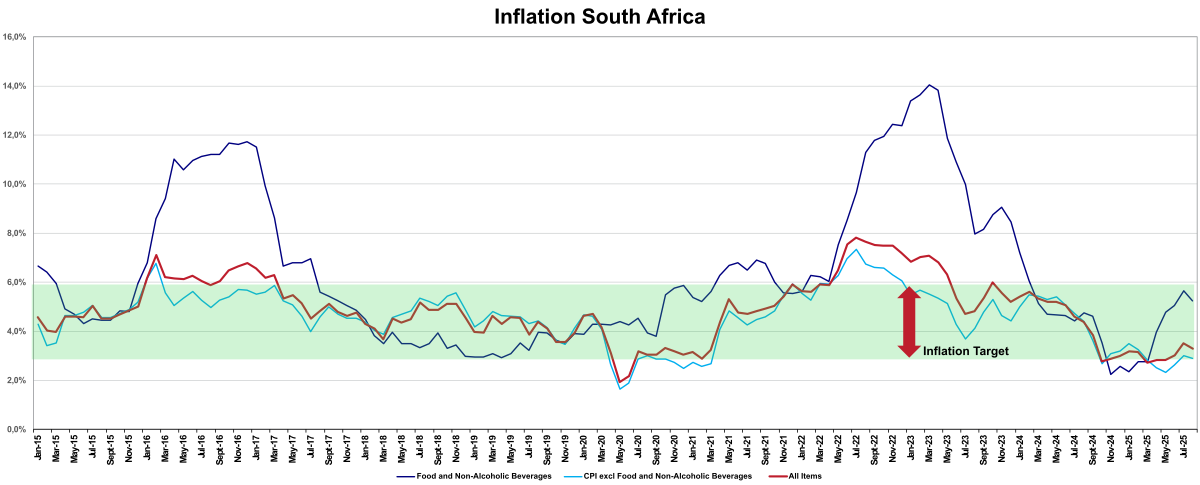
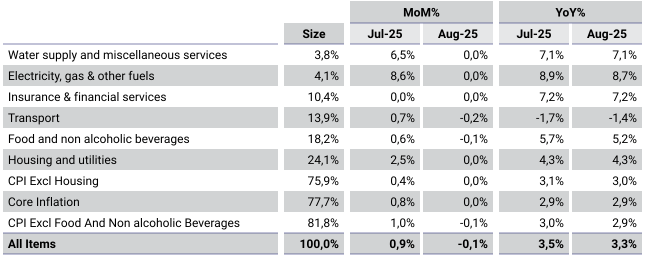
In August 2025, the Consumer Price Index (CPI) experienced a modest increase to 3.3%, down slightly from 3.5% in July. This was marginally below analysts’ forecast of 3.6% for the month.

The rise was predominantly attributed to:

  • Housing and Utilities: Up by 4.3%, contributing 1.0 percentage point.
  • Food and Non-Alcoholic Beverages: Increased by 5.2%, adding 0.9 percentage points.

On an annual basis, inflation for goods edged up slightly to 3.1%, compared to 3.2% in July, while services inflation remained steady at 3.6% for August 2025. Although the pace of price increases has slowed, inflation continues to erode household purchasing power across South Africa, albeit at a reduced rate. As a result, many families are increasingly relying on short-term credit to sustain their lifestyles and consumption patterns. This dependence heightens their vulnerability to fluctuations in interest rates and currency values, which can influence domestic prices.

During its July meeting, the Monetary Policy Committee (MPC) decided to lower the interest rates. The outcome of the September interest rate decision, which will be announced later this week following the latest inflation data, is highly anticipated. It is expected that the South African Reserve Bank (SARB) may opt to keep interest rates unchanged for the month, despite the slight decline in consumer inflation from July to August. This approach could reflect the Bank’s cautious stance on inflation and price stability amid ongoing economic uncertainties, such as the 30% US trade tariffs impacting South African exports. These uncertainties could also influence the Rand’s exchange rate against the US dollar, as more data from August and September becomes available. The SARB may therefore adopt a “wait-and-see” approach to supporting the Rand and maintaining domestic price stability in the short to medium term.

The interest rate reductions implemented in late 2024 and early 2025, along with the July rate cut, are expected to stimulate demand by increasing household disposable income after interest payments, potentially fostering overall economic growth. This is supported by the latest economic growth figures of 0.8% released by StatsSA.

Despite this positive outlook and the slightly above-market expectation growth for the second quarter of 2025, the Reserve Bank remains cautious due to ongoing global uncertainties. Concerns such as inflation, the US-China tariff dispute, and potential additional tariffs on BRICS nations could impact price stability. Future interest rate decisions are likely to be influenced by factors such as moderate inflation, sluggish economic growth, improvements in electricity supply, and positive market sentiment.

Ultimately, maintaining price stability and safeguarding the domestic value of the Rand remain priorities as South Africa navigates the second half of 2025.


More Coverage

South Africa’s Constitutional Court has reopened the Phala Phala impeachment process, creating renewed political uncertainty around President Cyril Ramaphosa and the GNU. While markets remain stable for now, concerns include weaker investor confidence, delayed reforms, and pressure on the Rand if political tensions escalate. At the same time, the ruling reinforces the strength of South Africa’s democratic institutions, showing that the Constitution and judiciary remain strong checks on political power.
Discover how South Africa is turning speed into a formidable economic shield against rising challenges such as fuel price hikes and cost-push inflation. Explore how the nation is battling “economic friction” by leveraging cutting-edge local fintech solutions, like PayShap, and groundbreaking international developments in blockchain technology to create a “velocity buffer.” This strategy empowers small businesses and larger firms alike to maintain agility and financial resilience through instant financial transactions. Witness the transformative impact of reducing exposure to currency volatility and unlocking 24/7 market access, as South Africa aims for a “T-Zero” economy where speed transforms into a strategic hedge against inflation, ensuring economic stability and growth even in tumultuous times.
In April 2026, South Africa’s International Liquidity Position presented a mixed picture, with USD reserves showing a notable increase amid regional hostilities that influenced currency dynamics. The Rand appreciated slightly against the US Dollar, although the net international liquidity position declined when measured in Rand, reflecting the complexities of the global market influenced by the ongoing conflict in the Middle East. Significant fluctuations in key commodities such as gold, which rose to $4634/oz, and oil prices, combined with the potential impact of new tariffs and geopolitical tensions, signal a volatile economic landscape ahead. This article delves into the intricate relationship between commodity prices, the South African Reserve Bank’s monetary policies, and inflation expectations, providing crucial insights for investors and policymakers navigating these challenging waters. Don’t miss the full report for a comprehensive analysis of how these trends could shape South Africa’s economic outlook in the months to come.
In an economic climate peppered with soaring fuel prices, the South African Reserve Bank (SARB) faces a critical decision as its upcoming interest rate announcement on May 28, 2026, approaches. Despite the pressure to hike rates amidst rising prices, there’s a strong argument for holding steady. With inflation anchored at a stable 3.1%, SARB’s cautious strategy addresses the recent fuel hikes as a supply-side shock influenced by external factors, rather than internal economic overheating. Burgeoning consumer and business costs make further restrictions risky, as raising interest rates now could stifle consumer spending and business expansions, thereby curtailing growth and threatening employment. Encouragingly, a dip in global oil prices suggests the recent surge might not be the new norm, allowing SARB to potentially maintain its rates, instilling economic stability and providing South Africa the necessary space to adapt. This approach reflects both a strategic restraint and a nod to future growth, urging stakeholders to focus on long-term stability amidst short-term disruptions.
In the wake of interest rate cuts by the South African Reserve Bank since September 2024, credit demand saw an uptick of 8.5% in March 2026, narrowly missing market expectations. Despite the encouraging growth across various credit segments, the property market remains sluggish due to persistent high consumer debt, slow wage growth, and rising living costs, particularly driven by soaring international oil prices and high administered rates. As South Africans increasingly turn to short-term credit to cope with these pressures, an upward trend in instalment sales and other loans is evident, with an anticipation of future benefits from reduced interest rates potentially offset by looming inflationary threats linked to the ongoing Middle East conflict. Explore how these dynamics may unfold in the remainder of 2026 and influence South Africa’s economic landscape.