Copyright © Aluma Capital (Pty) Ltd. All rights reserved.
Aluma Capital (Pty) Ltd is a registered Financial Services Provider (FSP 46449) in terms of The Financial Advisory and Intermediary Services Act (37 of 2002)
October 6, 2026

International Trade and Trade Balance – August 2026

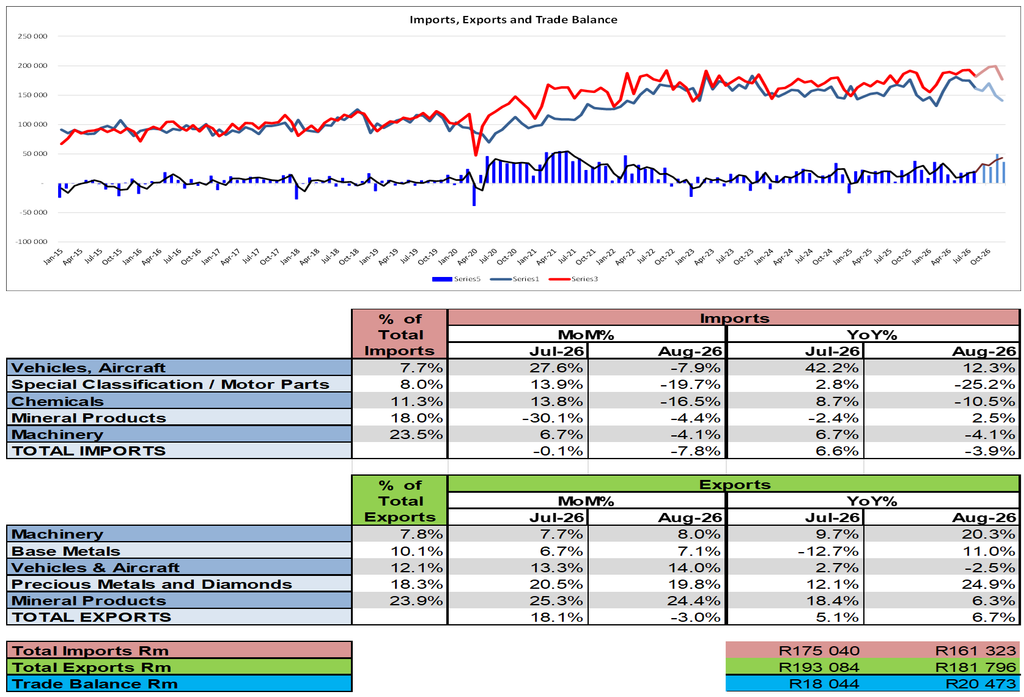
South Africa recorded a trade surplus of R20.4 billion in August 2026, as exports continued to outpace imports. Export growth has exceeded import growth over the first eight months of the year, reflecting subdued domestic demand among businesses and consumers. But with higher fuel prices and tighter monetary policy expected to weigh on spending, demand is likely to recover only gradually. Read the full report for a closer look at the trade figures and what they could mean for South Africa’s economy in the months ahead.

International trade measures South Africa’s demand for foreign goods and services relative to its demand for domestically produced goods and services in the global market. The country predominantly exports raw materials, including base metals, gold, other precious metals, and minerals, while importing value-added products such as vehicles, chemicals, and machinery.

In August 2026, South Africa recorded a trade surplus of R20.4 billion, indicating that exports once again exceeded imports. Over the last eight months ending August 2026, exports have grown by 8.0% compared to the same period in 2025, from R1.345 billion in 2025 to R1.453 billion in 2026. Meanwhile, imports increased by 4.7%, from R1.24 billion in 2025 to R1.302 billion in August 2026. This reflects the relatively low level of domestic demand among South African businesses and consumers at this stage.

Looking ahead, demand is expected to grow slowly in the latter stages of 2026 amid higher fuel prices and a more restrictive monetary policy stance, driven by imported inflationary pressures. Interest rates increased by another 25 basis points in September, and much higher fuel prices are expected to reduce domestic demand further in the coming months.


More Coverage

What Hong Kong’s 24/7 Tokenised Deposit Pilot Means for South African Banking & Capital Markets. Today’s announcement by the Hong Kong Monetary Authority, launching live 24/7 interbank settlement of tokenised commercial bank deposits backed by central bank money, marks a pivotal transition away from speculative crypto debates toward true institutional financial convergence. In our latest market analysis, we unpack how uniting commercial bank balance sheets with programmable blockchain rails eliminates trapped working capital, cuts reconciliation friction, and resolves the structural limitations of conventional operating hours. Crucially for South Africa, we examine the practical opportunities this shift creates to modernise corporate treasury, deepen secondary liquidity for private credit, and solidify the Rand’s role as the primary settlement gateway for intra-African trade under the AfCFTA, while highlighting where domestic regulatory and payments infrastructure must now transition from sandbox trials to live wholesale deployment.
Despite Binance confirming that it has replenished or covered 95% of the $6.36 billion stolen in last week’s historic cyberattack, verified market data reveals that customers pulled an extraordinary $3.64 billion in net outflows (processing $4.65 billion in gross withdrawals against $1.01 billion in deposits) within hours of withdrawal rails reopening on Sunday, 1 November. In my latest opinion piece, “Binance Replaced the Billions. So Why Are Investors Still Leaving?”, I unpack the critical economic disconnect between balance-sheet solvency, operational liquidity, and investor confidence, demonstrating why corporate treasury bailouts and functioning redemption queues cannot cure the psychological erosion caused by breached custodial architecture. For South Africa’s financial institutions and regulators (SARB and FSCA), these events, compounded by Polymarket’s simultaneous third-party vendor compromise, serve as an urgent wake-up call: domestic fintechs lack multi-billion-dollar treasury buffers, making statutory bankruptcy-remote custody, continuous on-chain proof-of-reserves, and real-time public-private threat circuit breakers essential if South Africa is to turn institutional trust into its greatest competitive economic moat.
The unprecedented security shocks that struck global digital asset markets this week, most notably an estimated $6.36 billion drain across Binance wallets attributed to state-backed cyber syndicates and a client-side vendor intrusion at Polymarket, deliver a blunt reality check to the financial sector: base-layer blockchain mathematics did not fail, but platform custody, access controls, and outsourced third-party software did. In my latest opinion piece, “The Billion-Dollar Wake-Up Call: Why Digital Finance Must Put Security Before Innovation”, I examine why Silicon Valley’s rapid feature velocity has dangerously outrun institutional governance, and why ad hoc balance-sheet reimbursements cannot substitute for fiduciary resilience. For South Africa’s banking, fintech, and regulatory leaders, these breaches highlight the urgency of tightening software supply-chain audits, mandating distributed multi-party custody, and deploying real-time threat coordination, presenting a strategic opportunity for South Africa to leverage institutional trust and rigorous oversight as our primary competitive edge in attracting long-term global digital investment.
Producer price inflation accelerated to 6.2% in September 2026, as higher fuel and energy costs continued to ripple through the economy. Although some cost increases have eased, producer prices remain above the South African Reserve Bank’s new target range, adding to concerns about consumer inflation and the outlook for interest rates. Read the full report for a closer look at the main cost pressures across manufacturing, mining and agriculture—and what they could mean for South African households and businesses in the months ahead.
Credit demand in South Africa continued to grow in September 2026, but fell short of market expectations as households and businesses faced higher interest rates, rising living costs and persistently high debt levels. While mortgage advances and fixed-asset credit picked up, the property market’s recovery remains fragile, and consumers continue to rely on short-term borrowing to manage expenses. With inflation above the target range and energy and fuel costs adding to price pressures, the latest interest rate hike raises fresh questions about the outlook for credit and the wider economy. Read the full report for a closer look at the trends shaping borrowing across the country.