Copyright © Aluma Capital (Pty) Ltd. All rights reserved.
Aluma Capital (Pty) Ltd is a registered Financial Services Provider (FSP 46449) in terms of The Financial Advisory and Intermediary Services Act (37 of 2002)
November 19, 2025

Consumer Inflation

October 2025
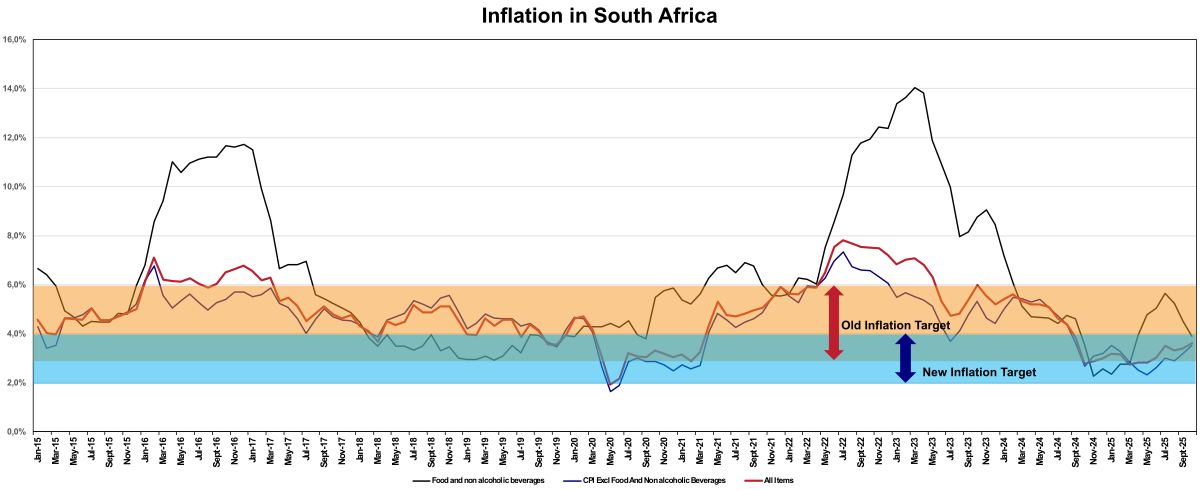
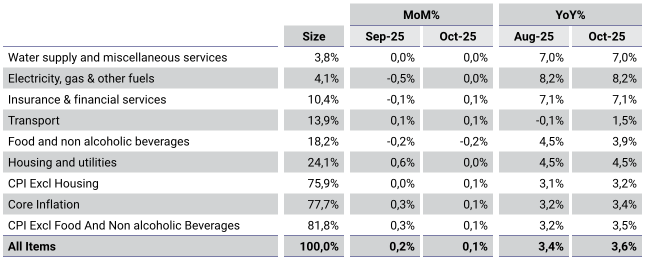
In September 2025, the Consumer Price Index (CPI) saw a modest rise to 3.4%, slightly up from 3.3% in August, yet just below the analysts’ forecast of 3.5%.

This increase was largely due to:

  • Housing and Utilities: An increase of 4.5%, contributing 1.1 percentage points.
  • Food and Non-Alcoholic Beverages: Up by 4.5%, adding 0.8 percentage points.

Year-on-year, inflation for goods eased from 3.1% in August to 2.9% in September, while services inflation rose from 3.6% to 3.9%. Although the rate of price increase has slowed and remains relatively stable near 3.5%, inflation continues to erode household purchasing power in South Africa, though at a slower pace. Consequently, many families are increasingly dependent on short-term credit to maintain their consumption habits, which makes them more vulnerable to interest rate and currency fluctuations affecting domestic prices.

During its September meeting, the Reserve Bank’s Monetary Policy Committee (MPC) chose to keep interest rates unchanged, despite stable consumer inflation from July to August. This decision likely reflects the Bank’s cautious approach to inflation and price stability amid lingering economic uncertainties, such as the 30% US trade tariffs affecting South African exports. These uncertainties may also affect the Rand’s exchange rate against the US dollar as more August and September data emerge. Thus, the SARB may adopt a “wait-and-see” strategy to support the Rand and maintain domestic price stability in the short to medium term.

The interest rate cuts introduced in late 2024 and early 2025, along with a reduction in July, are anticipated to boost demand by increasing household disposable income after interest payments, potentially fostering economic growth. This outlook is supported by StatsSA’s latest economic growth figure of 0.8%.

Despite an optimistic growth outlook that slightly exceeds market expectations for the second quarter of 2025, the Reserve Bank remains vigilant due to ongoing global uncertainties. Issues like inflation, the US-China tariff conflict, and possible further tariffs on BRICS nations could affect price stability. Future interest rate decisions are likely to consider factors such as moderate inflation, sluggish economic growth, enhancements in electricity supply, and positive market sentiment.

In summary, maintaining price stability and protecting the Rand’s domestic value remain key priorities as South Africa navigates the latter half of 2025.


More Coverage

South Africa recorded a trade surplus of R20.4 billion in August 2026, as exports continued to outpace imports. Export growth has exceeded import growth over the first eight months of the year, reflecting subdued domestic demand among businesses and consumers. But with higher fuel prices and tighter monetary policy expected to weigh on spending, demand is likely to recover only gradually. Read the full report for a closer look at the trade figures and what they could mean for South Africa’s economy in the months ahead.
South Africa’s credit market is showing surprising resilience, with credit demand rising by 7.5% in August 2026 despite renewed interest-rate pressure, elevated inflation and mounting household costs. While mortgage advances continued to grow, the fragile recovery in the property market highlights the strain caused by subdued investment, high debt levels and rising municipal and energy expenses. At the same time, sluggish instalment credit growth and continued reliance on short-term borrowing reveal how consumers are navigating increasingly difficult financial conditions. With higher oil prices, geopolitical risks and further SARB tightening adding to the pressure, this report examines what the latest credit trends reveal about household finances, business confidence and the broader South African economy.
South Africa’s producer price inflation eased to 5.0% year-on-year in August 2026, but persistent fuel and energy shocks continue to place pressure on the economy and keep inflation well above the South African Reserve Bank’s new 2%–4% target range. Although the pace of price increases has slowed, rising costs in petroleum, chemicals, metals, machinery, and intermediate goods, alongside elevated mining costs, suggest that inflationary pressures are still filtering through to businesses and consumers. With consumer inflation at 4.4% and the Reserve Bank having raised interest rates by 25 basis points, this report examines what the latest PPI trends mean for South Africa’s inflation outlook, interest-rate decisions, and the cost pressures likely to shape the economy in the months ahead.
When the South African Reserve Bank unexpectedly tightened monetary policy by 25 basis points to 7.25%, pushing the prime lending rate to 10.75%, it aimed to anchor inflation against imported oil shocks, but at what cost to an already bleeding real economy? With South Africa’s GDP contracting by 0.2%, unemployment climbing to 33.6%, and mining and manufacturing output in reverse, our economic challenge is not an overheated consumer base, but a severe supply-side squeeze. Raising the cost of capital cannot lower global crude prices; instead, it delivers a direct hit to strained household balance sheets and further stifles already anaemic Gross Fixed Capital Formation (GFCF). Dive into the full analysis to unpack why orthodox monetary tools miss the mark in an economy rationing out of necessity, what Governor Lesetja Kganyago’s latest guidance reveals about the interest rate path ahead, and how corporate leaders and investors must position their capital to navigate South Africa’s “higher-for-longer” reality.
South Africa’s August 2026 inflation data present a complex outlook: headline CPI rose to 4.4%, remaining below market expectations yet above the upper limit of the inflation target range, while services inflation continued to climb, and fuel and transport costs exerted further pressure on households and businesses. With the economy contracting, international oil prices rising and global uncertainties, including Middle East tensions and tariff disputes, continuing to weigh on the rand and domestic prices, attention is now focused on the South African Reserve Bank’s next interest-rate decision. Read the full report for an analysis of the factors driving inflation, the risks facing the economy and what the latest developments could mean for consumers, businesses and monetary policy in the months ahead.