Copyright © Aluma Capital (Pty) Ltd. All rights reserved.
Aluma Capital (Pty) Ltd is a registered Financial Services Provider (FSP 46449) in terms of The Financial Advisory and Intermediary Services Act (37 of 2002)
August 12, 2026

Manufacturing Production – June 2026
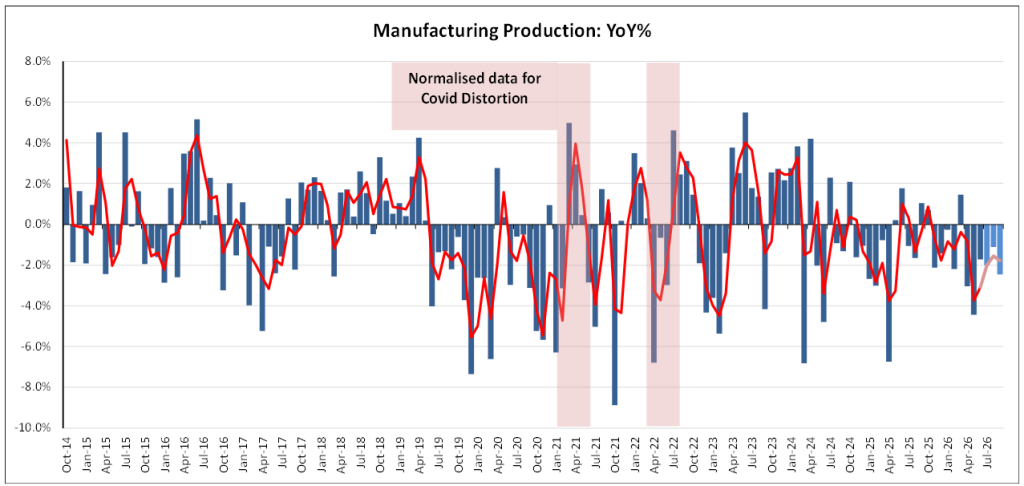
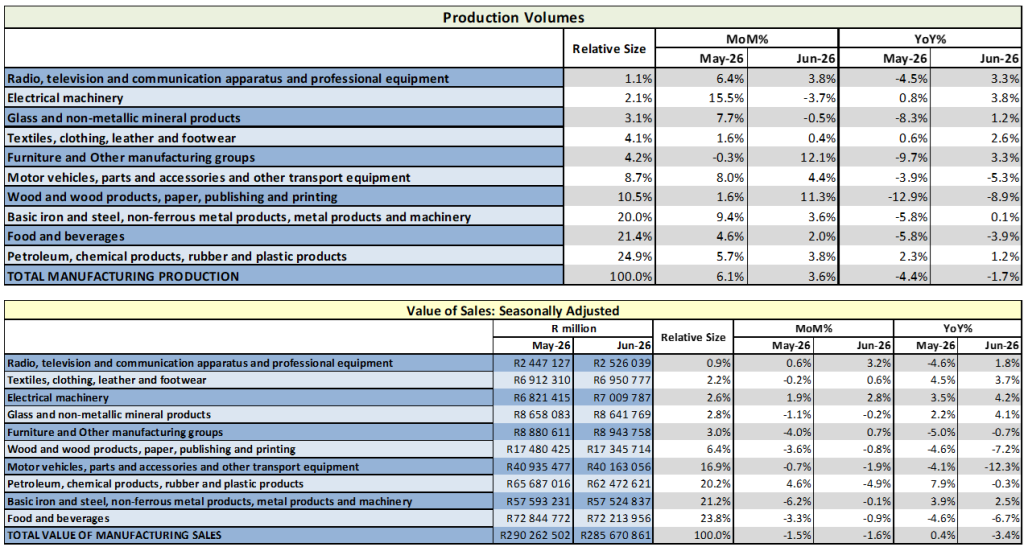
South Africa’s manufacturing sector came under renewed pressure in June 2026, with production declining by 1.7% following strong growth in May. The contraction was driven mainly by weaker output in food and beverages, wood products, and motor vehicles and transport equipment. Manufacturing production also fell by 1.5% in the second quarter, with seven of ten sectors recording declines. Despite subdued production, manufacturing sales increased by 0.6% during the quarter, supported by stronger sales in chemicals, petroleum, rubber and plastics, as well as motor vehicles. However, declining employment and a PMI below the 50-point threshold highlight growing caution among manufacturers. Ongoing US trade tariffs and diplomatic tensions are adding further pressure, while businesses continue to maintain high cash reserves as they navigate domestic and global economic uncertainty.

In June 2026, South Africa’s manufacturing output contracted by 1.7%, following the 4.4% increase in May 2026. This decrease is slightly better than the 2.3% decrease analysts forecast for June 2026. During the same period, the Purchasing Managers’ Index (PMI) decreased 3.5 points, from 50.8 in May 2026 to 47.3 in June 2026. This indicates a cautious view of the business environment as output contracted within the sector.

The contraction in manufacturing production during June was largely attributed to declines in:

  • Food and beverage production, which declined by 3.9% and contributed -1.0 percentage point,
  • wood and wood products that contracted by 8.9% and subtracted 0.9 percentage points from output growth, and
  • lower output in motor vehicles, parts and accessories and other transport equipment, which declined by 5.3% and contributed -0.4 points towards the contraction in manufacturing output for June.

Seasonally adjusted manufacturing production for the second quarter also decreased by 1.5% compared to the first quarter of 2026. Out of ten sectors, seven reported contractions during this period. Significant contractions included:

  • Food and beverages, declined by 3.0%, subtracting 0.8 percentage points from growth.
  • Furniture and ‘other’ manufacturing declined by 9.3%, subtracting 0.4 percentage points from growth
  • Basic iron and steel, non-ferrous metal products, metal products and machinery, which decreased by 1.2%, also contributed a 0.3 percentage point reduction.

Seasonally adjusted manufacturing sales increased by 0.6% during the second quarter of 2026 compared to the previous quarter. Significant increases occurred in:

  • Petroleum, chemical products, rubber and plastic products division, which increased by 5.0%, adding 1.1 percentage points towards sales growth for the quarter.
  • The motor vehicles, parts and accessories and other transport equipment division, which rose by 4.3%, added another 0.6 percentage points towards sales growth for the quarter under review.

Manufacturing is a critical component of South Africa’s economy, employing approximately 1.57 million people and accounting for 12.5% of the GDP in 2025. Employment slightly decreased from 1.587 million in Q1 2026 to 1.571 million in Q2 2026. GDP figures for the fourth quarter indicate a 0.6% quarterly decrease in manufacturing output, suggesting that US trade tariffs since August 2025 have caused some distress in the manufacturing sector by eroding price competitiveness in the US market, driven by higher import prices due to tariffs on South African exports. The reduction in employment numbers for the second quarter of 2026 suggests that the growing challenges South African exporters face in accessing the US market are starting to show up in annual growth numbers and employment opportunities for the sector at large. It should, however, be noted that exports to the US market have declined by 56% since 2025 due to tariffs, trade tensions and diplomatic “disputes” between Pretoria and Washington.

As a result of trade tariffs with the US and ongoing diplomatic tensions between Pretoria and Washington, business owners remain cautious, as evidenced by the June 2026 PMI data, which is now below the critical 50-point threshold. However, companies are still maintaining substantial cash reserves of approximately R1.8 trillion, up from R1.1 trillion in the first quarter of 2025, according to the Reserve Bank. This reflects a prudent approach amid current domestic and global economic uncertainties in the short- to medium-term.


More Coverage

South Africa’s latest inflation figures provide some welcome relief, but a renewed surge in global oil prices threatens to undermine this progress. With fuel prices rising sharply due to external geopolitical and supply-side pressures, the debate over whether the SARB should respond with higher interest rates has become increasingly important. This article argues that raising rates to combat imported inflation would risk doing more harm than good—placing further pressure on households, businesses and investment in an economy already facing weak growth, high unemployment and significant industrial challenges.
Private sector credit growth remained resilient in July 2026, reflecting continued demand for financing despite elevated living costs and renewed interest rate uncertainty. While overall credit extension continues to benefit from the rate-cutting cycle that began in late 2024, subdued property activity and rising household reliance on short-term credit highlight ongoing pressure on consumers and businesses.
South Africa’s producer price inflation eased from 7.5% to 5.7% year-on-year in July 2026, but the slowdown offers little comfort as rising fuel, energy and intermediate-goods costs continue to reverberate through the economy. With petroleum-related products driving much of the increase, mining costs still elevated, and consumer inflation already above the South African Reserve Bank’s new target range, inflationary pressures remain firmly entrenched, even as monthly producer prices declined. This report examines the sectors driving the latest figures, the implications of ongoing Middle East-related energy shocks, and what the data could mean for consumer prices, inflation expectations, and the Reserve Bank’s upcoming interest-rate decision in September.
South Africa has received a much-needed inflation reprieve, with July headline inflation easing to 4.3% and giving the South African Reserve Bank room to hold interest rates steady, but monetary relief alone cannot rescue an economy facing contracting mining and manufacturing sectors, depressed investment, mass unemployment, and mounting pressure on export earnings. This report examines how a 12.5% US tariff and a 56% annualised plunge in exports are intensifying the country’s economic vulnerability, while diplomatic disputes over property rights, empowerment policy, rural safety, political rhetoric, and South Africa’s geopolitical alliances threaten access to the strategically vital US market. It also sets out the practical policy choices, from structural reform and infrastructure investment to pragmatic trade diplomacy, that could determine whether South Africa converts this brief moment of inflation stability into sustainable growth or slips deeper into stagnation
South Africa’s July 2026 inflation reading delivered a genuine surprise: consumer prices rose just 4.3% year-on-year, well below June’s 5.0% and under the 4.5% the market had pencilled in, yet the story beneath that headline is far more complicated than a simple cooling trend. Goods inflation has slipped into the SARB’s new 2–4% target band, but services inflation stubbornly holds at 5.0%, revealing that price pressure is now entering the economy through a channel monetary policy struggles to reach. Meanwhile, housing, transport, and financial services drove the bulk of the increase; fuel costs remain elevated amid the renewed Middle East conflict and rising oil prices; and households and businesses relying on short-term credit are dangerously exposed to any shift in rates, the rand, or import costs. Add US tariffs weighing on manufacturing, fragile 0.5% first-quarter growth, and a Reserve Bank that has already wrong-footed markets twice this year, and the run-up to the 23 September MPC meeting becomes anything but predictable. This report unpacks what the numbers actually signal, why the SARB is holding its nerve, and what it will take to tip the next rate decision either way.