Copyright © Aluma Capital (Pty) Ltd. All rights reserved.
Aluma Capital (Pty) Ltd is a registered Financial Services Provider (FSP 46449) in terms of The Financial Advisory and Intermediary Services Act (37 of 2002)
July 1, 2026

Private Sector Credit Extension (PSCE): May 2026
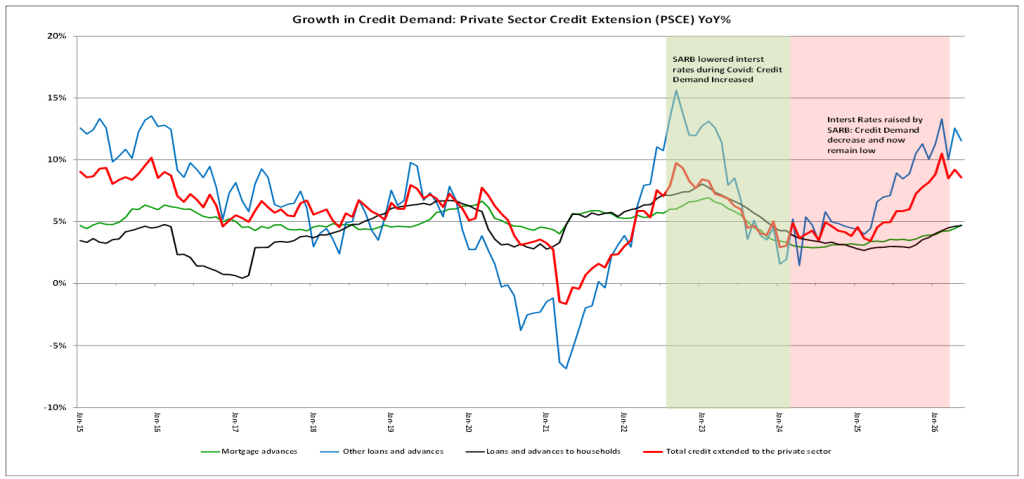

In a rapidly shifting economic landscape, May 2026 saw credit demand growth of 8.6%, falling short of the anticipated 9.4% forecast. Since interest rate cuts began in September 2024, credit growth has generally surged, particularly following strategic interest rate reductions by the South African Reserve Bank amidst global tensions and skyrocketing energy costs. However, the South African property market stagnates due to soaring consumer debts, muted wage increases, and escalating living expenses, notably in household fuel and utility prices. While instalment credit sales posted a modest rise, the reliance on short-term credit underscores consumer struggles with surging living costs. With inflation hovering above target and persistent high fuel prices, the anticipated interest rate hike in July could further suppress demand, adding pressure to the already challenging economic recovery. Discover the dynamics shaping South Africa’s financial climate in this insightful analysis.

In May 2026, credit demand grew by 8.6%, notably below the market’s expectation of 9.4%. Since interest rate cuts began in September 2024, overall credit growth has accelerated, with most subcategories experiencing increases, especially following the South African Reserve Bank’s decision to lower interest rates before the start of the conflict in the Middle East and subsequent increase in global energy costs and higher fuel prices.

Mortgage advances and credit for acquiring fixed assets remain low and have edged lower following a 25-basis-point increase in interest rates at the last meeting of the Monetary Policy Committee (MPC) in May 2026. The South African property market remains sluggish, reflecting low capital expenditure from both households and businesses. This sector’s recovery remains slow due to high consumer debt levels, low wage growth, and rising living costs, especially household fuel expenditure due to high international oil prices, as well as high administered prices such as water, electricity, and municipal rates & taxes.

In May, instalment credit sales increased again by 1.0% from the previous month, marking an annual growth of 9.3%. Over the past two years, consumers have remained increasingly dependent on short-term credit to manage rising living costs, as shown by an 11.5% increase in other loans and advances, slightly down from 12.6% in the April 2026 figures.

With inflation just above the target range and fuel prices remaining elevated despite a recent slight dip, energy costs continue to put upward pressure. As a result, the SARB may hike interest rates again at its next MPC meeting on July 23, 2026, which will likely further dampen consumer demand


More Coverage

South Africa’s latest inflation figures provide some welcome relief, but a renewed surge in global oil prices threatens to undermine this progress. With fuel prices rising sharply due to external geopolitical and supply-side pressures, the debate over whether the SARB should respond with higher interest rates has become increasingly important. This article argues that raising rates to combat imported inflation would risk doing more harm than good—placing further pressure on households, businesses and investment in an economy already facing weak growth, high unemployment and significant industrial challenges.
Private sector credit growth remained resilient in July 2026, reflecting continued demand for financing despite elevated living costs and renewed interest rate uncertainty. While overall credit extension continues to benefit from the rate-cutting cycle that began in late 2024, subdued property activity and rising household reliance on short-term credit highlight ongoing pressure on consumers and businesses.
South Africa’s producer price inflation eased from 7.5% to 5.7% year-on-year in July 2026, but the slowdown offers little comfort as rising fuel, energy and intermediate-goods costs continue to reverberate through the economy. With petroleum-related products driving much of the increase, mining costs still elevated, and consumer inflation already above the South African Reserve Bank’s new target range, inflationary pressures remain firmly entrenched, even as monthly producer prices declined. This report examines the sectors driving the latest figures, the implications of ongoing Middle East-related energy shocks, and what the data could mean for consumer prices, inflation expectations, and the Reserve Bank’s upcoming interest-rate decision in September.
South Africa has received a much-needed inflation reprieve, with July headline inflation easing to 4.3% and giving the South African Reserve Bank room to hold interest rates steady, but monetary relief alone cannot rescue an economy facing contracting mining and manufacturing sectors, depressed investment, mass unemployment, and mounting pressure on export earnings. This report examines how a 12.5% US tariff and a 56% annualised plunge in exports are intensifying the country’s economic vulnerability, while diplomatic disputes over property rights, empowerment policy, rural safety, political rhetoric, and South Africa’s geopolitical alliances threaten access to the strategically vital US market. It also sets out the practical policy choices, from structural reform and infrastructure investment to pragmatic trade diplomacy, that could determine whether South Africa converts this brief moment of inflation stability into sustainable growth or slips deeper into stagnation
South Africa’s July 2026 inflation reading delivered a genuine surprise: consumer prices rose just 4.3% year-on-year, well below June’s 5.0% and under the 4.5% the market had pencilled in, yet the story beneath that headline is far more complicated than a simple cooling trend. Goods inflation has slipped into the SARB’s new 2–4% target band, but services inflation stubbornly holds at 5.0%, revealing that price pressure is now entering the economy through a channel monetary policy struggles to reach. Meanwhile, housing, transport, and financial services drove the bulk of the increase; fuel costs remain elevated amid the renewed Middle East conflict and rising oil prices; and households and businesses relying on short-term credit are dangerously exposed to any shift in rates, the rand, or import costs. Add US tariffs weighing on manufacturing, fragile 0.5% first-quarter growth, and a Reserve Bank that has already wrong-footed markets twice this year, and the run-up to the 23 September MPC meeting becomes anything but predictable. This report unpacks what the numbers actually signal, why the SARB is holding its nerve, and what it will take to tip the next rate decision either way.