Copyright © Aluma Capital (Pty) Ltd. All rights reserved.
Aluma Capital (Pty) Ltd is a registered Financial Services Provider (FSP 46449) in terms of The Financial Advisory and Intermediary Services Act (37 of 2002)
July 23, 2026

Prudence Over Panic: Why the SARB’s Surprise Rate Hold Was the Right Call for South Africa

In a surprising yet calculated move, the South African Reserve Bank’s Monetary Policy Committee opted to hold the repo rate steady at 7.00%, defying market predictions of a rate hike amidst rising inflation concerns. With a 4–2 split vote, the Committee’s decision reflects a strategic balance between tackling global inflationary pressures caused by external supply shocks and addressing domestic economic fragilities. The SARB aims to protect South Africa’s growth by preserving liquidity and avoiding additional burdens on consumers and SMEs, who are already grappling with local infrastructure challenges and municipal dysfunction. Despite recognising persistent inflation, especially in services, the Bank remains cautious but data-driven, addressing risks while betting on economic recovery momentum in late 2026. Discover why this prudent approach may well be the key to steering South Africa through current economic uncertainties.

In a move that caught most financial analysts off guard, the South African Reserve Bank’s (SARB) Monetary Policy Committee (MPC) announced today that it is keeping the repo rate unchanged at 7.00% (leaving the prime lending rate at 10.50%). Heading into the meeting, market consensus leaned heavily toward a 25-basis-point increase, especially after Statistics South Africa reported that June headline inflation accelerated to 5.0%. However, in a split 4–2 vote, the MPC opted for policy stability.

Given the mounting geopolitical storm clouds abroad and structural fragilities at home, holding rates steady was not merely a pragmatic compromise, it was the most sensible policy choice for South Africa’s immediate economic future.

1. Looking Through External Supply Shocks

The decision directly addresses a core reality of our current economic backdrop: today’s inflationary pressures are imported. The ongoing conflict in the Middle East continues to disrupt global energy markets, keeping crude oil prices elevated. Crucially, lingering bottlenecks around the Strait of Hormuz, a central choke point for maritime oil shipments, continue to pose severe logistics challenges for international energy trade.
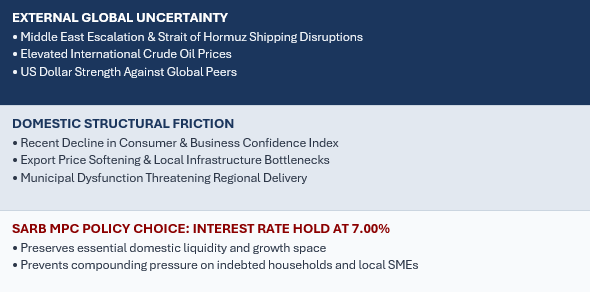
Monetary policy cannot unblock international shipping lanes or lower global oil spot prices. Squeezing South African consumers and businesses with higher borrowing costs to offset a global supply shock would simply punish the domestic market without fixing the root cause. While the Reserve Bank noted that world economic growth and global inflation expectations have remained roughly unchanged, it also observed key currency divergence: the US Dollar has strengthened against most global peers, whereas the Rand gained modest ground against the Euro, offering a slight domestic buffer.

2. Respecting Domestic Growth and Local Fragilities

While economic activity in South Africa surprised to the upside in the first quarter of 2026, recent indicators signal that momentum remains fragile. Recent monthly readings show a clear decline in both Consumer Confidence and Business Confidence, alongside a slight softening in export prices for key South African commodities.

  • Infrastructure Bottlenecks: Import and export logistics hurdles continue to restrict operational efficiency and throughput for local producers.
  • Municipal Dysfunction: Deteriorating service delivery across poorly managed municipalities requires urgent intervention to support regional commerce and protect local balance sheets.

Had the Reserve Bank added another 25 basis points to local borrowing costs, it would have intensified financial strain on households and small-to-medium enterprises (SMEs) already navigating operational disruptions.

3. Inflation Outlook: High, Sticky, but Improving

The Reserve Bank’s decision is not a sign of complacency regarding inflation. The MPC explicitly acknowledged that headline inflation is expected to remain high and sticky into 2027, with services inflation staying elevated over the coming months. However, there were encouraging signals in the details:

  • Food Inflation Moderation: Food price pressures eased slightly, providing vital relief to low- and middle-income households.
  • Improved Medium-Term Trajectory: Overall, the medium-term inflation outlook looks slightly better than it did during the previous meeting.
  • Upside Risks: The SARB sees clear upside risks on the horizon and emphasised that all future rate decisions will remain strictly data-driven.

The Bottom Line

The SARB expects economic recovery to regain traction in the latter stages of 2026. By choosing to hold the repo rate steady at 7.00% today, the Monetary Policy Committee successfully struck a balance between maintaining a cautious, inflation-aware stance and providing the real economy with the room it desperately needs to breathe, invest, and rebuild.


More Coverage

The US Federal Reserve’s decision to keep interest rates unchanged at 3.50%–3.75%, alongside the South African Reserve Bank’s decision to hold the repo rate at 7.00%, has provided South Africa with valuable economic breathing room. By preserving investor confidence, supporting the Rand, and easing pressure on domestic borrowing costs, the coordinated pause has helped shield the economy from global uncertainty while creating a more stable environment for businesses, consumers, and long-term economic recovery.
In a surprising yet calculated move, the South African Reserve Bank’s Monetary Policy Committee opted to hold the repo rate steady at 7.00%, defying market predictions of a rate hike amidst rising inflation concerns. With a 4–2 split vote, the Committee’s decision reflects a strategic balance between tackling global inflationary pressures caused by external supply shocks and addressing domestic economic fragilities. The SARB aims to protect South Africa’s growth by preserving liquidity and avoiding additional burdens on consumers and SMEs, who are already grappling with local infrastructure challenges and municipal dysfunction. Despite recognising persistent inflation, especially in services, the Bank remains cautious but data-driven, addressing risks while betting on economic recovery momentum in late 2026. Discover why this prudent approach may well be the key to steering South Africa through current economic uncertainties.
In “The SARB’s Dilemma: Why a 25-Basis-Point Rate Hike Would Be the Wrong Medicine for South Africa,” the article highlights the crucial choice facing the South African Reserve Bank (SARB) amid rising inflation, driven primarily by external factors like global oil volatility. As the Monetary Policy Committee prepares to meet, the piece argues against the anticipated 25-basis-point increase in the repo rate, asserting that such action would unfairly burden households and businesses already grappling with financial strain. Instead, the article advocates for a hold position, emphasizing that this approach would preserve liquidity in a struggling economy, support private sector growth, and allow for necessary structural reforms to take root. Readers will find compelling insights on the economic implications of SARB’s decision and the importance of distinguishing between domestic demand and external pressures.
In June 2026, the Consumer Price Index (CPI) saw a significant increase of 5.0% year-on-year, overtaking May’s 4.5% rise and exceeding market predictions. The surge, driven by notable upticks in housing, utilities, transport, and financial services, signals a persistent inflationary trend that has once again breached the Reserve Bank’s upper target limit. This economic pressure is eroding household purchasing power in South Africa, exacerbated by enduring high interest rates and elevated fuel prices due to ongoing global conflicts. As businesses and consumers increasingly lean on short-term credit, they face heightened vulnerability to volatile interest rates, exchange rates, and import costs. This report delves into the multifaceted impact of these economic challenges, painting a vivid picture of South Africa’s current inflation dynamics and its implications for the future.
With inflation largely driven by global supply-side pressures rather than strong consumer demand, another SARB interest rate hike may do little to reduce price increases while placing additional strain on already financially stretched South African households. Although higher rates may help anchor inflation expectations and support the Rand, they risk slowing economic growth, increasing loan defaults, and further weakening consumer spending.