

Strategic Breathing Room: How the US Fed Rate Hold Anchors South Africa’s Economic Recovery
The decision by the US Federal Reserve to hold its benchmark interest rate steady at 3.50%–3.75% has turned out to be a welcome development for South Africa’s economy. Coming closely on the heels of the South African Reserve Bank’s (SARB) decision to keep the local repo rate unchanged at 7.00% (prime at 10.50%), the Fed’s pause has stabilised capital flows, defended the Rand, and preserved much-needed domestic market liquidity.
1. Protecting the Interest Rate Differential and Capital Flows
In global finance, capital flows toward risk-adjusted yield. When the US central bank raises interest rates, the interest rate differential, the gap between South African and US yields, narrows. Had the Federal Reserve tightened further, global investors would have moved capital out of emerging markets and back into lower-risk US Dollar assets, triggering a sharp sell-off in South African securities.
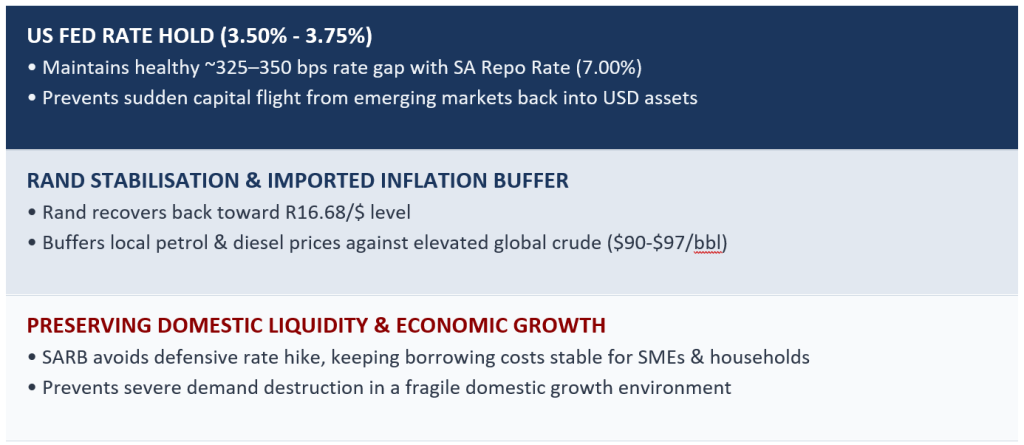
By holding rates steady, the Fed preserved a comfortable 325-to-350 basis-point spread. Combined with high real yields on South African Government Bonds (SAGBs), where benchmark 10-year yields trade near 8.50%, foreign investors retained their appetite for Rand-denominated income assets. This sustained inflow helped the Rand recover from its initial post-MPC volatility near R16.98/$, steadying back toward R16.68–R16.80/$.
2. Buffering South Africa Against Global Oil Shocks
The currency recovery provides vital insulation against external inflation. Ongoing geopolitical conflict in the Middle East and shipping disruptions around the Strait of Hormuz have kept Brent crude prices elevated between $90 and $97 per barrel. Because oil is priced in US Dollars, a weakening Rand would have magnified local fuel price increases at the pump, spilling over into transport logistics, food inflation, and consumer basket costs.
The steadying Rand acts as a critical shock absorber, softening the blow of expensive energy imports and containing second-round inflationary pressure across domestic supply chains.
3. Preserving Domestic Liquidity and Supporting Local Businesses
Perhaps the greatest benefit of this policy alignment is that it spared South African households and businesses from another interest rate hike. Had the Fed raised rates, the SARB might have felt compelled to execute a defensive 25-basis-point hike to defend the Rand, raising prime lending rates to 10.75%.
With domestic consumer and business confidence already subdued, further rate tightening would have drained critical liquidity from the market, increasing debt servicing burdens for SMEs and stifling discretionary household demand. By holding rates steady, monetary authorities avoided compounding domestic friction, giving the real economy room to navigate structural challenges such as municipal debt recovery and infrastructure bottlenecks.
The Bottom Line
The decision by both central banks to maintain interest rate stability has granted South Africa much-needed operational space. While global energy costs and geopolitical risks remain persistent, preserving local market liquidity and capital inflows ensures the domestic economy remains resilient without sacrificing underlying growth capacity.


