Copyright © Aluma Capital (Pty) Ltd. All rights reserved.
Aluma Capital (Pty) Ltd is a registered Financial Services Provider (FSP 46449) in terms of The Financial Advisory and Intermediary Services Act (37 of 2002)
December 17, 2025

Mining Production and Sales

October 2025
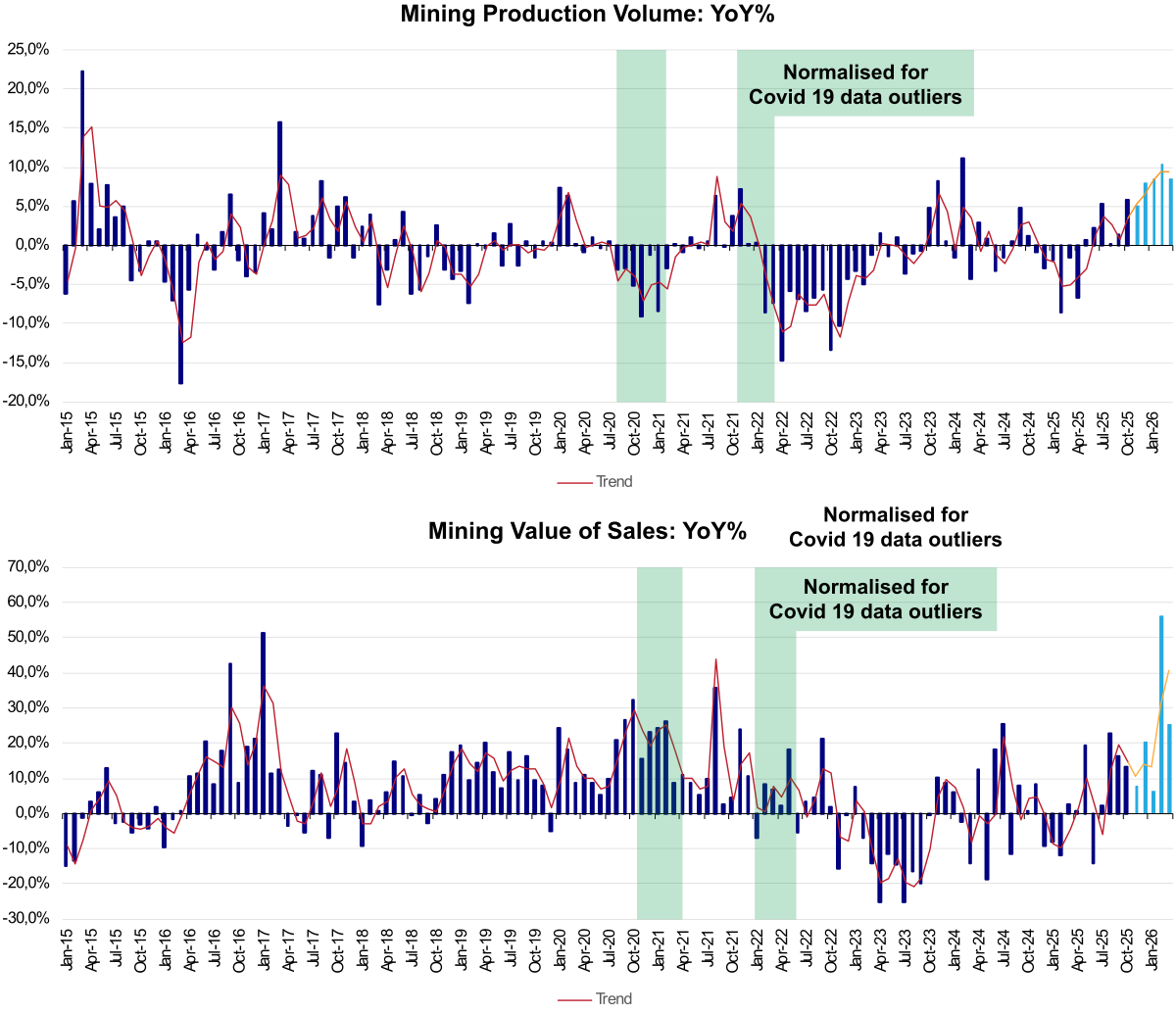
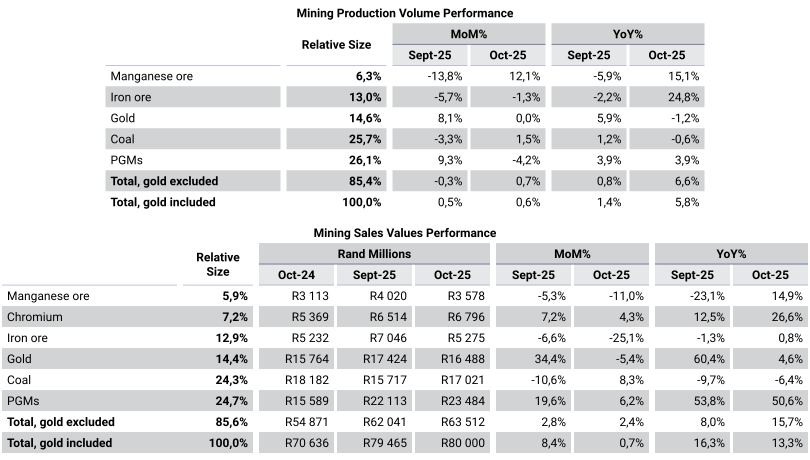
In October 2025, mining activity in South Africa saw a year-on-year increase of 5.8%, following a 1.4% rise recorded in September.

This growth was mainly attributed to:

  • A 3.9% increase in platinum production, contributing 1.1 percentage points to the overall monthly output.
  • A significant 15.1% rise in manganese ore, which added another 1.0 percentage point.
  • A 14.1% increase in chromium mining, contributing an additional 0.8 percentage points to total monthly production.
  • Iron ore production, which grew by 24.8%, contributing a further 2.9 percentage points.

Seasonally adjusted mining production for the three months ending in October rose by 2.3% compared to the previous three months ending in July. This quarterly growth was primarily driven by:

  • Platinum mining, which expanded by 4.1%, contributing 1.1 percentage points.
  • An increase in iron ore mining by 3.2%, adding 0.5 percentage points.
  • Manganese ore, which grew by 5.7%, contributing an additional 0.4 percentage points.

Nominal mining sales climbed by 13.3% in October, buoyed by several subsectors:

  • Platinum sales surged by 50.6%, contributing 11.2 percentage points to the total growth in mining sales.
  • Gold sales increased by 4.6%, adding 1.0 percentage point.
  • Chromium ore sales rose by 26.6%, contributing another 2.0 percentage points.

The largest negative contributor to mining sales growth for the month was coal, which experienced a decline of 6.4%, subtracting 1.4 percentage points from overall mining sales.

The mining sector remains essential to South Africa’s economy, generating foreign exchange and providing employment for approximately 449,000 people—16,000 more than the previous quarter, according to StatsSA labour statistics for Q3 2025. The sector experienced a 2.3% growth from the second to the third quarter of 2025, based on recent GDP data, which is encouraging, given its ongoing importance for employment and foreign earnings in the South African economy.

Employment in the industry has seen a slight increase compared to the previous quarter, highlighting its continued relevance. However, several challenges persist, including concerns regarding exports to the US following new tariff measures introduced on 7 August, proposed export tariffs on manganese, and import tariffs on steel exports to the Eurozone. The sector also faces potential risks related to the loss of AGOA benefits in September and discussions regarding exclusion from a potential two-year extension of the AGOA agreement by the US government, alongside ongoing issues related to the new Mining Charter.

On the international front, geopolitical tensions between the US and China, characterised by trade conflicts and tariff disputes, continue to disrupt global markets and limit trade flows. However, some positive developments have arisen, such as the temporary exemption of certain mining materials used in steelmaking from high US tariffs, providing some relief for the sector, which remains crucial to South Africa’s economy in terms of employment, foreign exchange earnings, and overall growth.


More Coverage

South Africa is trapped in severe economic stagnation, facing a projected 1.0% growth rate for 2026, 33.6% unemployment, and sharp contractions in mining (-12.7%) and manufacturing (-4.3%). Exposed to global fuel shocks via depleted reserves and >R12.00/litre pump levies, the nation is also caught in a fiscal spiral where national debt nears 80% of GDP and interest payments exceed R1 billion daily. Escaping this trap requires four urgent structural reforms: halting interest rate hikes for supply-side inflation, replacing rigid B-BBEE quotas with job-creation incentives, scrapping Expropriation Without Compensation (EWC), and deregulating Transnet’s logistics corridors.
South Africa’s mining sector remains a vital source of jobs, foreign exchange and economic growth, but August’s sharp fall in mining output and sales highlights the mounting pressure on the industry. Rising fuel and energy costs, policy uncertainty and growing trade challenges are weighing on producers, even as firm gold prices and temporary US tariff exemptions offer some relief. Read the full report for a closer look at the latest figures, the forces shaping the sector and what they could mean for mining’s future in South Africa.
A $100-plus oil price, a weaker rand and record fuel hikes are putting South Africa’s economy under mounting pressure, while strategic reserves offer little protection. This report examines how imported inflation is squeezing households and businesses, why higher interest rates may do little to tackle its root causes, and how sluggish growth and rising debt are tightening the fiscal squeeze. It also explores the stakes for trade with the United States and AGOA, and the policy choices that could restore investor confidence, unlock growth and put the country on a more resilient path.
South Africa recorded a trade surplus of R20.4 billion in August 2026, as exports continued to outpace imports. Export growth has exceeded import growth over the first eight months of the year, reflecting subdued domestic demand among businesses and consumers. But with higher fuel prices and tighter monetary policy expected to weigh on spending, demand is likely to recover only gradually. Read the full report for a closer look at the trade figures and what they could mean for South Africa’s economy in the months ahead.
South Africa’s credit market is showing surprising resilience, with credit demand rising by 7.5% in August 2026 despite renewed interest-rate pressure, elevated inflation and mounting household costs. While mortgage advances continued to grow, the fragile recovery in the property market highlights the strain caused by subdued investment, high debt levels and rising municipal and energy expenses. At the same time, sluggish instalment credit growth and continued reliance on short-term borrowing reveal how consumers are navigating increasingly difficult financial conditions. With higher oil prices, geopolitical risks and further SARB tightening adding to the pressure, this report examines what the latest credit trends reveal about household finances, business confidence and the broader South African economy.