Copyright © Aluma Capital (Pty) Ltd. All rights reserved.
Aluma Capital (Pty) Ltd is a registered Financial Services Provider (FSP 46449) in terms of The Financial Advisory and Intermediary Services Act (37 of 2002)
April 22, 2026

Consumer Inflation – March 2026
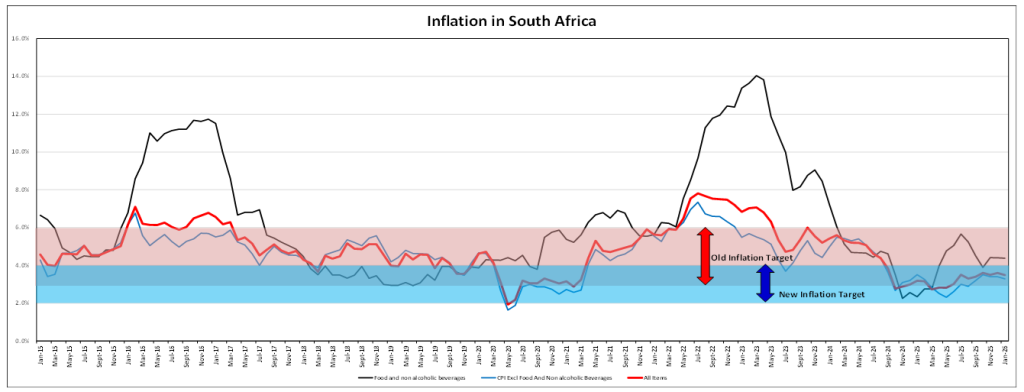
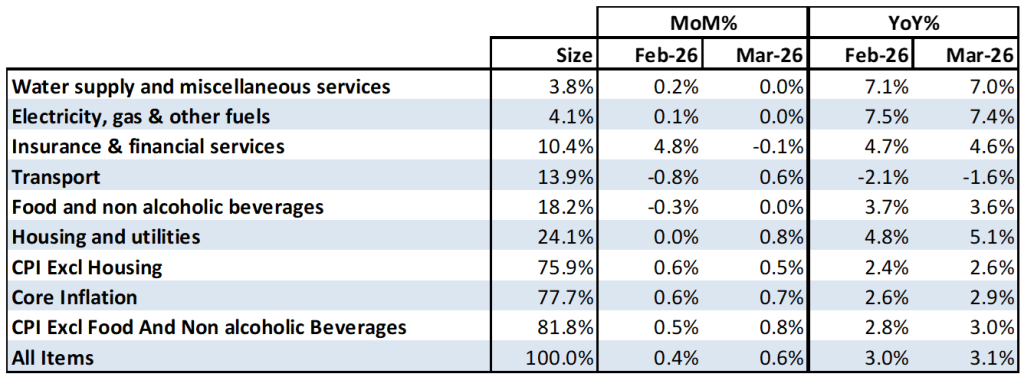
In March 2026, South Africa’s Consumer Price Index (CPI) rose 3.1% year-on-year, slightly above the previous month’s 3.0% and below the forecast of 4.1%. This was mainly driven by increases in housing, utilities, food, and financial services, pushing services inflation just over the Reserve Bank’s upper target limit. As rising inflation erodes purchasing power, many rely on short-term credit, increasing exposure to economic shifts. The Reserve Bank, cautious amid global uncertainties like the Middle East conflict and high fuel prices, maintained interest rates, although potential hikes loom to stabilise prices. Despite positive but modest economic growth, ongoing global tensions, notably the US-China tariff dispute and potential BRICS tariffs, alongside persistent high oil prices, threaten stability. The focus on maintaining price stability and safeguarding the Rand’s value remains paramount as South Africa navigates these challenges in 2026.

In March 2026, the Consumer Price Index (CPI) increased by 3.1% year-on-year, which is slightly higher than the 3.0% recorded in February and notably below analysts’ forecast of 4.1%. This rise in consumer prices was primarily driven by:

  • Housing and Utilities: Increased by 5.1%, contributing 1.2 percentage points.
  • Food and Non-Alcoholic Beverages: Increased by 3.6%, contributing 0.6 percentage points.
  • Insurance and Financial Services: Increased by 4.6%, contributing 0.5 percentage points.

Year-on-year, the inflation rate for goods rose by 1.8%, compared to 1.9% in February. Meanwhile, services inflation increased by 4.2%, up from 3.8% the previous month. Importantly, services inflation just rose above the Reserve Bank’s upper limit of 4.0% within the new inflation target range. This ongoing rise in services inflation, while just above the target limit, continues to diminish household purchasing power in South Africa. Consequently, many consumers and businesses remain dependent on short-term credit to sustain their consumption and liquidity, which exposes both groups to greater vulnerability to shifts in interest rates, exchange rates, international oil prices, and import costs, thereby affecting domestic prices. This is even more true with the ongoing conflict in the Middle East and the huge increase in fuel prices in April, which will likely cause inflationary pressure in the months to follow.

At the end of the January 2026 Monetary Policy Committee (MPC) meeting, the Reserve Bank decided to keep interest rates unchanged, having assessed inflation figures and forecasts for January. The Bank is anticipated to remain cautious about inflation, particularly in light of the Middle East conflict, the significant rise in international oil prices, and the resulting increase in fuel costs of R3 to R7 across the economy. These factors are likely to shape inflation expectations moving forward. The Bank’s prudent approach aims to uphold price stability amid ongoing economic and international uncertainties, including the 30% tariffs imposed by the US on South African exports, which have adversely affected the manufacturing sector, as indicated by Q4 GDP data. Such uncertainties may also impact the Rand’s exchange rate against the US dollar, even as the Rand depreciates, with investors shifting away from emerging-market assets in favour of safer, more stable investments amid the current Middle East conflict.

The South African Reserve Bank (SARB) may pause the rate-cutting cycle in light of persistently higher international fuel prices and may even raise interest rates this year to ensure price stability and keep inflation expectations grounded for as long as possible. The interest rate cuts, however, instituted in late 2024 and throughout 2025, along with a reduction in November 2025, are designed to stimulate demand by increasing disposable income for households after interest payments, thereby fostering economic growth. However, the surge in fuel prices may moderately hinder this potential.

Despite a continued positive growth, albeit slightly revised downwards for 2026, the Reserve Bank remains cautious due to persistent global uncertainties. Factors such as inflation, the US-China tariff dispute, and possible future tariffs on BRICS nations could affect price stability. Furthermore, the ongoing Middle East conflict may keep international oil prices elevated if safe passage for shipping cannot be guaranteed through the Strait of Hormuz or if the strait is completely closed as a result of conflict. Future interest rate decisions are likely to take into account moderate inflation within the new target band, sluggish economic growth, improvements in electricity supply, positive market sentiment, and international tensions that could influence oil prices.

In conclusion, sustaining price stability and safeguarding the value of the Rand are top priorities for South Africa as it navigates the early months of 2026, in light of current international developments and the uncertainties they bring.


More Coverage

South Africa is trapped in severe economic stagnation, facing a projected 1.0% growth rate for 2026, 33.6% unemployment, and sharp contractions in mining (-12.7%) and manufacturing (-4.3%). Exposed to global fuel shocks via depleted reserves and >R12.00/litre pump levies, the nation is also caught in a fiscal spiral where national debt nears 80% of GDP and interest payments exceed R1 billion daily. Escaping this trap requires four urgent structural reforms: halting interest rate hikes for supply-side inflation, replacing rigid B-BBEE quotas with job-creation incentives, scrapping Expropriation Without Compensation (EWC), and deregulating Transnet’s logistics corridors.
South Africa’s mining sector remains a vital source of jobs, foreign exchange and economic growth, but August’s sharp fall in mining output and sales highlights the mounting pressure on the industry. Rising fuel and energy costs, policy uncertainty and growing trade challenges are weighing on producers, even as firm gold prices and temporary US tariff exemptions offer some relief. Read the full report for a closer look at the latest figures, the forces shaping the sector and what they could mean for mining’s future in South Africa.
A $100-plus oil price, a weaker rand and record fuel hikes are putting South Africa’s economy under mounting pressure, while strategic reserves offer little protection. This report examines how imported inflation is squeezing households and businesses, why higher interest rates may do little to tackle its root causes, and how sluggish growth and rising debt are tightening the fiscal squeeze. It also explores the stakes for trade with the United States and AGOA, and the policy choices that could restore investor confidence, unlock growth and put the country on a more resilient path.
South Africa recorded a trade surplus of R20.4 billion in August 2026, as exports continued to outpace imports. Export growth has exceeded import growth over the first eight months of the year, reflecting subdued domestic demand among businesses and consumers. But with higher fuel prices and tighter monetary policy expected to weigh on spending, demand is likely to recover only gradually. Read the full report for a closer look at the trade figures and what they could mean for South Africa’s economy in the months ahead.
South Africa’s credit market is showing surprising resilience, with credit demand rising by 7.5% in August 2026 despite renewed interest-rate pressure, elevated inflation and mounting household costs. While mortgage advances continued to grow, the fragile recovery in the property market highlights the strain caused by subdued investment, high debt levels and rising municipal and energy expenses. At the same time, sluggish instalment credit growth and continued reliance on short-term borrowing reveal how consumers are navigating increasingly difficult financial conditions. With higher oil prices, geopolitical risks and further SARB tightening adding to the pressure, this report examines what the latest credit trends reveal about household finances, business confidence and the broader South African economy.