Copyright © Aluma Capital (Pty) Ltd. All rights reserved.
Aluma Capital (Pty) Ltd is a registered Financial Services Provider (FSP 46449) in terms of The Financial Advisory and Intermediary Services Act (37 of 2002)
June 17, 2026

Consumer Inflation – April 2026
In the latest analysis on South Africa’s economic landscape, our article delves into the implications of the recent 4.5% year-on-year rise in the Consumer Price Index (CPI), highlighting critical factors behind this uptick, including significant increases in housing, transport, and financial services. As inflation continues to surpass the Reserve Bank’s target, the report examines the resulting strain on household purchasing power and the rising reliance on short-term credit amid fluctuating global conditions. The article further explores the complexities of recent monetary policy decisions, including the Reserve Bank’s cautious approach to interest rates in response to these economic pressures exacerbated by international conflicts and tariff impacts. With insights into future inflation expectations and their potential effects on South Africa’s economic stability, this comprehensive report offers valuable perspectives on navigating the challenges ahead. Don’t miss out on the full details that could shape your understanding of the current economic climate!

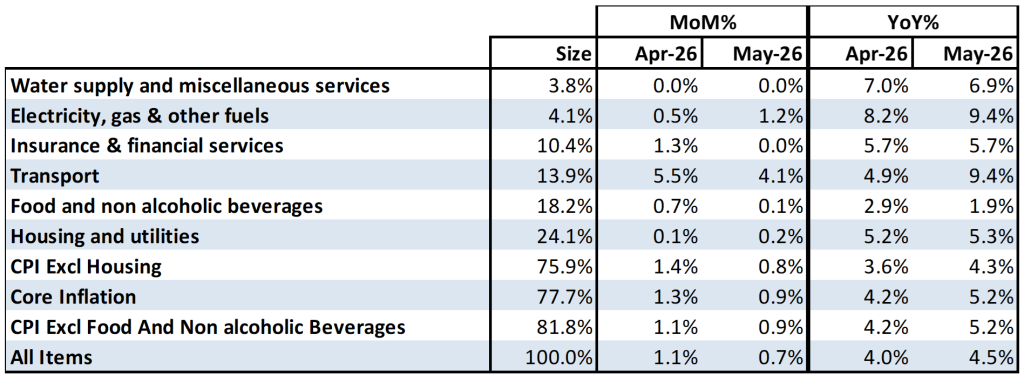
In May 2026, the Consumer Price Index (CPI) rose by 4.5% year-on-year, which is slightly higher than the 4.0% increase recorded in April, yet just below the market’s forecast of 4.7%. This uptick in consumer prices was mainly due to:

  • Housing and Utilities: Increased by 5.3%, contributing 1.3 percentage points.
  • Transport: Jumped by 9.4%, also contributing 1.3 percentage points.
  • Insurance and Financial Services: Went up by 5.7%, adding 0.6 percentage points.

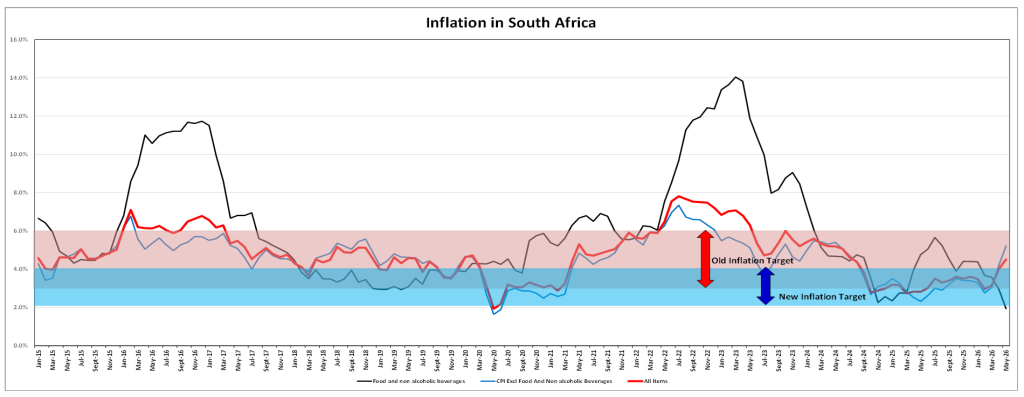
Compared to April, the year-on-year inflation rate for goods climbed from 3.4% to 4.4%. Meanwhile, services inflation rose slightly from 4.6% to 4.7%. Notably, inflation for both goods and services has again surpassed the Reserve Bank’s upper limit of 4.0% within the new target range. This inflationary rise continues to erode household purchasing power in South Africa. Consequently, many consumers and businesses rely more on short-term credit, making them vulnerable to changes in interest rates, exchange rates, global oil prices, and import costs, which in turn affect domestic prices. These vulnerabilities have been exacerbated by the ongoing conflict in the Middle East and the significant increase in fuel prices from April to May, although some relief is expected in June. This scenario is likely to add inflationary pressures in the coming months.

Following the Monetary Policy Committee (MPC) meeting in January 2026, the Reserve Bank chose to keep interest rates unchanged after reviewing January inflation figures and forecasts. However, there was a 25 basis-point increase at the end-of-May meeting due to the recent inflation spike, which stems from the Middle East conflict and rising international oil prices observed in April and May. The elevated fuel and transport costs are anticipated to influence current inflation expectations. The Bank’s cautious stance aims to maintain price stability amid ongoing economic and international uncertainties, including the 30% tariffs imposed by the US on South African exports, which have negatively impacted the manufacturing sector as reflected in the Q4 GDP data. Such uncertainties could also affect the Rand’s value against the US dollar, with expected volatility, particularly with the potential peace deal between the US and Iran and the reopening of the Strait of Hormuz on the horizon.

Due to the consistently high international fuel prices, the South African Reserve Bank (SARB) has temporarily paused the rate-cutting cycle to ensure price stability and anchor inflation expectations. Prior interest rate cuts in late 2024, throughout 2025, and another in November 2025 were aimed at stimulating demand by increasing disposable income for households beyond interest payments, fostering economic growth. However, rising fuel prices may somewhat limit this growth potential.

Despite sustained economic growth of 0.5% in the first quarter of 2026, the Bank remains wary due to persistent global uncertainties. Factors such as inflation, the US-China tariff dispute, and the possibility of future tariffs on BRICS nations could affect price stability. Furthermore, the Middle East conflict may continue to keep international oil prices high if shipping safety cannot be assured through the Strait of Hormuz or if the proposed peace deal collapses and the strait is closed off again. Future interest rate decisions will likely consider moderate inflation within the new target band, slow economic growth, improvements in electricity supply, positive market sentiment, and international tensions impacting oil prices.

In conclusion, maintaining price stability and protecting the Rand’s value are top priorities for South Africa as it navigates the initial months of 2026, amid current international developments and associated uncertainties.


More Coverage

In the latest analysis on South Africa’s economic landscape, our article delves into the implications of the recent 4.5% year-on-year rise in the Consumer Price Index (CPI), highlighting critical factors behind this uptick, including significant increases in housing, transport, and financial services. As inflation continues to surpass the Reserve Bank’s target, the report examines the resulting strain on household purchasing power and the rising reliance on short-term credit amid fluctuating global conditions. The article further explores the complexities of recent monetary policy decisions, including the Reserve Bank’s cautious approach to interest rates in response to these economic pressures exacerbated by international conflicts and tariff impacts. With insights into future inflation expectations and their potential effects on South Africa’s economic stability, this comprehensive report offers valuable perspectives on navigating the challenges ahead. Don’t miss out on the full details that could shape your understanding of the current economic climate!
In April 2026, South Africa’s mining sector saw a significant resurgence, with an impressive 8.2% growth in activity driven by a remarkable 36.5% increase in platinum group metals (PGM) production. The industry’s vitality is evident in the rolling quarter growth of 2.4%, bolstered by surging platinum and gold outputs. With mining sales soaring by 30.3%, supported by a dramatic upswing in platinum and gold sales, the sector remains a cornerstone of South Africa’s economy, providing crucial employment and foreign exchange. Despite this historic success, challenges loom, such as geopolitical tensions, new tariffs, and the loss of key international trade benefits, threatening future stability. Discover how South Africa’s mining industry is navigating these turbulent times, seizing opportunities, and overcoming the obstacles posed by international and domestic pressures in this compelling report.
In the wake of interest rate cuts by the South African Reserve Bank since September 2024, credit demand saw an uptick of 8.5% in March 2026, narrowly missing market expectations. Despite the encouraging growth across various credit segments, the property market remains sluggish due to persistent high consumer debt, slow wage growth, and rising living costs, particularly driven by soaring international oil prices and high administered rates. As South Africans increasingly turn to short-term credit to cope with these pressures, an upward trend in instalment sales and other loans is evident, with an anticipation of future benefits from reduced interest rates potentially offset by looming inflationary threats linked to the ongoing Middle East conflict. Explore how these dynamics may unfold in the remainder of 2026 and influence South Africa’s economic landscape.
In the face of South Africa’s proposed Draft Capital Flow Management Regulations, a transformative shift in how the country handles digital wealth is imminent. By redefining cryptocurrencies as “capital” and enforcing stringent penalties, South Africa aims to build a digital barrier around its economy. However, this “Regulatory Firewall” faces the immense challenge of controlling decentralised assets, akin to China’s struggle with the “Great Firewall.” The proposed measures could inadvertently push financial innovation underground, risking an unintended exodus of talent and investment to jurisdictions with a more favourable stance on digital finance. This article explores the critical implications of such regulatory hurdles, emphasising the need for a balanced, risk-based framework that supports transparency and innovation, averting the pitfalls of overly rigid controls.
In February 2026, South Africa witnessed a 1.6% rise in retail sales, signalling a fragile yet ongoing recovery in consumer demand, though falling short of the 4.8% expected by analysts. Despite challenges like rising administered prices and sluggish wage growth, this growth persists. Factors such as interest-rate cuts between September 2024 and November 2025 support the retail upswing, highlighted by a rise in both the South African Chamber of Commerce’s business confidence index and the FNB/BER consumer confidence index. Key contributors to the February increase include a 9.4% rise in sales from other retailers and a 3.9% uptick in textiles and apparel, indicating cautious but sustained recovery amidst economic uncertainties.