Copyright © Aluma Capital (Pty) Ltd. All rights reserved.
Aluma Capital (Pty) Ltd is a registered Financial Services Provider (FSP 46449) in terms of The Financial Advisory and Intermediary Services Act (37 of 2002)
July 16, 2026

Mining Production and Sales for April 2026

In May 2026 South Africa’s mining sector slipped into contraction, down 5.4% month on month after April’s revised 8.0% gain — driven by steep declines in iron ore ( 12.7), coal ( 6.1) and PGMs ( 4.4) that together shaved several percentage points off output; mining output for the rolling quarter fell 1.7%, led by drops in manganese, other metallics and coal. Yet nominal mining sales surged 13.9% on a 70.5% jump in platinum, stronger gold and coal receipts, underscoring a split between weaker physical production and firmer export earnings. With the sector employing roughly 476,000 people, having expanded in Q1 2026 amid higher gold and platinum prices, the industry remains central to South Africa’s economy, even as it grapples with new trade tariffs (including US and proposed manganese measures), the loss of AGOA preferences, and uncertainty around the Mining Charter. Read the full report for detailed drivers, regional implications, and policy paths to stabilise output and sustain foreign earnings resilience

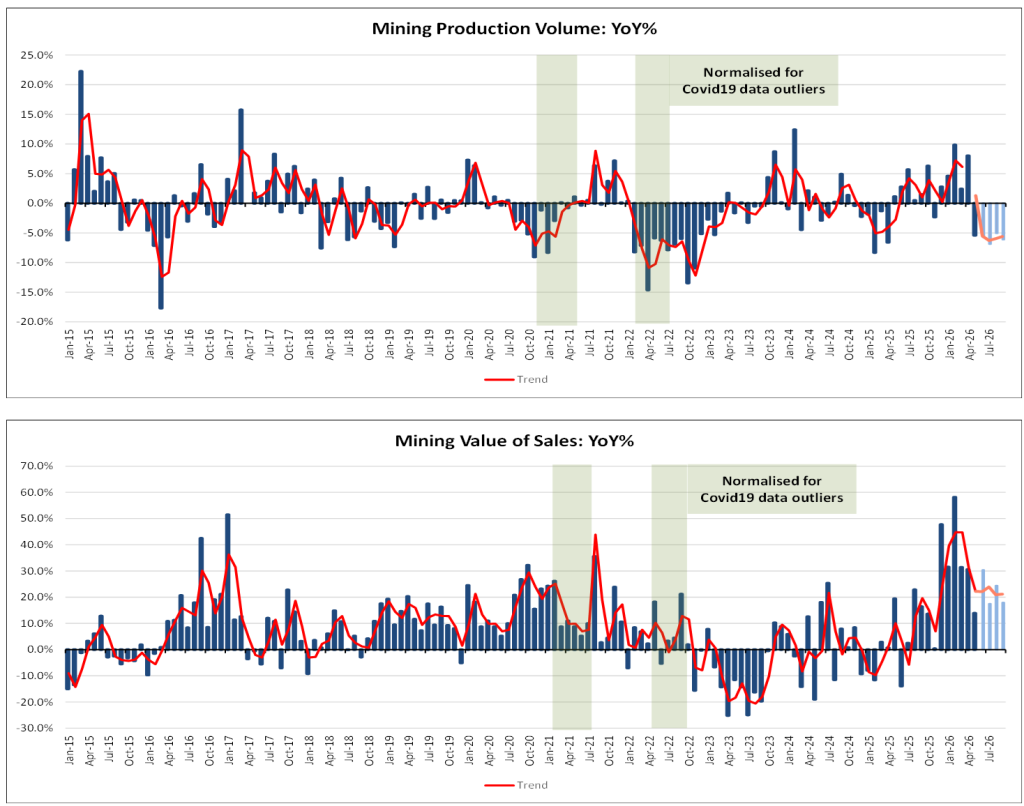
In May 2026, South Africa’s mining activity contracted by 5.4% following the revised 8.0% increase recorded in April 2026. This contraction was predominantly driven by:

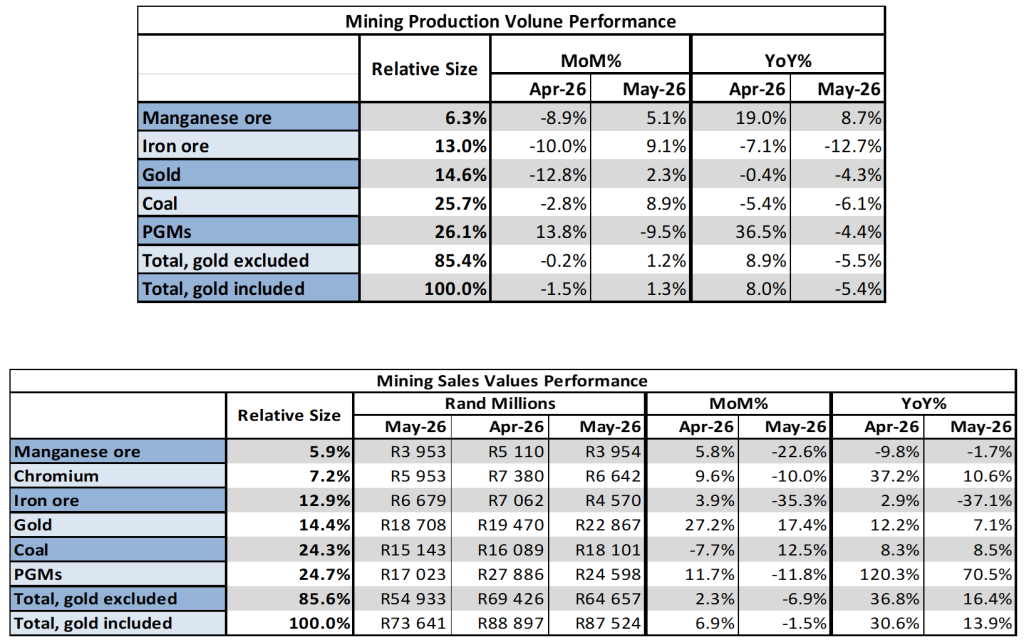
  • A 12.7% decrease in Iron ore mining production, which contributed -2.1 percentage points to the overall mining output for the month.
  • Coal production decreased by 6.1%% during May, while it subtracted 1.5 percentage points from mining production growth and
  • A 4.4% contraction in PGM production, which stripped an additional 1.21 percentage points from total mining output growth for the month.

For the rolling quarter ending May 2026, compared with the previous rolling quarter, seasonally adjusted mining output decreased by 1.7%. This decrease was primarily due to:

  • A 5.8% decrease in manganese mining, which decreased total mining production by 0.5 percentage points,
  • A decrease in mining of ‘other’ metallic minerals, which contracted by 16.2% and subtracted 0.4 percentage points for the quarter under review, and
  • Coal mining, which declined by 1.8% and subtracted an additional 0.4 percentage points from mining output for the quarter.

In May, nominal mining sales rose 13.9%. This positive trend was notably supported by:

  • A 70.5% surge in platinum sales, which added 13.2 percentage points to overall mining sales growth.
  • Another 7.1% rise in gold sales, contributing 2.0 percentage points and
  • Coal sales, which grew by 8.5% and added another 1.8 percentage points towards overall mining sales growth for May 2026.

The mining sector remains vital to South Africa’s economy, generating foreign exchange and employing approximately 476,000 people, an increase of around 32,000 from the previous quarter, according to StatsSA labour statistics for the first quarter of 2026. According to the latest GDP data, the mining sector grew by 5.7% during the first quarter of 2026, driven by a notable increase in global gold and platinum prices due to the ongoing conflict in the Middle East and the subsequent flight to safe-haven assets such as gold. This sector remains crucial for the South African economy due to the number of people employed within it and in associated auxiliary businesses, and its importance in earning foreign reserves.

However, challenges persist, including concerns over exports to the US following new tariff measures introduced on 7 August, proposed export tariffs on manganese, and import tariffs on steel exports to the Eurozone. The sector also faces challenges related to the loss of AGOA benefits in September and ongoing issues with the new Mining Charter.

Internationally, tensions between the US and China are rising, primarily due to trade disputes and tariff wars. These issues are further complicated by the ongoing conflict in the Middle East, particularly between the US, Israel, and Iran, as well as the re-closure of the Strait of Hormuz. This situation continues to drive up fuel and production costs for South Africa’s manufacturing and mining sectors in the short- to medium-term, at least.

These geopolitical challenges and the conflict in the Middle East are disrupting global markets and limiting trade, as evidenced by data released since the conflict began. However, there is some good news: certain mining materials essential to steelmaking remain temporarily exempt from high US tariffs. This exemption offers some relief to the mining sector, which is vital to South Africa’s economy, providing jobs and foreign exchange and supporting overall growth.


More Coverage

In May 2026 South Africa’s mining sector slipped into contraction, down 5.4% month on month after April’s revised 8.0% gain — driven by steep declines in iron ore ( 12.7), coal ( 6.1) and PGMs ( 4.4) that together shaved several percentage points off output; mining output for the rolling quarter fell 1.7%, led by drops in manganese, other metallics and coal. Yet nominal mining sales surged 13.9% on a 70.5% jump in platinum, stronger gold and coal receipts, underscoring a split between weaker physical production and firmer export earnings. With the sector employing roughly 476,000 people, having expanded in Q1 2026 amid higher gold and platinum prices, the industry remains central to South Africa’s economy, even as it grapples with new trade tariffs (including US and proposed manganese measures), the loss of AGOA preferences, and uncertainty around the Mining Charter. Read the full report for detailed drivers, regional implications, and policy paths to stabilise output and sustain foreign earnings resilience
In “South Africa’s Inflation Dilemma: Why Bleeding an Anaemic Patient Won’t Cure the Illness,” the article navigates the precarious economic landscape facing South Africa amidst rising inflation and stagnant growth. With consumer demand faltering due to slow wage growth, recent fuel price hikes, and increased municipal fees, the country stands at a critical junction. The looming threat of another interest rate hike by the South African Reserve Bank could further cripple an already fragile economy, likened to an anaemic patient, with potential long-term repercussions for job creation and corporate investment. However, recent geopolitical developments offer a flicker of hope, as a ceasefire in the US-Iran conflict has led to a decline in global oil prices, promising immediate relief for consumers and a slower inflation trajectory. The article argues that maintaining the current repo rate is essential to allow this relief to translate into economic growth and stability. Dive into the full report to explore how South Africa can navigate these turbulent waters without sacrificing its fragile economic health.
In a rapidly shifting economic landscape, May 2026 saw credit demand growth of 8.6%, falling short of the anticipated 9.4% forecast. Since interest rate cuts began in September 2024, credit growth has generally surged, particularly following strategic interest rate reductions by the South African Reserve Bank amidst global tensions and skyrocketing energy costs. However, the South African property market stagnates due to soaring consumer debts, muted wage increases, and escalating living expenses, notably in household fuel and utility prices. While instalment credit sales posted a modest rise, the reliance on short-term credit underscores consumer struggles with surging living costs. With inflation hovering above target and persistent high fuel prices, the anticipated interest rate hike in July could further suppress demand, adding pressure to the already challenging economic recovery. Discover the dynamics shaping South Africa’s financial climate in this insightful analysis.
In May 2026, producer price inflation surged to 7.8%, driven by significant fuel price shocks that impacted goods leaving the factory gate. Important sectors saw remarkable price hikes, with Coke, petroleum, and chemical products alone rising by 22%. Meanwhile, mining costs soared by 28.1%, heightening concerns about ongoing inflationary pressures. With consumer inflation climbing to 4.5%, surpassing the South African Reserve Bank’s target of 2% to 4%, the economic landscape is becoming increasingly unstable. Readers will find critical insights into how these trends affect overall inflation expectations and the imminent interest rate decisions that could shape South Africa’s economic future. Dive into the full report for a comprehensive analysis of these pivotal issues and their implications.
Dive into “South Africa’s Crypto Crossroads: Modern Regulation or an Economic Time Machine?” an eye-opening exploration of South Africa’s latest Draft Capital Flow Management Regulations, 2026. As the South African government aims to modernise cross-border financial regulations and tighten digital currency controls, these proposed changes have sparked uproar among fintech leaders and legal experts. The draft threatens to overreach into constitutional rights, potentially stifling innovation and economic growth. With concerns over encroachments on privacy and powers to seize assets, critics argue that the regulations could deter investment and spark a talent exodus. As the public comment period extends, the country’s financial future hangs in the balance, poised between innovation and economic regression. Discover why industry stakeholders are on high alert and advocating for a careful recalibration of this legislative move.