Copyright © Aluma Capital (Pty) Ltd. All rights reserved.
Aluma Capital (Pty) Ltd is a registered Financial Services Provider (FSP 46449) in terms of The Financial Advisory and Intermediary Services Act (37 of 2002)
July 17, 2026

Squeezing a Stone: Why the SARB’s Blunt-Force Rate Hike Threat Misses the Mark for Squeezed Consumers

With inflation largely driven by global supply-side pressures rather than strong consumer demand, another SARB interest rate hike may do little to reduce price increases while placing additional strain on already financially stretched South African households. Although higher rates may help anchor inflation expectations and support the Rand, they risk slowing economic growth, increasing loan defaults, and further weakening consumer spending.

The South African Reserve Bank (SARB) is facing an intense debate as its Monetary Policy Committee (MPC) prepares for its next interest rate decision on 23 July 2026.

With the Rand showing signs of vulnerability at R16.45/$, Producer Price Inflation (PPI) climbing to 7.8%, and Consumer Price Inflation (CPI) ticking up to 4.5%, market expectations are heavily leaning toward another 25-basis-point hike to the repo rate, which currently sits at 7.00% (10.50% Prime).

Yet, for news-oriented and investment-driven market participants, the burning question is not whether they will do it, but rather: Is this the right economic medicine, or are we simply trying to squeeze blood from a stone?

The Blunt Instrument vs. The Structural Sickness

The fundamental critique of further monetary tightening in South Africa lies in the nature of our current inflation. Interest rate hikes are designed to combat demand-pull inflation, when an economy is growing too quickly, and excess cash is chasing too few goods.

However, South Africa is suffering from a textbook case of cost-push inflation, driven by factors entirely outside the SARB’s sphere of influence:

  • Geopolitical Oil Spikes: The recent escalation in the Middle East has kept Brent Crude highly volatile. No amount of domestic rate hikes can alter OPEC supply policies or secure shipping corridors.
  • Factory-Gate Pressures: The 7.8% PPI print shows that input costs are rising long before goods reach retail shelves. Squeezing consumer liquidity does not lower the cost of raw materials or industrial chemicals on global markets.
  • The Diesel Under-Recovery Threat: While temporary petrol over-recoveries offered a brief respite, massive daily under-recoveries in diesel (~R1.90/l) signal that structural transport and logistics costs are set to remain elevated, adding a persistent tax on local business operations.

A Middle Class Running on Empty

Draining further liquidity from the domestic system is highly problematic given the health of the average South African consumer.

The latest TransUnion Q2 2026 Consumer Pulse Study paints a stark picture of the domestic credit climate:

These metrics tell us that the domestic savings buffer has been completely decimated. Draining more liquidity from households that are already running on empty will not stop them from driving to work or buying food. It will simply increase the rate of non-performing loans, erode banking book quality, and severely stall South Africa’s fragile GDP growth trajectory.

The Governor’s Dilemma: Controlling the Uncontrollable

If a rate hike is so economically destructive to the local consumer, why is Governor Lesetja Kganyago still widely expected to pull the trigger? The answer lies in the narrow, rigid mandate of inflation targeting.
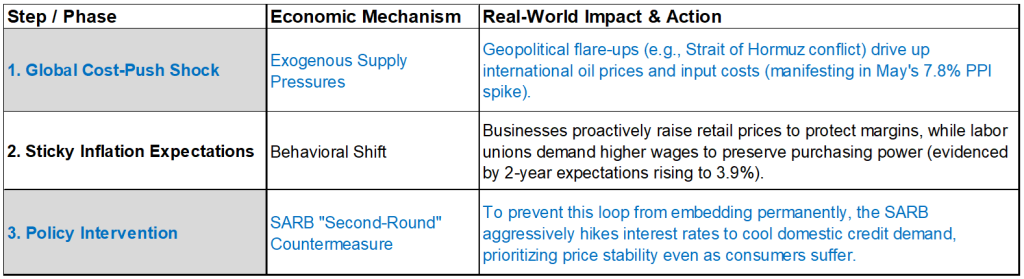
The SARB Hikes Rates to “Break” this Expectation Loop

While the SARB knows it cannot print oil, it is deeply concerned about second-round inflation expectations. According to the latest Bureau for Economic Research (BER) survey, two-year-ahead inflation expectations have risen to 3.9%.

If local businesses and labour unions begin pricing in a permanent 4% to 5% inflation baseline, high prices will become structurally embedded in the economy. By raising rates, the central bank is effectively trying to shock local “price-setters” into keeping their prices low, even if it means triggering a domestic slowdown.

Ultimately, while the SARB’s hawkishness aims to protect the Rand and anchor long-term expectations, it is a blunt tool for a delicate job. Squeezing a dry consumer is a high-risk policy path that will test the resilience of South African investments in the second half of 2026.


More Coverage

In May 2026 South Africa’s mining sector slipped into contraction, down 5.4% month on month after April’s revised 8.0% gain — driven by steep declines in iron ore ( 12.7), coal ( 6.1) and PGMs ( 4.4) that together shaved several percentage points off output; mining output for the rolling quarter fell 1.7%, led by drops in manganese, other metallics and coal. Yet nominal mining sales surged 13.9% on a 70.5% jump in platinum, stronger gold and coal receipts, underscoring a split between weaker physical production and firmer export earnings. With the sector employing roughly 476,000 people, having expanded in Q1 2026 amid higher gold and platinum prices, the industry remains central to South Africa’s economy, even as it grapples with new trade tariffs (including US and proposed manganese measures), the loss of AGOA preferences, and uncertainty around the Mining Charter. Read the full report for detailed drivers, regional implications, and policy paths to stabilise output and sustain foreign earnings resilience
In “South Africa’s Inflation Dilemma: Why Bleeding an Anaemic Patient Won’t Cure the Illness,” the article navigates the precarious economic landscape facing South Africa amidst rising inflation and stagnant growth. With consumer demand faltering due to slow wage growth, recent fuel price hikes, and increased municipal fees, the country stands at a critical junction. The looming threat of another interest rate hike by the South African Reserve Bank could further cripple an already fragile economy, likened to an anaemic patient, with potential long-term repercussions for job creation and corporate investment. However, recent geopolitical developments offer a flicker of hope, as a ceasefire in the US-Iran conflict has led to a decline in global oil prices, promising immediate relief for consumers and a slower inflation trajectory. The article argues that maintaining the current repo rate is essential to allow this relief to translate into economic growth and stability. Dive into the full report to explore how South Africa can navigate these turbulent waters without sacrificing its fragile economic health.
In a rapidly shifting economic landscape, May 2026 saw credit demand growth of 8.6%, falling short of the anticipated 9.4% forecast. Since interest rate cuts began in September 2024, credit growth has generally surged, particularly following strategic interest rate reductions by the South African Reserve Bank amidst global tensions and skyrocketing energy costs. However, the South African property market stagnates due to soaring consumer debts, muted wage increases, and escalating living expenses, notably in household fuel and utility prices. While instalment credit sales posted a modest rise, the reliance on short-term credit underscores consumer struggles with surging living costs. With inflation hovering above target and persistent high fuel prices, the anticipated interest rate hike in July could further suppress demand, adding pressure to the already challenging economic recovery. Discover the dynamics shaping South Africa’s financial climate in this insightful analysis.
In May 2026, producer price inflation surged to 7.8%, driven by significant fuel price shocks that impacted goods leaving the factory gate. Important sectors saw remarkable price hikes, with Coke, petroleum, and chemical products alone rising by 22%. Meanwhile, mining costs soared by 28.1%, heightening concerns about ongoing inflationary pressures. With consumer inflation climbing to 4.5%, surpassing the South African Reserve Bank’s target of 2% to 4%, the economic landscape is becoming increasingly unstable. Readers will find critical insights into how these trends affect overall inflation expectations and the imminent interest rate decisions that could shape South Africa’s economic future. Dive into the full report for a comprehensive analysis of these pivotal issues and their implications.
Dive into “South Africa’s Crypto Crossroads: Modern Regulation or an Economic Time Machine?” an eye-opening exploration of South Africa’s latest Draft Capital Flow Management Regulations, 2026. As the South African government aims to modernise cross-border financial regulations and tighten digital currency controls, these proposed changes have sparked uproar among fintech leaders and legal experts. The draft threatens to overreach into constitutional rights, potentially stifling innovation and economic growth. With concerns over encroachments on privacy and powers to seize assets, critics argue that the regulations could deter investment and spark a talent exodus. As the public comment period extends, the country’s financial future hangs in the balance, poised between innovation and economic regression. Discover why industry stakeholders are on high alert and advocating for a careful recalibration of this legislative move.