

Employment Statistics in South Africa: 2026Q2
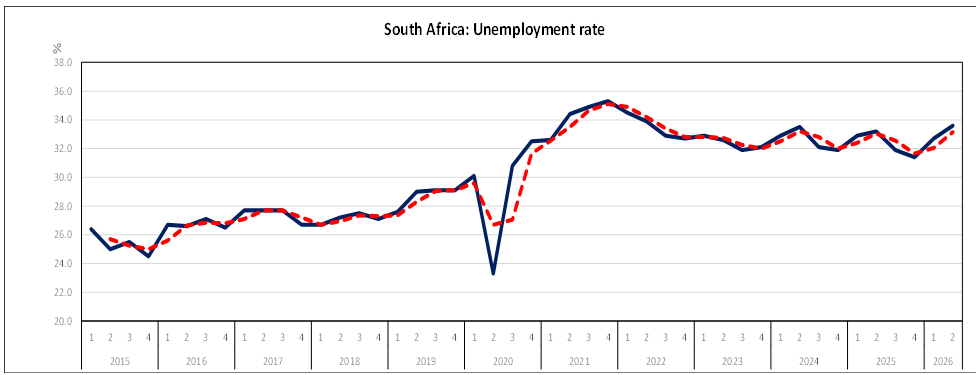
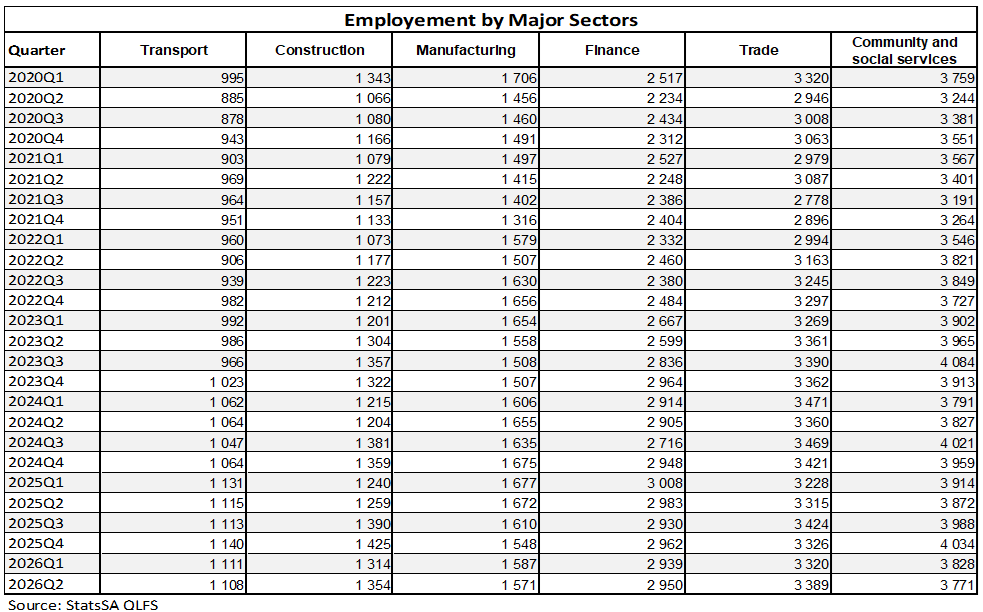
The employment statistics for the second quarter of 2026 again painted a sombre picture across certain sectors, as shown in the preceding table. Some sectors lost employment, with the Manufacturing and Mining sectors the most prominent in terms of job losses. The unemployment rate increased from 32.7% in the first quarter to 33.6% in the second quarter of 2026, exceeding market expectations of 33.1%. Similarly, the expanded unemployment rate increased from 43.7% to 43.8% during the second quarter of 2026.
In South Africa, total employment decreased by 16,000, to an estimated 16.7 million in the second quarter of 2026. Meanwhile, the number of unemployed individuals increased by around 345,000, bringing the total to approximately 8.5 million. The working-age population grew by about 121,000 again in the second quarter, as in the previous quarter, marking an increase of roughly 0.3%.
Employment rates fell in the following provinces: the Northern West (-15,000), Gauteng (-22,000), and Western Cape (-48,000), with increases recorded in Mpumalanga (+41,000) and the Eastern Cape (+13,000).
Overall, these employment figures are somewhat sombre, with the unemployment rate slightly worse than consensus forecasts. The decrease in employment can be attributed to declines across most sectors, although construction and trade increased notably during the last quarter under review. Ongoing international uncertainties, including the US tariff war against China and other countries, the conflict in the Middle East, and concerns about the future of the AGOA agreement beyond the 2026 extension, are likely to affect economic activity and job creation in South Africa in the short- to medium-term, especially in the Western Cape, which exports to the US market and is currently finding it increasingly difficult given the US administration’s stance towards South Africa as reflected in the latest employment numbers.


