Copyright © Aluma Capital (Pty) Ltd. All rights reserved.
Aluma Capital (Pty) Ltd is a registered Financial Services Provider (FSP 46449) in terms of The Financial Advisory and Intermediary Services Act (37 of 2002)
March 6, 2026

Producer Price Inflation – January 2026
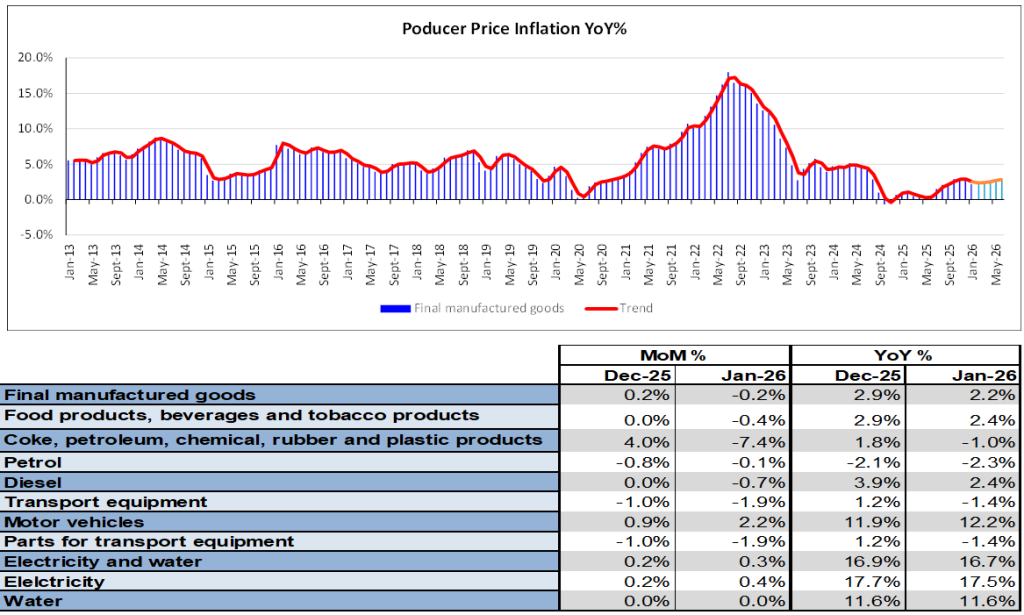
In January 2026, producer price inflation fell from 2.9% in December to 2.2% after minor revisions to producer price category weights. However, producer inflation fell by 0.2% month-on-month. Significant cost increases were noted in the following categories:

  • Food and Beverage Production: Increased by 2.2% and contributed 0.7 percentage point,
  • furniture and other manufacturing: Rose by 12.2% year-on-year while contributing 0.5 of a percentage point.

Production costs for intermediate goods rose by 10.5% in January, following a 10.1% increase in December. This indicates a clear inflationary trend that requires attention, as these increases exceed the South African Reserve Bank’s (SARB) new inflation target range of 2% to 4%. Annual growth is still significantly influenced by base effects from the 2024/25 data.

In the primary sector, mining costs climbed by 28.4% in January, following a 25.7% rise in December. In contrast, the agriculture sector experienced a further 5.8% decline, following a 5.0% decrease in December.

Overall, the trend in producer price inflation for final manufactured goods supports positive inflation expectations in South Africa for the short to medium term. Consumer inflation remains low at 3.5% for January, closely aligned with SARB’s target of 3%. While prices for certain intermediate goods—particularly water and electricity—exceed the target range, current figures suggest consumer inflation will likely remain low and stable in the near future.

This stability has allowed the Reserve Bank to lower interest rates at the November Monetary Policy Committee (MPC) meeting while keeping the rate unchanged during the January 2026 meeting, as both consumer and producer inflation expectations appear well-managed at this time. The Bank’s interest rate decision will consider both the Consumer Price Index (CPI) and Producer Price Index (PPI) when analysing inflation expectations for the first quarter of 2026.


More Coverage

South Africa is trapped in severe economic stagnation, facing a projected 1.0% growth rate for 2026, 33.6% unemployment, and sharp contractions in mining (-12.7%) and manufacturing (-4.3%). Exposed to global fuel shocks via depleted reserves and >R12.00/litre pump levies, the nation is also caught in a fiscal spiral where national debt nears 80% of GDP and interest payments exceed R1 billion daily. Escaping this trap requires four urgent structural reforms: halting interest rate hikes for supply-side inflation, replacing rigid B-BBEE quotas with job-creation incentives, scrapping Expropriation Without Compensation (EWC), and deregulating Transnet’s logistics corridors.
South Africa’s mining sector remains a vital source of jobs, foreign exchange and economic growth, but August’s sharp fall in mining output and sales highlights the mounting pressure on the industry. Rising fuel and energy costs, policy uncertainty and growing trade challenges are weighing on producers, even as firm gold prices and temporary US tariff exemptions offer some relief. Read the full report for a closer look at the latest figures, the forces shaping the sector and what they could mean for mining’s future in South Africa.
A $100-plus oil price, a weaker rand and record fuel hikes are putting South Africa’s economy under mounting pressure, while strategic reserves offer little protection. This report examines how imported inflation is squeezing households and businesses, why higher interest rates may do little to tackle its root causes, and how sluggish growth and rising debt are tightening the fiscal squeeze. It also explores the stakes for trade with the United States and AGOA, and the policy choices that could restore investor confidence, unlock growth and put the country on a more resilient path.
South Africa recorded a trade surplus of R20.4 billion in August 2026, as exports continued to outpace imports. Export growth has exceeded import growth over the first eight months of the year, reflecting subdued domestic demand among businesses and consumers. But with higher fuel prices and tighter monetary policy expected to weigh on spending, demand is likely to recover only gradually. Read the full report for a closer look at the trade figures and what they could mean for South Africa’s economy in the months ahead.
South Africa’s credit market is showing surprising resilience, with credit demand rising by 7.5% in August 2026 despite renewed interest-rate pressure, elevated inflation and mounting household costs. While mortgage advances continued to grow, the fragile recovery in the property market highlights the strain caused by subdued investment, high debt levels and rising municipal and energy expenses. At the same time, sluggish instalment credit growth and continued reliance on short-term borrowing reveal how consumers are navigating increasingly difficult financial conditions. With higher oil prices, geopolitical risks and further SARB tightening adding to the pressure, this report examines what the latest credit trends reveal about household finances, business confidence and the broader South African economy.