

Manufacturing Production – June 2026
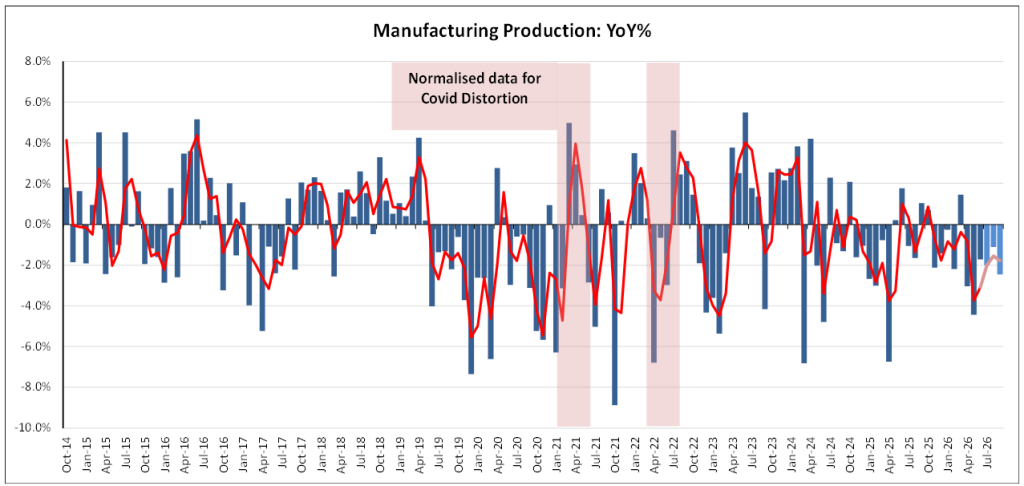
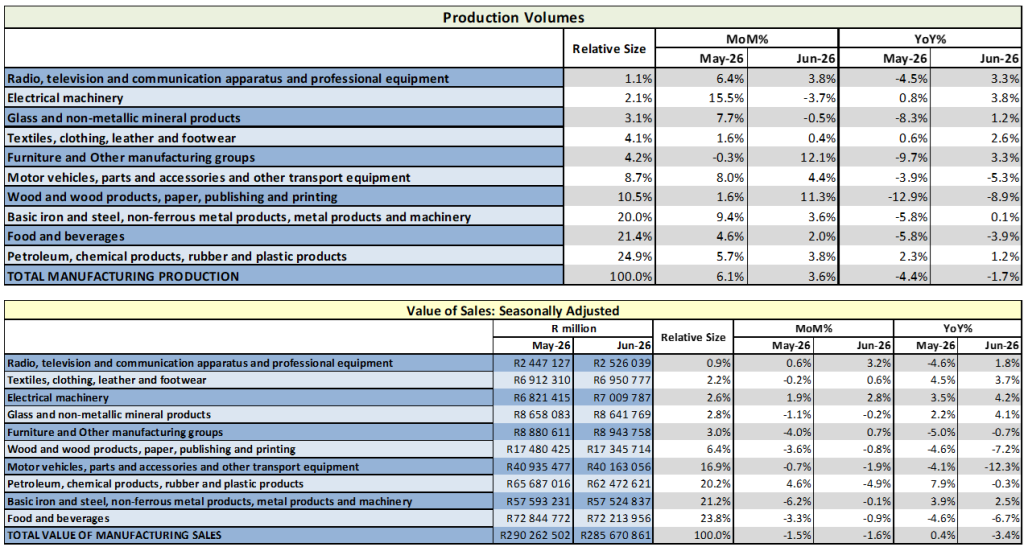
In June 2026, South Africa’s manufacturing output contracted by 1.7%, following the 4.4% increase in May 2026. This decrease is slightly better than the 2.3% decrease analysts forecast for June 2026. During the same period, the Purchasing Managers’ Index (PMI) decreased 3.5 points, from 50.8 in May 2026 to 47.3 in June 2026. This indicates a cautious view of the business environment as output contracted within the sector.
The contraction in manufacturing production during June was largely attributed to declines in:
- Food and beverage production, which declined by 3.9% and contributed -1.0 percentage point,
- wood and wood products that contracted by 8.9% and subtracted 0.9 percentage points from output growth, and
- lower output in motor vehicles, parts and accessories and other transport equipment, which declined by 5.3% and contributed -0.4 points towards the contraction in manufacturing output for June.
Seasonally adjusted manufacturing production for the second quarter also decreased by 1.5% compared to the first quarter of 2026. Out of ten sectors, seven reported contractions during this period. Significant contractions included:
- Food and beverages, declined by 3.0%, subtracting 0.8 percentage points from growth.
- Furniture and ‘other’ manufacturing declined by 9.3%, subtracting 0.4 percentage points from growth
- Basic iron and steel, non-ferrous metal products, metal products and machinery, which decreased by 1.2%, also contributed a 0.3 percentage point reduction.
Seasonally adjusted manufacturing sales increased by 0.6% during the second quarter of 2026 compared to the previous quarter. Significant increases occurred in:
- Petroleum, chemical products, rubber and plastic products division, which increased by 5.0%, adding 1.1 percentage points towards sales growth for the quarter.
- The motor vehicles, parts and accessories and other transport equipment division, which rose by 4.3%, added another 0.6 percentage points towards sales growth for the quarter under review.
Manufacturing is a critical component of South Africa’s economy, employing approximately 1.57 million people and accounting for 12.5% of the GDP in 2025. Employment slightly decreased from 1.587 million in Q1 2026 to 1.571 million in Q2 2026. GDP figures for the fourth quarter indicate a 0.6% quarterly decrease in manufacturing output, suggesting that US trade tariffs since August 2025 have caused some distress in the manufacturing sector by eroding price competitiveness in the US market, driven by higher import prices due to tariffs on South African exports. The reduction in employment numbers for the second quarter of 2026 suggests that the growing challenges South African exporters face in accessing the US market are starting to show up in annual growth numbers and employment opportunities for the sector at large. It should, however, be noted that exports to the US market have declined by 56% since 2025 due to tariffs, trade tensions and diplomatic “disputes” between Pretoria and Washington.
As a result of trade tariffs with the US and ongoing diplomatic tensions between Pretoria and Washington, business owners remain cautious, as evidenced by the June 2026 PMI data, which is now below the critical 50-point threshold. However, companies are still maintaining substantial cash reserves of approximately R1.8 trillion, up from R1.1 trillion in the first quarter of 2025, according to the Reserve Bank. This reflects a prudent approach amid current domestic and global economic uncertainties in the short- to medium-term.


